 ultimate-guide
Flexible Childcare Options for Parents in 2026
Table of Contents
- What Are Flexible Childcare Options for Parents?
- Comparing Flexible Childcare Models: A Quick Guide
- Drop-In Childcare Services: Care on Your Schedule
- Coworking Space with Childcare: Work and Parent in Parallel
- Key Factors to Consider When Choosing a Provider
- Navigating Costs and Employer-Sponsored Benefits
- Making the Right Choice for Your Work-Life Balance
- Frequently Asked Questions
Last Updated: September 9, 2026
The 9-to-5 daycare model doesn't fit every family. Whether you are a freelancer with a midday client call, a nurse working non-traditional hours, or a parent who needs a few hours to run errands, the demand for flexible childcare options for parents has grown well beyond traditional enrollment. This guide breaks down the modern landscape of care, helping you match a model to your actual schedule.
At its core, flexible childcare adapts to your schedule instead of requiring you to adapt to a fixed calendar. Below, we explore the main types, key factors to weigh, and the financial and logistical trade-offs.
What Are Flexible Childcare Options for Parents?
Flexible childcare options for parents operate on an as-needed, hourly, part-time, or hybrid basis, moving away from the traditional five-day-a-week enrollment model. They serve working parents, gig workers, and stay-at-home parents who need occasional coverage outside standard business hours.
The core shift is from a "seat" model to a "schedule" model. Traditional daycare charges for a fixed slot whether you use it or not. Flexible care offers subscription models, day passes, and drop-in rates that let you pay for what you actually use.
The benefit is twofold: reduced wasted spend on unused days and a reliable safety net for last-minute needs like a sick sitter or a surprise meeting. The trade-off is that you often need to plan around availability, making the provider's scheduling and capacity rules essential to vet.
Comparing Flexible Childcare Models: A Quick Guide
Not all flexible care is created equal. The right choice depends on whether you need recurring coverage, emergency backup, or a place to focus while your child is supervised nearby.
| Care Model | Best For | Commitment Level | Typical Use Case |
|---|---|---|---|
| Drop-In Childcare | Errands, appointments | None or day pass | 2-3 hours of occasional care |
| Part-Time Daycare | Fixed short weeks | Weekly contract | Tuesday/Thursday coverage |
| Coworking with Childcare | Remote work | Monthly membership | Full workdays with child on site |
| Backup Care Services | Emergency gaps | Pay-per-use | Sick nanny or school closure |
| Nanny Shares | Consistent home care | Long-term agreement | Shared costs with another family |
The most significant distinction is between drop-in childcare services and recurring models. Drop-in care offers zero long-term commitment, ideal for unpredictable schedules. Membership-based coworking models require a monthly commitment but offer the reliability of a dedicated workspace.
A common mistake is assuming "flexible" means "always available." Most providers require advance booking, even for drop-in slots, to maintain proper caregiver-to-child ratios. Confirm the booking window and cancellation policy before you need them.
Drop-In Childcare Services: Care on Your Schedule
Drop-in childcare services are the closest thing to "care on demand," letting parents reserve a slot for a few hours without a recurring weekly schedule, often through day passes or hourly rates.
This model shines for sporadic needs. A realtor showing houses, a consultant with a single on-site meeting, or a parent attending a medical appointment all benefit from paying only for the hours they use. It also serves as practical backup childcare when regular arrangements fall through.
When evaluating a drop-in provider, ask about the caregiver-to-child ratio, how they handle separation anxiety, and whether staff are trained to support new children. Many providers offer educational programs during drop-in hours, turning a logistical stopgap into a developmental win.
Coworking Space with Childcare: Work and Parent in Parallel
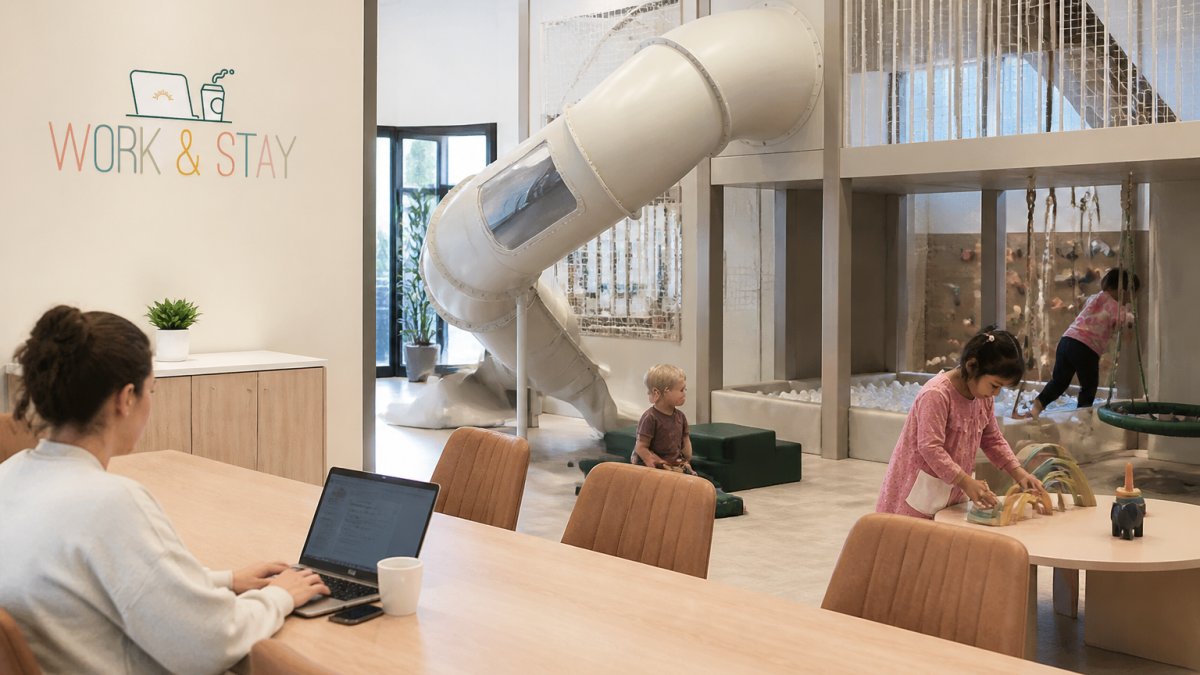
A coworking space with childcare places a professional workspace for the parent in the same facility as supervised care for the child, removing the commute between drop-off and desk.
For remote-working parents, this is often the most productive option. Instead of losing an hour driving to a sitter and back, a parent can walk into a quiet lounge, take client calls, and check on their child during breaks. The best setups offer curriculum-based, teacher-led classroom time rather than just supervised play.
This model also addresses remote-work isolation. Working in a coworking lounge restores the separation between "office" and "home," giving parents workplace productivity without screen-time guilt and children socialization with peers.

The key consideration is age range and environment separation. High-quality providers design separate areas for infants and toddlers versus preschoolers. For children under two, confirm staff are equipped to handle diapering and bottle feeding.
Key Factors to Consider When Choosing a Provider
Choosing a flexible provider requires looking past the shiny play equipment. The most critical factors are safety standards, caregiver vetting, and the facility's incident protocol. Because flexible care often means your child is in a space with unfamiliar children, the vetting process deserves extra scrutiny. Here is a practical safety-vetting checklist for drop-in and coworking-with-childcare environments.
The Safety-Vetting Checklist for Flexible Care Settings
1. Verify the Facility's Licensing and Insurance
Childcare licensing requirements vary by state. Some states license drop-in centers under the same rules as traditional daycares, while others have a separate category for "drop-in" or "intermittent" care. Ask for the provider's state license number and regulatory body, verify it online through your state's health or human services website, and request proof of liability insurance. A reputable provider will not hesitate to share this.
2. Confirm the Caregiver-to-Child Ratio for Mixed-Age Groups
Flexible settings often mix ages during low-traffic hours. A ratio safe for preschoolers may not be safe if infants are present. Ask for the specific ratio for your child's age and confirm it is maintained during drop-in hours. Most states mandate ratios (e.g., 1:4 for infants, 1:10 for four-year-olds), but flexible providers may stretch these during slow periods. Walk away if the provider cannot guarantee the ratio in writing.
3. Ask About the "Stranger" Factor and Newcomer Integration
One of the biggest emotional hurdles is the "stranger" environment. Ask staff how they handle newcomer integration. Do they assign a dedicated caregiver to shadow a new child for the first hour? Do they have a buddy system? A high-quality provider will have a written protocol for helping new children acclimate.
4. Review the Illness and Injury Protocol in Writing
Flexible care environments see higher child turnover, increasing germ transmission risk. Ask to see the written illness policy: what symptoms require sending a child home, and how often are high-touch surfaces sanitized? For injuries, ask about the incident report process and notification speed. A provider that cannot produce a written policy on the spot is not prepared.
5. Check the Physical Security of the Space
Because flexible care often operates within a larger facility, understand the security boundaries. Is the childcare area completely separate from the adult workspace? Is there a secure entry system preventing unauthorized adults from entering? In a coworking-with-childcare model, confirm the childcare environment is not a thoroughfare for adults. The best setups have a single, controlled entry point with a visual barrier between the workspace and care space.
6. Observe a Session Before You Commit
Most flexible providers offer day passes or trial hours. Use these to observe how staff interact with new children. Watch for signs of separation anxiety and how caregivers respond. Do they comfort the child or let them "cry it out"? Do they engage the child in an activity? Your gut feeling during a trial session is a powerful data point.
Accessibility and Inclusion in Flexible Settings
Accessibility matters more than many parents realize. If your child has special needs or sensory sensitivities, ask how the provider adapts activities. Flexible settings can be noisy and unpredictable, which can overwhelm a child with sensory processing differences. Ask about a quiet corner or calm-down space and staff training in inclusive practices. Some providers are well-equipped to support children with autism or ADHD, while others are not. Be direct about your child's needs and observe how staff respond. A genuinely inclusive provider will welcome the conversation and offer specific accommodations.
Finally, trust your instincts about the emotional fit. A child with separation anxiety will thrive where caregivers are patient and the parent can remain nearby during the transition. Ask about their newcomer integration approach before you commit. The right provider will meet your scheduling needs and make your child feel safe, seen, and supported from the first visit.
Navigating Costs and Employer-Sponsored Benefits
Cost is often the deciding factor, but the math is more complex than comparing hourly rates. Factor in the value of your time, commute expenses, and whether you are paying for unused scheduled hours. Flexible models can offer significant savings because you only pay for what you use. However, for consistent weekly needs, a part-time daycare contract might be more cost-effective than premium drop-in rates. Track your actual care hours for a month and compare totals against different pricing structures.
The Fine Print: Contracts, Cancellation Policies, and Notice Periods
A major pain point most guides overlook is the contractual side of flexible care. Unlike traditional daycare's month-to-month or annual contracts, flexible providers often have unique terms that can trip up parents. Before signing up, ask for the provider's written policies on the following:
- Cancellation windows: Many drop-in and coworking-with-childcare models require you to cancel a booked slot 12 to 24 hours in advance. If you cancel later, you may forfeit the session or be charged a fee. Understand the exact cutoff time and how it applies to sick days.
- Notice for membership changes: If you are on a monthly membership for a coworking-with-childcare model, find out the notice period required to pause or cancel. Some require 30 days' written notice, while others allow you to freeze your membership for a month if you are traveling.
- Credit expiration: Some providers sell day passes in bundles (e.g., a 10-pass card) that expire after a set period, such as 90 days. If your schedule is unpredictable, this could lead to wasted spend. Ask if unused credits roll over or can be donated.
- Rate lock guarantees: If you are committing to a recurring part-time schedule, ask whether the rate is locked for the duration of your contract or if it is subject to change with 30 days' notice.
Always request a copy of the parent handbook or service agreement before paying a deposit. A provider transparent about its policies is more likely to be transparent about its care practices.
Tax Implications and Dependent Care FSAs
One of the most underutilized financial tools is the Dependent Care Flexible Spending Account (FSA). This employer-sponsored benefit lets you set aside up to $5,000 per year (or $2,500 if married filing separately) in pre-tax dollars for eligible childcare expenses. The IRS requires the provider to give you their tax ID number (EIN or SSN) for reimbursement. Drop-in centers, coworking-with-childcare facilities, and backup care services are generally eligible, but confirm the provider is not a dependent and the care is for a child under 13.
If you do not have an FSA, you may qualify for the Child and Dependent Care Credit, worth up to $3,000 for one child or $6,000 for two or more. The credit is based on your earned income and the amount you actually paid for care. For flexible arrangements, the care must have been necessary so you could work or look for work. Keep detailed records, including receipts and the provider's tax ID.
Employer-Sponsored Backup Care and Negotiating with HR
There is a growing trend of employer-sponsored flexible care. Some companies offer backup childcare benefits or subsidies through third-party providers to reduce absenteeism and support productivity. Check with your HR department to see if you have access. If not, consider making a business case framed around productivity and retention: when a regular sitter cancels, a parent without backup care loses a full workday. Employers who offer a stipend or backup care benefit often see a net gain in focus and reduced unplanned time off.
If you are a freelancer or independent contractor, you can deduct childcare expenses as a business expense under certain conditions, but the rules are stricter than for employees. The care must be necessary for you to earn income, and you must document the direct connection between care hours and work hours. Consult a tax professional for your specific situation.
Making the Right Choice for Your Work-Life Balance
The ultimate goal of flexible care is to support a sustainable work-life balance. The right model reduces stress, protects your professional focus, and ensures your child is in a safe, enriching environment.
Start by listing your non-negotiables: location, hours, age range, and budget. Then, match those against the models above. If you need a quiet space to work and have a child under six, a coworking with childcare model like Work & Stay is often the strongest fit because it consolidates your day. If you only need occasional coverage for errands, drop-in childcare services are more economical.
Visit the facility with your child. Observe how staff interact with the children and whether the environment feels welcoming. A provider that offers day passes or short-term memberships lets you test the fit without a long-term commitment, giving you peace of mind before you settle in.
Frequently Asked Questions
What is the difference between drop-in childcare and traditional daycare?
Traditional daycare usually requires a fixed weekly or monthly schedule with full-time enrollment. Drop-in childcare services offer care on an as-needed basis, often by the hour or for a half-day, without a long-term contract. This means you pay for the time you use, making it ideal for irregular work schedules, appointments, or as a backup care solution, providing flexibility that traditional daycare enrollment doesn't.
How can flexible childcare improve work-life balance?
Flexible childcare directly addresses scheduling conflicts. Instead of structuring your workday around a rigid daycare pickup time, you can align care with your actual workload. For example, a coworking space with childcare allows you to focus on a project while your child is nearby. This reduces stress, minimizes missed work, and creates guilt-free time for both professional responsibilities and family, which is the core of a better work-life balance.
Are there childcare options that include a workspace for parents?
Yes, a coworking space with childcare is a growing option. These spaces provide parents with a professional, quiet workspace, such as a coworking lounge or private office, while their children are cared for in a separate, supervised environment on-site. This model eliminates the commute between work and daycare, allows for quick check-ins, and offers the peace of mind that comes from having your child in the same building.
What should I look for when choosing a flexible childcare provider?
When evaluating flexible childcare, prioritize safety and caregiver qualifications. Ask about caregiver-to-child ratios, staff background checks, and facility security. Observe the environment for cleanliness and age-appropriate toys, and ask about their curriculum or daily activities. For drop-in services, confirm their sick-child policy and sign-in procedures. Taking a facility tour and asking about staff turnover will give you a strong sense of the provider's reliability and standards.
Can flexible childcare work for a child who has separation anxiety?
Many flexible childcare environments, especially those attached to coworking spaces, are designed to ease this transition. The ability for a parent to be nearby can be a huge comfort. Start with short visits to help your child acclimate to the new space and caregivers. A gradual introduction, where you stay for the first few sessions before working independently, can build your child's confidence and make the drop-in experience positive for both of you.
What are the benefits of flexible childcare for working parents?
Flexible childcare offers working parents greater control over their schedules. It provides a reliable solution for non-traditional hours or fluctuating workloads. This model often reduces stress by eliminating the need to find backup care at the last minute. It also supports workplace productivity by allowing parents to meet deadlines without compromising on childcare quality, and many find it more cost-effective than paying for full-time care they don't always need.
Finding care that bends to your schedule rather than the other way around is the single best investment you can make in your daily routine. At Play & Stay, the connected Work & Stay concept pairs a professional coworking lounge with supervised, curriculum-based childcare for ages 0-6, available on memberships or day passes with no long-term contract. Get started with a day pass today and experience how flexible care can transform your workday.