 listicle
Hourly Daycare: What Parents Need to Know
Table of Contents
- What Is Hourly Daycare?
- Drop-In Childcare vs. Traditional Daycare
- Flexible Childcare Options for Working Parents
- Coworking with Childcare: A Solution for Remote Work
- Safety Standards and Licensing Requirements
- What to Look for in an Hourly Daycare Facility
- Making the Transition Smooth: First-Visit Checklist
- Frequently Asked Questions
Last Updated: August 31, 2026
What Is Hourly Daycare?
Hourly daycare is a flexible childcare arrangement where parents pay for care by the hour rather than committing to full-time enrollment or long-term contracts. Unlike traditional daycare that requires weekly or monthly commitment, hourly daycare lets parents access supervised childcare for short periods, a few hours for a doctor's appointment, an afternoon running errands, or a full workday. This model serves remote workers juggling calls with childcare responsibilities, stay-at-home parents seeking occasional breaks, or families whose schedules don't fit the 9-to-5 daycare mold.
The core appeal is straightforward: pay only for the hours you actually use. No enrollment fees locking you in for months. No guilt about underutilizing a full-time slot.
Work & Stay brings this concept to life by combining flexible hourly childcare with dedicated workspace for parents. The model acknowledges a reality most daycare centers ignore: parents don't just need childcare, they need a place to actually work while their kids are cared for. Separate, supervised childcare environments allow parents to focus on their jobs without the constant mental load of managing home chaos.
Drop-In Childcare vs. Traditional Daycare
The distinction matters because they solve different problems. Drop-in childcare is unscheduled, walk-in care where parents show up when needed. Traditional daycare requires advance enrollment, fixed weekly schedules, and monthly fees regardless of attendance.
Drop-in childcare works best for occasional needs. A parent needs two hours to attend a meeting, drops their child off, picks them up when done, and pays only for those two hours. No paperwork. No long-term commitment.
Traditional daycare assumes consistency. A child attends the same center three days per week, every week, for months or years. The trade-off: inflexibility. If a parent only needs care two days one week and four days the next, they still pay for the full three-day slot.
Hourly daycare splits the difference. It offers more structure than pure drop-in but more flexibility than traditional daycare. A parent might use it consistently three days per week, then scale back to one day the next month without penalty. Work & Stay exemplifies this middle ground, offering hourly childcare on memberships or day passes with no long-term contract. The separate workspace means parents aren't paying for childcare and then scrambling to find a quiet corner to work, the infrastructure is already built in.
Flexible Childcare Options for Working Parents
Remote work created a new problem: children at home while parents are supposed to be productive. Traditional full-time daycare feels wasteful if a parent only needs coverage during specific hours. Hourly daycare fills this gap.
Common flexible childcare models include:
Drop-in centers. Parents book online, drop the child off for a few hours, and pick up when done. Ideal for occasional needs.
Membership-based hourly care. Parents pay a monthly membership fee and access childcare by the hour with no per-hour overage charges. This model rewards consistent use while maintaining flexibility.
Day passes. Single-day access without membership. Higher per-hour cost than membership, but no upfront commitment.
Backup childcare networks. Some employers or insurance plans offer emergency access to vetted providers when regular arrangements fall through, usually subsidized.
In-home providers with flexible hours. Nannies or family daycare providers who accept part-time, hourly arrangements. More personalized but often more expensive than centers.
For working parents, the practical choice depends on schedule predictability. A parent with a consistent remote work schedule benefits from membership-based hourly care. A parent with highly unpredictable needs might prefer day passes where they pay only for what they use.
The real advantage of hourly models is psychological. Parents stop feeling trapped by daycare schedules and stop paying for time they don't use. This mental shift, from "I'm paying for full-time care I don't need" to "I'm paying for exactly what I use", is often as valuable as the actual cost savings.
Coworking with Childcare: A Solution for Remote Work
Remote work sounds ideal until the reality hits: a parent needs to focus on a client call while a toddler demands attention in the background. Home offices don't provide the separation needed for deep work.

Coworking with childcare solves this by putting both under one roof. Parents work in a professional environment, quiet and equipped for focus, while their children are supervised in a separate, age-appropriate childcare space. No background noise bleeding into video calls. No constant interruptions.
This model acknowledges what traditional offices understood: professional work requires focus. Childcare requires active supervision. Trying to do both simultaneously in a home office fails at both.
Work & Stay implements this with curriculum-based, teacher-led childcare, not just supervised play, but structured activities and early learning programming. Parents can take a 90-minute client meeting knowing their child is engaged in age-appropriate activities. The financial case is strong for parents who'd otherwise pay for both childcare and a separate coworking space. Combining them into a single membership often costs less than the two separately.
The scheduling flexibility is equally important. A parent doesn't need to commit to full-time daycare if they only work from the coworking space three days per week. They book those days and scale up or down without penalty.
Safety Standards and Licensing Requirements
Childcare facility standards vary by state, but common requirements include:
Licensing. Most states require childcare centers to be licensed by the state health or human services department. Licensing involves background checks for all staff, health and safety inspections, staff-to-child ratio requirements, and ongoing compliance monitoring.
Staff qualifications. States typically require lead teachers to have early childhood education credentials or equivalent training. Assistant teachers must usually complete CPR and first aid certification. Background checks, including criminal history and child abuse registry checks, are standard.
Child-to-staff ratios. Regulations specify how many children one staff member can supervise, varying by age. A facility with 2:1 infant ratios provides more attention than 4:1 ratios. Lower ratios mean safer supervision and more individualized care.
SIGN UP FOR YOUR MEMBERSHIP TODAY →
Health and safety. Facilities must maintain clean, safe environments with working smoke detectors, fire extinguishers, first aid kits, and emergency procedures. Immunization records are typically required before enrollment.
Incident reporting. Serious incidents, injuries, allergic reactions, and behavioral concerns must be documented and reported to parents immediately.
When evaluating an hourly daycare facility, ask directly about licensing status. Request the most recent inspection report, these are public records in most states. Check the staff-to-child ratio for your child's age group. A reputable facility welcomes these questions and provides documentation without hesitation.
What to Look for in an Hourly Daycare Facility
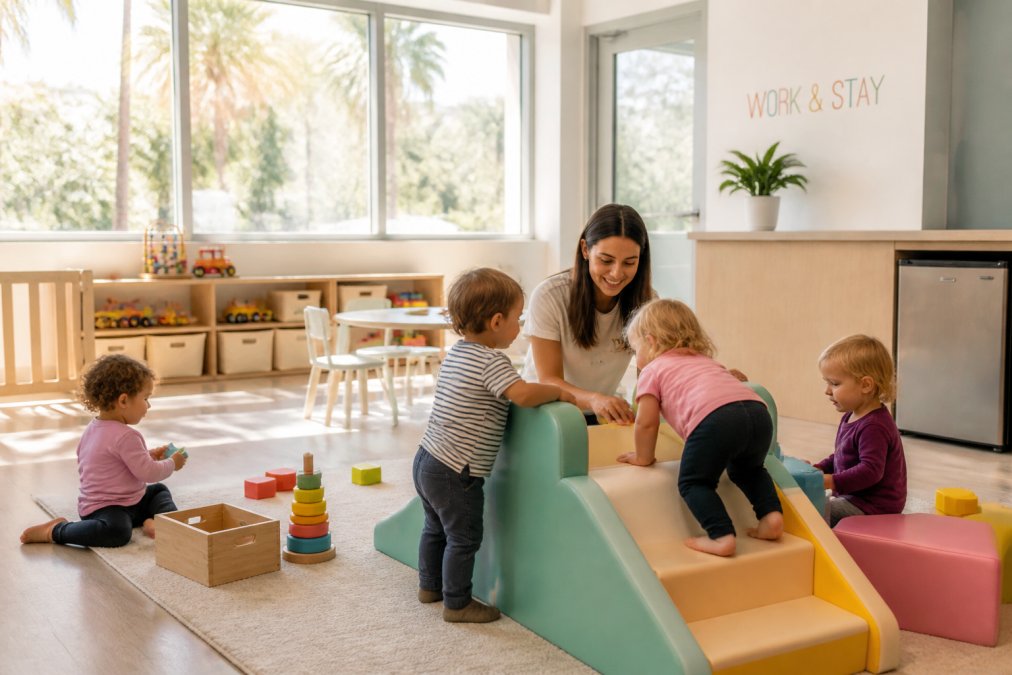
Beyond licensing, several practical factors separate mediocre facilities from excellent ones.
Cleanliness and maintenance. Walk through the facility. Does it smell clean? Are toys sanitized? Are bathrooms well-maintained? Cleanliness reflects staff attention to detail and reduces illness transmission.
Age-appropriate activities. A facility should have separate spaces for different ages, with activities matched to developmental stages. Infants need safe sleep areas and sensory play. Toddlers need climbing structures and exploration. Preschoolers benefit from structured learning activities.
Staff engagement. Observe how staff interact with children. Are they responsive, warm, and attentive? Do they respond to cries or requests quickly? The quality of staff-child interaction directly impacts your child's experience and development.
Communication systems. How does the facility keep parents informed? Do they send daily updates? Can parents call during the day? Clear communication reduces parent anxiety and ensures consistency between home and facility.
Curriculum or activity plan. Does the facility have structured activities or just free play? Understand what your child will actually do during their time there.
Reservation and cancellation policies. How far in advance must you book? Can you cancel without penalty if plans change? Clear policies prevent surprises and frustration.
Parent reviews and references. Ask the facility for references from current or recent parents. Listen for specific stories about whether parents feel their kids are safe and informed.
Making the Transition Smooth: First-Visit Checklist
The first visit to an hourly daycare facility sets the tone. A calm, intentional transition teaches a child that they're safe and will be reunited.
Before the first visit:
- Tour the facility with your child if possible. Familiarity reduces anxiety.
- Read any parent handbook or policies provided.
- Gather required documents: immunization records, emergency contact information, health forms, allergy information.
- Talk to your child about what to expect using simple language.
- Pack comfort items if allowed: a favorite toy, a photo of family, or a blanket that smells like home.
On the first visit:
- Arrive early. Rushing adds stress for both parent and child.
- Meet the staff member who will care for your child and share any concerns.
- Show your child the bathroom, play areas, and where they'll nap or rest.
- Keep the initial visit short, 30 minutes to an hour.
- Establish a goodbye routine: a hug, a kiss, a specific phrase like "I'll be back after snack." Consistency matters.
- Leave when you say you will. Sneaking away teaches a child that goodbyes are scary and unpredictable.
After pick-up:
- Ask the staff member how the visit went and what your child did.
- Ask your child about their experience, but don't push if they're not ready to talk.
- Keep the first few days low-key.
- Expect some adjustment behavior, clinginess, fussiness, or unusual tiredness. This is normal and typically passes within a week or two.
Separation anxiety is age-dependent. Infants under 6 months show less separation distress. Toddlers aged 12-24 months often experience peak separation anxiety. By age 3, most children adjust more readily if they've had consistent positive experiences with separation.
The transition gets easier. Most children adjust within a week or two if the facility is safe, staff are attentive, and goodbyes are consistent and calm.
Hourly daycare removes friction from working parenthood. It eliminates guilt about paying for full-time care you don't use and provides the flexibility that traditional arrangements can't match. When combined with workspace, as in coworking with childcare, it creates an environment where parents can actually focus on work while knowing their children are safe, supervised, and engaged in quality activities.
For parents seeking flexible childcare without long-term contracts, hourly daycare is worth exploring. Look for facilities with strong licensing compliance, engaged staff, and clear communication. Visit in person. Ask questions. Trust your instincts about whether the environment feels safe and nurturing for your child.
Work & Stay brings this model to life by combining flexible hourly childcare with professional workspace. Parents access memberships or day passes with no long-term commitment, with curriculum-based childcare for ages 0-6 in a separate, supervised environment. Learn more about memberships and day passes at Work & Stay flexible childcare and coworking | https://playandstayaz.com/work-stay/.
Frequently Asked Questions
What is the difference between hourly daycare and traditional daycare?
Hourly daycare offers flexible, contract-free care by the hour or day, while traditional daycare typically requires monthly enrollment and longer commitments. Hourly options work well for parents who need occasional or variable childcare, such as remote workers taking client calls or parents running errands. Traditional daycare is better suited for families needing consistent, full-time care. Many facilities now offer both models to serve different family needs.
What should I look for when evaluating an hourly daycare facility?
Prioritize child-to-staff ratios, licensed staff with early childhood education training, and clean, age-appropriate spaces. Ask about background checks, immunization records requirements, and daily curriculum or structured activities. Visit in person to observe supervision, check for safety hazards, and read parent reviews. Confirm reservation policies, operating hours, and what happens in emergencies. A quality facility will welcome questions and show you exactly where your child will spend time.
How does hourly childcare support remote work productivity?
Hourly childcare allows remote-working parents to book care during focused work blocks, client calls, deadline-driven projects, or important meetings. Unlike managing children at home, supervised play in a separate environment means you can concentrate without interruption. Some facilities combine coworking spaces with childcare, placing your child steps away in a curriculum-based program while you work in a quiet, professional setting. This model eliminates the guilt and distraction of juggling both roles simultaneously.
Is hourly childcare a good backup care option?
Yes. Hourly daycare is ideal for backup care situations, when your regular childcare falls through, you need last-minute coverage for a work emergency, or you want respite time for personal errands. Contract-free, drop-in options provide the flexibility traditional daycare cannot. Many parents use hourly care a few times per month rather than committing to full-time enrollment, making it cost-effective for occasional needs. Check facility availability and reservation policies to ensure they can accommodate your emergency timeline.
This article was written using GrandRanker