 ultimate-guide
Childcare by the Hour: Options, Costs & How It Works
Table of Contents
- What Is Childcare by the Hour?
- Drop-In Childcare: Flexibility Without Long-Term Commitment
- Coworking With Childcare: A Game-Changer for Working Parents
- Flexible Childcare Options: Comparing Your Choices
- Vetting Childcare Providers: A Parent's Checklist
- Understanding Costs and Making the Financial Case
- Helping Your Child Transition to Hourly Childcare
- Frequently Asked Questions
Last Updated: August 25, 2026
What Is Childcare by the Hour?
Childcare by the hour is flexible, short-term supervision for young children paid on an hourly basis rather than through long-term contracts or monthly fees. Parents use hourly childcare for focused work time, running errands, attending appointments, or managing unexpected schedule changes. Unlike traditional daycare with enrollment periods and commitment requirements, childcare by the hour offers drop-in flexibility that works around a parent's actual life. 🎯
Parents pay only for the hours they use, with no obligation to book minimum days per week or sign multi-month agreements. This model works especially well for remote workers, shift workers, freelancers, and parents juggling unpredictable schedules. It also serves as backup childcare when regular arrangements fall through.
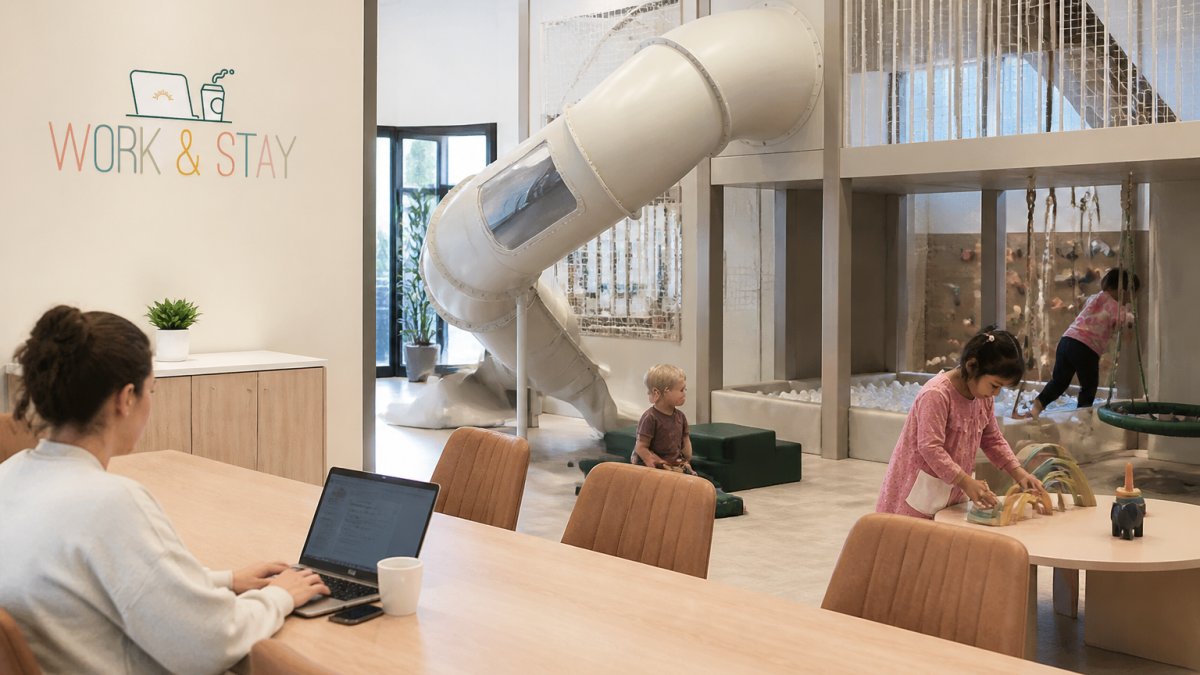
Work & Stay, a flexible coworking space in Scottsdale, exemplifies how modern childcare by the hour operates. The facility combines supervised, curriculum-based childcare for ages 0-6 with workspace designed for parents who need to work nearby. Parents can book hourly sessions or memberships without long-term contracts, creating genuine flexibility for families managing both work and parenting responsibilities.
Drop-In Childcare: Flexibility Without Long-Term Commitment
Drop-in childcare is the most accessible form of childcare by the hour. Parents simply arrive during operating hours, register their child, and leave knowing supervision is provided. No application process, no waitlist, no enrollment paperwork. 📋
This model eliminates the logistical friction that makes traditional daycare difficult for parents with unpredictable schedules. A parent working from home can drop a toddler off for two hours while handling an important client call. A caregiver managing multiple errands can leave their child in a safe, stimulating environment instead of rushing through stops with an unhappy kid in tow.
The flexibility extends to frequency. Some parents use drop-in childcare once or twice a month. Others rely on it several times per week. There's no penalty for irregular use, no "you need to commit to Tuesdays and Thursdays" requirement.
Safety and supervision are non-negotiable in quality drop-in settings. Staff maintain appropriate child-to-staff ratios, monitor children continuously, and follow health and safety protocols (the CDC). Parents receive updates about their child's time, activities, meals, and naps.
The limitation is curriculum depth. Drop-in childcare emphasizes safe, supervised play and age-appropriate activities, but doesn't typically include structured educational programming. For parents seeking both flexibility and learning-focused care, coworking with childcare may be worth exploring.
Coworking With Childcare: A Game-Changer for Working Parents
This is where childcare by the hour meets workspace. Coworking with childcare combines professional office space with onsite, supervised childcare, allowing parents to work productively while their children receive care just steps away. 💼
The setup eliminates the mental load of coordinating separate locations. A parent doesn't drop a child at one facility, drive to another, then worry about pickup times or transitions. Instead, they move between their workspace and the childcare area within the same building, maintaining visibility and reducing logistical complexity.
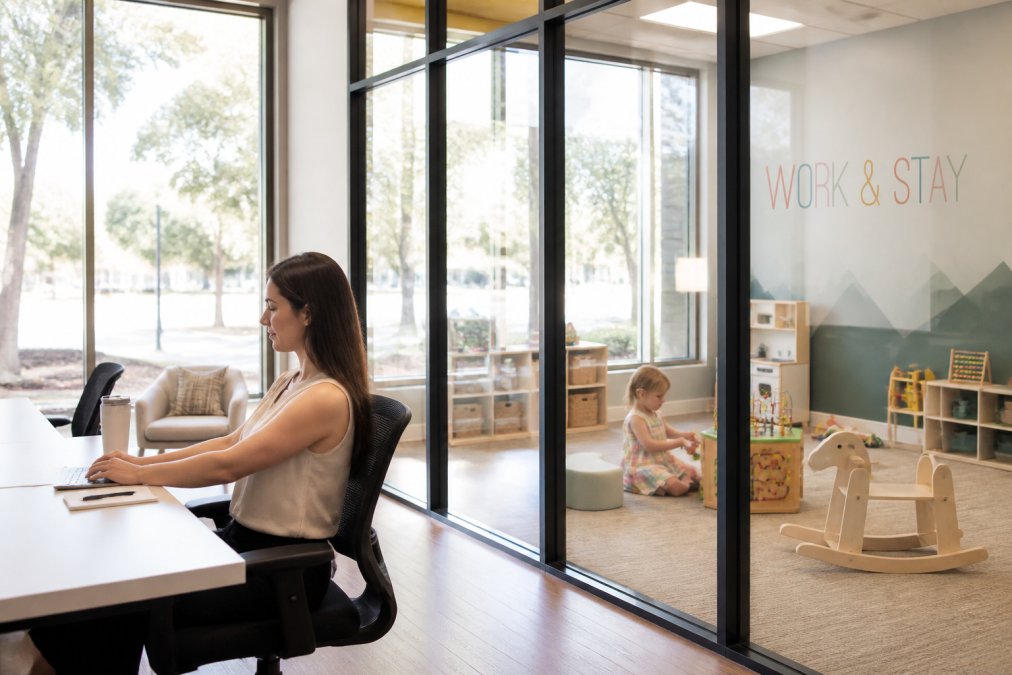
Work & Stay operates precisely this model. The facility provides coworking lounges and private workspaces where parents can focus on professional tasks, calls, and client work, while their children attend supervised, curriculum-based childcare in a separate, age-appropriate environment. Parents choose hourly drop-in sessions or memberships with no long-term contracts.
The educational component sets this model apart from basic supervised play. Trained staff lead classroom time, guided activities, music, and age-appropriate learning. Parents get focused work time while their children benefit from structured early childhood education.
Parents report less guilt and stress when they can see their child is thriving in a quality environment. Some parents bring work to observation areas, maintaining proximity while completing tasks.
Cost-effectiveness depends on usage frequency. For parents needing childcare several times per week, hourly rates add up faster than full-time care. But for those needing flexibility without commitment, it often costs less than hiring a part-time babysitter or maintaining a full-time daycare slot they don't fully use.
Flexible Childcare Options: Comparing Your Choices
Parents choosing childcare by the hour have several distinct options, each with different trade-offs around flexibility, cost, learning focus, and convenience.
Hourly Care at Licensed Facilities
Licensed childcare facilities offering hourly rates provide professional supervision, regulatory oversight, and structured environments. Staff undergo background checks, facilities maintain child-to-staff ratios required by law, and follow health and safety standards set by state regulations (the CDC). 🏢
The licensed facility model offers peace of mind through accountability. Parents can verify licensing status, review inspection records, and understand the regulatory framework protecting their child. Staff typically have training in early childhood development and first aid.
Quality varies significantly between facilities. Some focus purely on supervised play and safety. Others, like Work & Stay, integrate curriculum-based learning, guided activities, and developmental programming. The difference matters if parents want their child to benefit from early education alongside childcare.
Hourly rates at licensed facilities are generally predictable and transparent. The limitation is availability. Many facilities operate during standard business hours (typically 7 a.m. to 6 p.m.), which doesn't work for shift workers or parents needing weekend childcare. Waitlists are common at quality facilities.
Nanny Shares and Babysitting Services
A nanny share splits the cost of one caregiver between two or three families. Babysitting services provide on-demand supervision, often through agencies that vet and schedule caregivers. 👶
Nanny shares offer personalized attention and flexibility in location. Children benefit from consistency if the same person provides care regularly.
The trade-off is less structured oversight. Babysitters and nanny shares aren't licensed facilities, so regulatory requirements differ. Parents must thoroughly vet caregivers themselves, verify references, and conduct background checks.
Scheduling can be unpredictable. If a babysitter cancels, finding last-minute replacement care is stressful. Nanny shares require coordination among families, which adds complexity if schedules don't align perfectly.
Before and After School Care
For families with school-age children, before and after school programs fill the gap between school hours and work schedules. These programs operate at schools or community centers, providing supervision and activities during non-school hours. 🚌 daily routine planners.
Before and after school care solves a specific problem: school-age children need supervision before school starts and after dismissal. This model keeps kids in familiar environments with peers they already know.
Programs vary in educational focus. Some emphasize homework help and skill-building. Others prioritize recreational activities and social time.
The limitation is age specificity. These programs serve elementary and middle school children, not younger kids. Also, they operate on school calendars, so parents still need alternative childcare during school breaks, summer, and holidays.
| Childcare Option | Best For | Flexibility | Learning Focus | Typical Setup |
|---|---|---|---|---|
| Licensed hourly facilities | Parents needing regular, structured care | High (drop-in, hourly rates) | Medium to high | Professional staff, regulated environment |
| Nanny shares | Families wanting personalized attention | Medium (depends on caregiver schedule) | Low to medium | In-home or shared space, one caregiver |
| Babysitting services | Short-term, on-demand supervision | Medium (agency dependent) | Low | Flexible location, vetted caregivers |
| Before/after school care | School-age children needing coverage | Medium (school calendar dependent) | Medium | School or community center |
| Coworking with childcare | Working parents needing workspace + care | High (hourly, no contracts) | High (curriculum-based) | Professional workspace + supervised childcare |
Vetting Childcare Providers: A Parent's Checklist
Choosing a childcare provider requires careful evaluation. Parents need confidence that their child is safe, supervised properly, and in an environment aligned with their values.

Safety and Licensing:
- Verify the facility is licensed by the state. Check licensing status on the state's early care and education database.
- Ask about background checks for all staff. Childcare workers should have criminal background clearances and child abuse registry checks.
- Review the facility's most recent inspection report. State inspections assess health, safety, and regulatory compliance.
- Confirm child-to-staff ratios meet state requirements.
Facility Environment:
- Visit in person during operating hours. Observe how staff interact with children, are they engaged, responsive, and patient?
- Check for age-appropriate safety features: secure entry/exit, covered electrical outlets, safe storage of hazardous materials.
- Ask about illness policies. How does the facility handle sick children?
- Inquire about emergency procedures. Does the facility have evacuation plans, first aid training, and incident protocols?
Staff Qualifications:
- Ask about staff training in early childhood development, CPR, and first aid.
- Understand the facility's approach to discipline and conflict resolution. Do they use positive guidance strategies?
- Ask about staff turnover. Consistent staff provides continuity for children.
Communication and Updates:
- How does the facility communicate with parents? Daily updates, weekly reports, or incident-based communication?
- Ask about observation. Can parents observe their child during care?
- What's the policy if a child is injured or has a behavioral incident?
Educational and Activity Focus:
- Ask what activities and learning happen during childcare hours. Is there structured time, free play, outdoor time, and arts and crafts?
- For facilities claiming curriculum-based care, ask what curriculum they follow and how it's implemented.
- Observe the physical environment. Are there age-appropriate books, toys, learning materials, and play equipment?
Practical Logistics:
- Confirm hours of operation match your schedule. Do they offer weekend care or extended hours if needed?
- Understand the payment structure and flexibility. Can you book drop-in sessions, or do you need to pre-register?
- Ask about cancellation policies if plans change.
References and Reviews:
- Ask for references from current parents. Contact them and ask specific questions about their experience.
- Check online reviews cautiously. Read both positive and negative feedback, looking for patterns.
- Ask the facility about any licensing violations, complaints, or incidents. Transparency is a good sign.
Trust Your Instincts: If a facility doesn't feel right, if staff seem rushed, the environment feels chaotic, or your questions aren't answered clearly, keep looking. Your child will pick up on your confidence or anxiety.
Understanding Costs and Making the Financial Case
Childcare by the hour costs less than full-time daycare when used occasionally, but can become expensive if needed frequently. Understanding the financial picture helps parents decide whether hourly childcare makes sense for their situation.
Hourly rates vary based on geography, facility quality, child's age, and whether care includes meals or activities. Rates are typically higher for infants and toddlers than for preschoolers. Many hourly childcare providers charge minimum session lengths, often 2 or 3 hours, even if parents need care for less time.
Cost-benefit analysis depends on usage frequency:
For occasional use (1-2 times per month), hourly childcare is cost-effective. For regular use (2-3 times per week), hourly costs can rival part-time daycare contracts. For frequent use (4+ times per week), full-time daycare or a part-time nanny often becomes cheaper.
Beyond the hourly rate, consider:
Transportation time and cost. Does dropping off and picking up require extra driving?
Backup childcare value. Hourly childcare's real benefit for many families is having reliable backup when regular care falls through.
Parent productivity. If hourly childcare enables a parent to work focused hours, the value generated often exceeds the cost.
Tax implications. Childcare expenses may qualify for the Dependent Care Account (DCA) or Child and Dependent Care Credit on federal taxes. Consult a tax professional for your specific situation.
Work flexibility. For remote workers or freelancers, hourly childcare enables flexible work arrangements that might not be possible otherwise.
Helping Your Child Transition to Hourly Childcare
Starting childcare by the hour is a transition for both parent and child. Children thrive with preparation, clear expectations, and a gradual approach.
Before the first visit:
Talk positively about the experience. Use simple language: "You're going to a place where kids play and learn. I'll be working nearby. I'll come back and pick you up."
Visit the facility together if possible. Let your child see the space, meet staff, and get comfortable with the environment before their first supervised session.
Read age-appropriate books about starting childcare. Stories normalize the experience and give children language to understand what's happening.
On the first day:
Keep goodbyes brief and matter-of-fact. Long, emotional goodbyes increase anxiety. A quick hug and "I'll pick you up after snack time" works better than extended farewells.
Don't sneak away. Children handle separation better when they know it's happening.
Arrive on time for pickup. Consistency builds trust.
Expect adjustment time:
Most children adapt within 2-3 sessions (peer-reviewed research). Separation anxiety is normal and temporary.
Stay consistent. Regular, predictable visits help children adjust faster.
Communicate with staff about your child's adjustment. Ask what activities they enjoyed and how they settled.
For children with separation anxiety:
Shorter initial sessions help. Start with 1-2 hours, then gradually extend as the child adjusts.
Bring a comfort item, a stuffed animal, blanket, or photo of the parent.
Create a goodbye ritual. A specific phrase, hand gesture, or routine signals that goodbye is coming and the parent will return.
Avoid pressuring the child. If they're upset, staff will handle it.
Most children surprise their parents. A child who cried at drop-off is often happily playing within minutes after the parent leaves. Staff are trained to manage transitions and help children settle.
Frequently Asked Questions
How much does childcare by the hour typically cost?
Hourly childcare costs vary widely depending on location, facility type, and child age. Licensed facilities generally charge different rates than nanny shares or babysitting services. Costs also depend on whether you need before/after school care, weekend availability, or evening hours. Contact local providers directly for current rates, or visit Work & Stay to explore membership and day pass options designed for flexible scheduling.
Is hourly childcare cheaper than hiring a full-time nanny?
It depends on your needs. If you need childcare only a few hours per week, hourly drop-in care is usually more cost-effective than a full-time nanny. However, if you need regular, predictable care 20+ hours weekly, a nanny share or part-time arrangement might offer better value. Consider your actual hours, consistency, and whether you need workspace access, coworking with childcare combines both, which can offset costs by eliminating separate office and childcare expenses.
What should I look for when choosing a childcare by the hour provider?
Prioritize licensed facilities with background-checked staff, appropriate child-to-staff ratios, and safety certifications. Ask about curriculum and educational programming, not just supervision. Check facility hours, registration processes, and whether they accommodate walk-in services or require advance notice. Visit in person, observe interactions between staff and children, and ask about their protocols for illness, injury, and parent communication. Read reviews and verify they meet your state's early childhood education standards.
How does drop-in childcare work for working parents?
Drop-in childcare allows you to book care without long-term contracts, typically by the hour or half-day. Many facilities let you schedule in advance or accept walk-ins, depending on availability. This works well for remote workers needing occasional focus time, parents running errands, or those with unpredictable schedules. Some providers, like Work & Stay, combine drop-in childcare with coworking space, so you can work steps away from your child in a professional environment while maintaining productivity.
Ready to explore flexible childcare that works with your work schedule? Work & Stay combines coworking space with supervised, curriculum-based childcare for ages 0-6, available hourly or by membership with no long-term contracts. Learn more about how flexible childcare by the hour can fit your family's needs at https://playandstayaz.com/work-stay/.
This article was written using GrandRanker