 ultimate-guide
Productive Work From Home Tips for Parents
Table of Contents
- Create a Dedicated Workspace That Works for Your Family
- Build a Work From Home Schedule for Parents That Fits Your Reality
- How to Stay Focused Working From Home With Kids
- Work From Home Tips for Parents With a Baby
- Childcare for Working Parents: Your Foundation for Productivity
- Set Boundaries and Communicate Expectations
- Manage Burnout and Protect Your Mental Health
- Frequently Asked Questions
Last Updated: October 4, 2026
Create a Dedicated Workspace That Works for Your Family
A dedicated workspace is the foundation of productive work from home for parents. 🏠 Without a physical boundary between work and home life, the two blur into constant distraction. The goal isn't perfection, it's containment.
The best workspace setup depends on what's available. A spare bedroom works. A corner of the dining room with a folding screen works. Even a closet with a small desk can work if it has a door. The key is separation, not square footage.

Temperature control matters more than most parents realize. Home offices in warm climates need air conditioning to stay comfortable during long work sessions. A workspace that's too hot becomes a workspace that gets abandoned.
Keep supplies within arm's reach: headphones, water bottle, notebook, chargers. Parents working from home lose focus not from their kids, but from constantly jumping up to find things. A small shelf or drawer next to the desk eliminates those micro-interruptions.
Build a Work From Home Schedule for Parents That Fits Your Reality
A work from home schedule for parents must bend around children's natural rhythms, not fight them. 📅 The parents who succeed aren't the ones with iron discipline, they're the ones who work WITH their kids' energy levels, not against them.
Most children have peak energy in the morning. If childcare starts at 8 a.m., protect that first hour or two for deep work. Save email, meetings, and reactive tasks for late morning or early afternoon when kids are typically more tired or occupied. This isn't flexible scheduling, it's strategic scheduling based on when focus is actually possible.
Afternoon energy dips are real. Between 2 p.m. and 4 p.m., many children get cranky, hungry, or bored. This is the WORST time to schedule important client calls or creative work. This is when a parent should handle admin tasks, quick emails, or collaborative work where interruptions matter less.
School schedules and summer break create hard stops. Parents with school-age children often have a predictable 6-hour window during the school day. That window is precious, treat it like a client meeting you cannot miss. Work during those hours, not around them.
The most productive work from home tips parents use involve protecting focus time in blocks. A parent with three 90-minute blocks of uninterrupted work accomplishes more than someone with eight scattered 20-minute sessions. Build your schedule to create those blocks, even if it means working earlier or later than typical office hours.
How to Stay Focused Working From Home With Kids
Staying focused working from home with kids requires two things: physical barriers and mental boundaries. 🎯 The physical barrier is the closed door. The mental boundary is the agreement with family about what "closed door" means.
Interruptions aren't the real problem, predictable interruptions are manageable. Unpredictable interruptions destroy focus. A child who knows Mom works until 10 a.m., then plays together until 10:30 a.m., can wait. A child who never knows when Mom might stop working cannot.
Noise is a focus killer, especially for calls. Headphones with noise cancellation help, but the best solution is a separate space for video calls.
Task prioritization prevents the "I did a lot but finished nothing" trap. Each morning, identify the three tasks that matter most. Not ten tasks. Three. Protect time for those three tasks before handling anything else. Everything else is bonus work.
Many parents find that working in time blocks with built-in breaks works better than traditional 8-hour days. Work hard for 90 minutes, take a 15-minute break with kids, then work another 90 minutes. This rhythm prevents burnout and gives children predictable interaction time.
Work From Home Tips for Parents With a Baby
Infants and toddlers change the entire equation. 👶 A parent with a baby under 18 months cannot rely on independent play or nap schedules that line up with work time. The work from home tips parents with babies need are different from those with older children.
Babies need feeding, changing, and soothing throughout the day. These tasks are unpredictable and non-negotiable. The realistic expectation for a parent with a baby working from home is not eight productive hours, it's maybe three to four hours of real focus.
The best strategy for parents with babies is task batching combined with flexibility. Group similar tasks together: answer all emails in one sitting, make all calls in another block, do creative work in a third.
Nap time is sacred. Many parents schedule their most important work during nap windows. This is where deep focus happens. Everything else, admin, email, meetings, happens during times when the baby is awake and might need attention.
Some parents find that working very early (5 a.m. to 7 a.m. before kids wake) or very late (9 p.m. to 11 p.m. after kids sleep) gives them uninterrupted time. This is exhausting and not sustainable long-term, but it can work for specific projects or deadlines.
Childcare for Working Parents: Your Foundation for Productivity
Childcare for working parents isn't optional, it's the foundation that makes everything else possible. 🧒 A parent cannot be fully present at work while also managing a baby. Something gives. Usually it's work quality, mental health, or both.
The childcare options available depend on location, budget, and preference. Some parents use family members. Others use in-home providers. Some use daycare centers. Each has trade-offs. The key is finding an option that's reliable, affordable, and allows the parent to actually work without constant worry about the child's safety or wellbeing.
SIGN UP FOR YOUR MEMBERSHIP TODAY →
Backup childcare plans matter as much as primary childcare. School closures, sick days, and unexpected schedule changes happen. A parent without a backup plan either misses work or scrambles last-minute. Building a backup plan, whether it's a trusted neighbor, a flexible family member, or a backup care service, prevents these crises.
For parents seeking flexible childcare that aligns with work from home schedules, options like drop-in care or hourly childcare can bridge gaps. These services allow parents to access childcare when needed without committing to full-time enrollment.
Set Boundaries and Communicate Expectations
Boundaries are the difference between sustainable remote work and burnout. 🚧 Without clear boundaries, work expands to fill all available time. Emails come in at 9 p.m. Slack messages arrive on weekends. The work never stops.
The first boundary is working hours. Define when work starts and when it ends. Communicate this to family, colleagues, and clients. If work ends at 5 p.m., don't check email at 6 p.m. If work starts at 8 a.m., don't start early.
The second boundary is location. Work happens at the desk. Breaks happen away from the desk. Meals happen away from the desk. This separation prevents the mental fog of always being "at work" even when not actively working. The brain needs to know when work is over.
Communication with children matters, even for very young children.
Communication with partners or family members sharing the home is equally important. Everyone needs to know the work schedule, the signals that indicate "do not interrupt," and the plan for handling emergencies. A partner who understands that 9 a.m. to noon is deep work time can manage kids accordingly.
Manage Burnout and Protect Your Mental Health
Burnout for work from home parents often looks like: always being on, inability to stop thinking about work, resentment toward family, exhaustion that rest doesn't fix, and a sense of failing at both roles.
The fix isn't working harder. It's working differently. Many burned-out parents discover they need less work, not more efficiency.
Breaks aren't lazy. They're maintenance. A parent who takes a 15-minute walk, sits outside, or has lunch away from the desk returns to work with better focus.
Social connection matters. Remote work isolates. Add parenting responsibilities and isolation deepens. Finding community, whether through coworking spaces, parent groups, or online communities, provides both mental health support and practical advice.
The most effective work from home tips parents use for mental health involve accepting that perfect balance doesn't exist. Some seasons of life are work-heavy. Others are parenting-heavy. The goal is sustainable rhythm, not perfect equilibrium.
Remote work with children isn't about finding the perfect system, it's about building one that bends without breaking.
Frequently Asked Questions
How can I keep a baby or toddler occupied while I work from home?
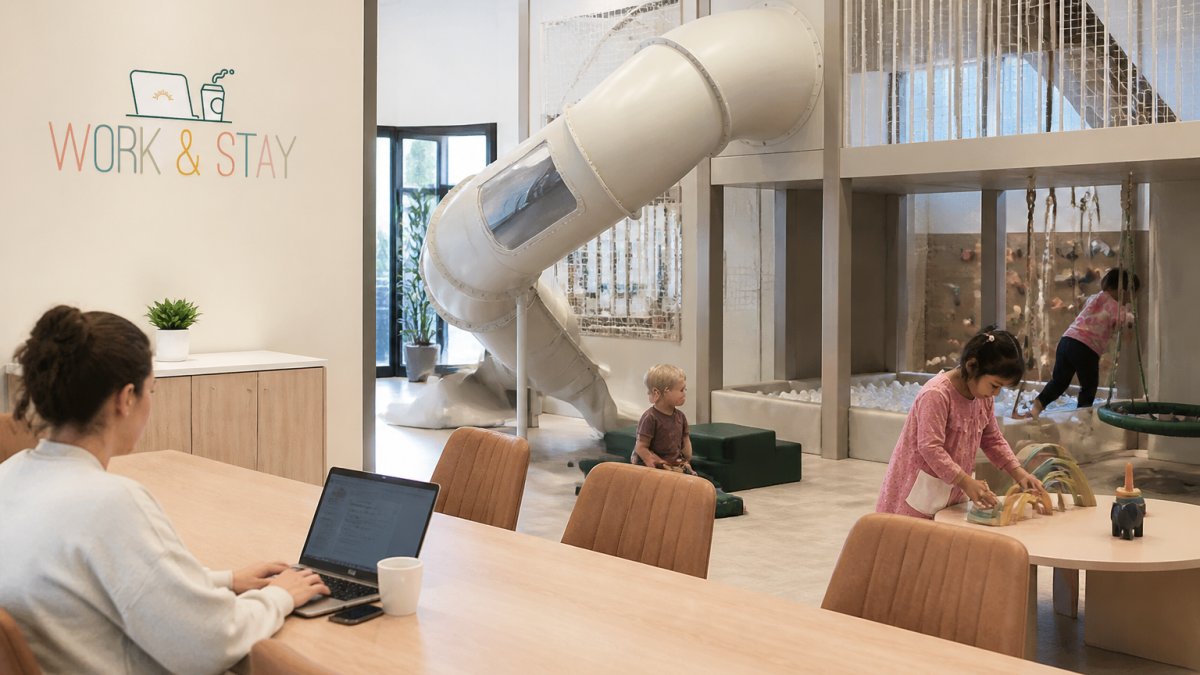
Rotate age-appropriate activities every 20-30 minutes: sensory play (water table, kinetic sand), building blocks, picture books, and short videos. Babies under 12 months need proximity and frequent check-ins; toddlers benefit from structured play stations. Many working parents find that supervised childcare a few hours per week, whether through a provider, family member, or a facility like Work & Stay, creates focused work blocks and gives children consistent social interaction and curriculum-based activities rather than screen time.
What is the 7-7-7 rule for parents, and can it help with a work-from-home routine?
The 7-7-7 rule suggests dedicating 7 hours to work, 7 hours to personal time and family, and 7 hours to rest and sleep. For work-from-home parents, this framework helps protect sleep (non-negotiable for functioning) and intentional family time, preventing work from bleeding into all hours. Adjust the numbers to your reality, 5-8-11 or 6-7-11, but the principle is powerful: ringfence time for each category rather than letting one dominate.
How do you create a work-from-home schedule around childcare?
Start with your child's natural rhythms: nap times, meal times, and peak energy hours. Block your most demanding work (calls, deep focus) during predictable quiet windows. Schedule flexible or lower-focus tasks (email, admin) during active play periods. If childcare is available part-time, anchor your heaviest work to those hours. Build in transition time between work and parenting blocks, 5-10 minutes to reset. Review and adjust weekly; children's needs change, and rigid schedules fail.
How can working parents set boundaries between work and family time?
Close your office door or workspace at a set time each day, even if work isn't finished. Communicate that boundary to your household and employer: "I'm offline at 5 p.m. on weekdays." Use a visual cue (door closed, desk cleared, laptop closed) to signal the shift. Turn off work notifications after hours. If you must work evenings, schedule it after children are asleep rather than during family time. Boundaries protect both your focus during work hours and your presence during family time.
What should I do if my child gets sick or my childcare falls through unexpectedly?
Have a backup plan before crisis hits: a trusted family member, neighbor, or flexible childcare option on speed dial. Communicate with your employer about your contingency, many now expect this reality for working parents. On sick days, adjust expectations downward; you're managing a child's illness, not delivering your usual output. Consider drop-in childcare options for occasional gaps. Some facilities offer flexible, no-contract day passes specifically for these emergencies.
How can I measure whether my work-from-home routine is actually working?
Track three metrics: completed work tasks (are deadlines met?), child's behavior and mood (are they thriving or stressed?), and your own energy (do you feel burned out?). If any one is consistently failing, something needs to change. Common signs of a broken routine include missed deadlines, frequent child meltdowns, or you working after bedtime to catch up. Adjust one variable at a time, shift childcare hours, change your work schedule, or add a focus-time block, and observe the impact over two weeks before changing again.
Can I work from home productively if I don't have reliable childcare?
Solo parenting while working is possible but unsustainable long-term without support. Realistic productivity drops significantly. Consider part-time childcare (even a few hours weekly), school or preschool programs, or community resources. Some employers offer backup childcare benefits or flexible scheduling. If external childcare isn't accessible, protect your most critical work for early mornings or after bedtime, and reset expectations with your manager about output during this season. This isn't permanent; build toward reliable support as your situation allows.