 ultimate-guide
Indoor Playground Safety Protocols Explained for Parents
Table of Contents
- Why Indoor Playground Safety Protocols Matter For Young Children
- Indoor Playground Equipment Inspection Checklist
- Indoor Playground Sanitation Standards That Actually Work
- Child Supervision Policies In Play Centers
- Surfacing, Fall Zones, And Age-Segregated Zones
- Emergency Preparedness, Incident Logs, And Digital Child Tracking
- ADA Compliance, Liability, And Insurance Documentation
- Choosing A Safe Indoor Play Space In Scottsdale
- Frequently Asked Questions
Last Updated: September 12, 2026
Why Indoor Playground Safety Protocols Matter For Young Children
Indoor playground safety protocols are the documented routines and standards a play facility follows to keep children safe, from daily equipment checks to staff supervision ratios. At Play & Stay, we've built our play space with safety routines in mind because parents deserve to know exactly what happens behind the scenes. A 2026 guide from the Consumer Product Safety Commission found that falls remain the leading cause of playground-related emergency visits for children under six, and most of those incidents happen on equipment that wasn't inspected that day. That's the uncomfortable truth: safety isn't a vibe, it's a schedule. Below, we'll walk through the exact protocols every parent should be able to ask about before handing over a toddler.
Indoor Playground Equipment Inspection Checklist
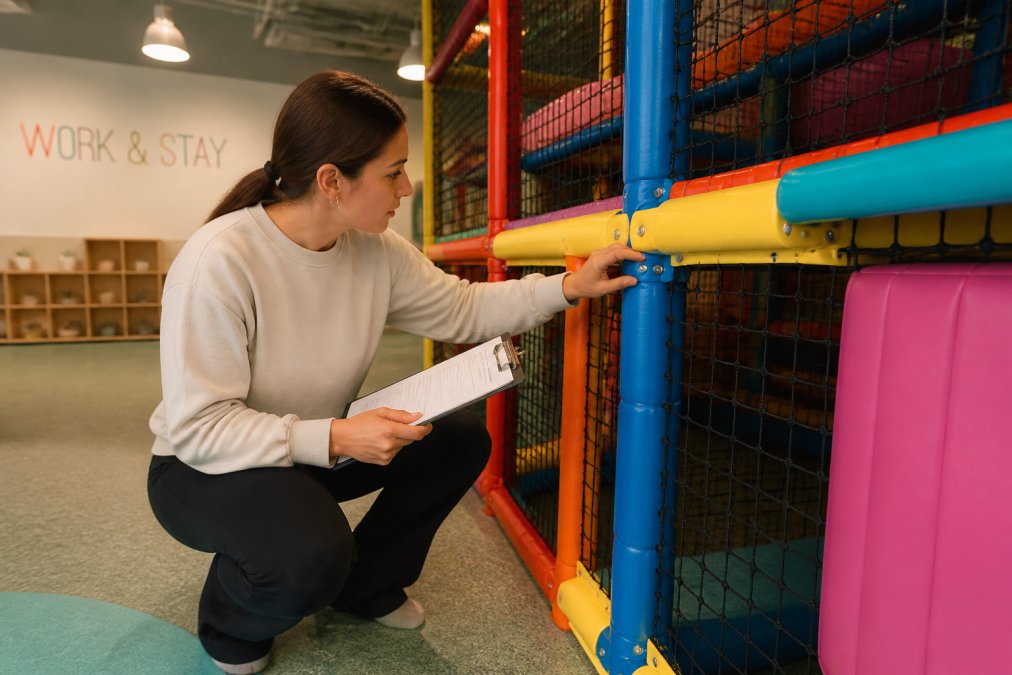
A proper inspection checklist covers structural stability, wear and tear, and every possible entrapment or protrusion hazard before a single child walks in. The American Society for Testing and Materials publishes the ASTM F1487 standard for play equipment that most reputable facilities reference, and it's the baseline, not the ceiling.
Daily Checks Before Doors Open
Staff walk the entire floor before opening. This isn't a glance-and-go; it's a documented pass through every zone.
- Tighten and test all bolts, brackets, and anchor points
- Check padded corners and mats for tears or compression
- Inspect netting, ropes, and climbing surfaces for fraying
- Confirm no sharp edges or protrusions at child height
- Verify fall zones are clear of toys and debris
- Test emergency exits and walkway clearance
Weekly And Monthly Preventative Maintenance
Daily checks catch surface issues. Preventative maintenance catches the slow stuff: structural stability, surfacing compression, and equipment integrity that degrades over weeks. Many facilities keep a maintenance log that maps each piece of equipment to its last inspection date. If a climbing frame hasn't been logged in a month, that's a red flag worth asking about.
Indoor Playground Sanitation Standards That Actually Work
Indoor playground sanitation standards work best when cleaning follows a fixed schedule tied to traffic, not a wipe-down whenever someone remembers. High-touch surfaces need attention far more often than most parents assume.
A practical routine looks like this:
- Hourly: wipe down railings, handles, and gate latches
- Twice daily: sanitize ball pits, tunnels, and shared toys
- Daily close: deep clean floors, mats, and restrooms
- Weekly: full equipment wash with non-toxic cleaning agents
The choice of cleaner matters as much as the frequency. Facilities serving children under six should use non-toxic cleaning agents and let surfaces dry fully before play resumes. A common mistake is spraying a toy and handing it straight back to a toddler. Residue on hands goes straight to mouths.
Child Supervision Policies In Play Centers
Child supervision policies in play centers define who watches whom, and how closely. Supervision ratios are the number that matters most to parents.
Most quality facilities staff a lower child-to-staff ratio in zones for the youngest guests, since toddlers need closer monitoring than a five-year-old on a slide. Staff should be positioned to see the whole room, not clustered at a desk. The thing nobody tells you is that a good ratio on paper means nothing if staff are also running the front counter and handing out snacks. Ask whether supervision is a dedicated role or a side task.
Surfacing, Fall Zones, And Age-Segregated Zones
Age-segregated zones and proper surfacing are the two structural features that prevent the most common injuries. Impact attenuation, or how well a surface absorbs a fall, is the technical term, and it's why you'll see thick foam mats under climbing equipment rather than bare floor.
Fall zones extend well beyond the equipment itself, usually several feet in every direction, and they must stay clear. Age-segregated zones keep toddlers away from bigger kids who move faster and collide harder. For children ages 0-6, separate areas for the youngest guests aren't a luxury; they're how you prevent a two-year-old from being bowled over by a five-year-old mid-sprint.
| Zone | Typical Age | Key Safety Feature |
|---|---|---|
| Soft crawl area | 0-2 | Extra padding, low structures |
| Toddler zone | 2-3 | Rounded edges, close supervision |
| Active play | 3-6 | Larger fall zones, clear sightlines |
| Party room | All ages | Controlled entry, staff present |
Emergency Preparedness, Incident Logs, And Digital Child Tracking
Emergency preparedness means the facility has a written plan for injuries, evacuations, and lost children, and staff have practiced it. Incident logs record every bump, scrape, and near-miss, which helps staff spot patterns before they become repeat injuries. Two angles most facilities miss: post-incident response and digital child tracking. Here is what a real protocol looks like on both.
Post-Incident Response, Step By Step
A written plan is only as good as the sequence staff can execute under pressure. A common pattern in well-run play spaces looks like this:
- Stop play in the affected zone. Staff pause the activity around the incident so no other child runs into the scene.
- Assess and give first aid. At least one staff member on every shift holds current pediatric first aid and CPR certification. Most facilities post certification cards where parents can see them.
- Notify the parent or guardian immediately. For a head injury, loss of consciousness, or anything beyond a minor scrape, the parent is contacted before the child returns to play, not at pickup.
- Document within the hour. The incident log entry captures the time, location, equipment involved, what happened, who responded, and what care was given. Memory fades fast; the log is what protects the child and the facility.
- Flag the equipment or zone. If a piece of equipment was involved, it comes out of rotation until it is re-inspected.
- Review the pattern. A single incident is an incident. Three incidents on the same slide in a month is a design or supervision problem, and the log is how staff catch it.
For a serious injury or a missing child, the plan escalates: staff call 911, secure the building, and account for every child through the check-in system rather than a headcount from memory.
Digital Check-In And Child Tracking
Paper sign-in sheets can be forged, lost, or skipped during a rush. Digital check-in systems close that gap by logging which adult dropped off each child, which adult is authorized to pick up, and the exact time of each handoff. The mechanism matters more than the software brand:
- Matching wristbands or tags. The child and the authorized adult wear linked identifiers, so a pickup requires a match, not a familiar face.
- Authorized pickup lists. Parents name who may collect their child, and staff check the list before releasing anyone.
- Time-stamped records. Every drop-off and pickup is logged, which is exactly the record a facility needs if there is ever a question about who left with whom.
- Ratio visibility. A live count of children in each zone tells staff when a zone is approaching its supervision limit, not after.
Parents should feel comfortable asking three questions: How do you verify who picks up my child? What happens if the person on my pickup list is not the one who arrives? And can you show me the log from today? A facility with a real system answers all three without hesitation.
Evacuation And Lost-Child Drills
Emergency preparedness also covers the scenarios nobody wants to think about. Evacuation routes should be posted, unobstructed, and practiced with staff at least quarterly. Lost-child protocols should include an immediate sweep of exits, a zone-by-zone search, and a parent notification, in that order. The point of a drill is that no one has to invent the plan in the moment.
ADA Compliance, Liability, And Insurance Documentation
ADA compliance, liability coverage, and insurance documentation are the paperwork side of safety, and they are worth asking about directly. The Americans with Disabilities Act requirements mean play spaces must provide accessible routes, accessible restrooms, and equipment that does not exclude children with mobility needs. But compliance is the floor, not the ceiling, inclusive safety goes further than the legal minimum, and the documentation behind it is what tells you whether a facility takes any of it seriously.
What ADA Compliance Actually Requires
For a play space, ADA compliance shows up in concrete features rather than a certificate on the wall:
- Accessible routes connecting the entrance, play areas, restrooms, and party rooms without stairs or narrow pinch points.
- Accessible restrooms with clear floor space and grab bars, not just a wider stall door.
- Ground-level play components so a child who uses a wheelchair or walker can reach at least some of the play experience, not just watch from the edge.
- Clear walkways wide enough for a stroller, wheelchair, or a parent carrying a child to pass without squeezing past equipment.
A facility can be technically compliant and still feel unwelcoming. The difference is whether accessibility was designed in or added on.
Inclusive Safety Beyond The Legal Floor
Inclusive safety means a space designed for all kids, not just the ones who fit the default. That shows up as sensory-friendly quiet corners for children who get overwhelmed, lower-stimulation time blocks, soft lighting in at least one zone, and staff trained to recognize when a child needs a break rather than a reprimand. For children with sensory processing differences, autism, or mobility needs, these features are not extras, they are what makes the space usable at all. Parents of children with disabilities should be able to ask, "How does your space work for my child?" and get a specific answer, not a general reassurance.
Liability Coverage And The Records Behind It
On the liability side, a reputable facility carries general liability insurance and, where applicable, childcare-specific coverage, and it should be able to show proof of both without hesitation. The documentation that backs up a real safety program typically includes:
- Current insurance certificates naming the coverage types and effective dates.
- Staff certification records for pediatric first aid and CPR, kept current.
- Inspection and maintenance logs tied to each piece of equipment.
- Incident reports retained for the period the facility's insurer requires.
- Safety audit results from the most recent internal or third-party review.
These records are not just for the facility's protection. They are the evidence a parent can ask to see, and a well-run space will hand them over without a pause. If a facility cannot produce a current insurance certificate or a staff certification list, that is a meaningful signal about how the rest of the operation is run.
Why This Matters For Parents Choosing A Space
Compliance, inclusion, and documentation are the parts of safety you cannot see from the play floor. They are also the parts that hold up when something goes wrong. A facility that treats them as paperwork to file and forget is a facility that treats the visible safety routines the same way. The questions are simple: Is the space accessible? Is it inclusive? And can you prove it?
Choosing A Safe Indoor Play Space In Scottsdale
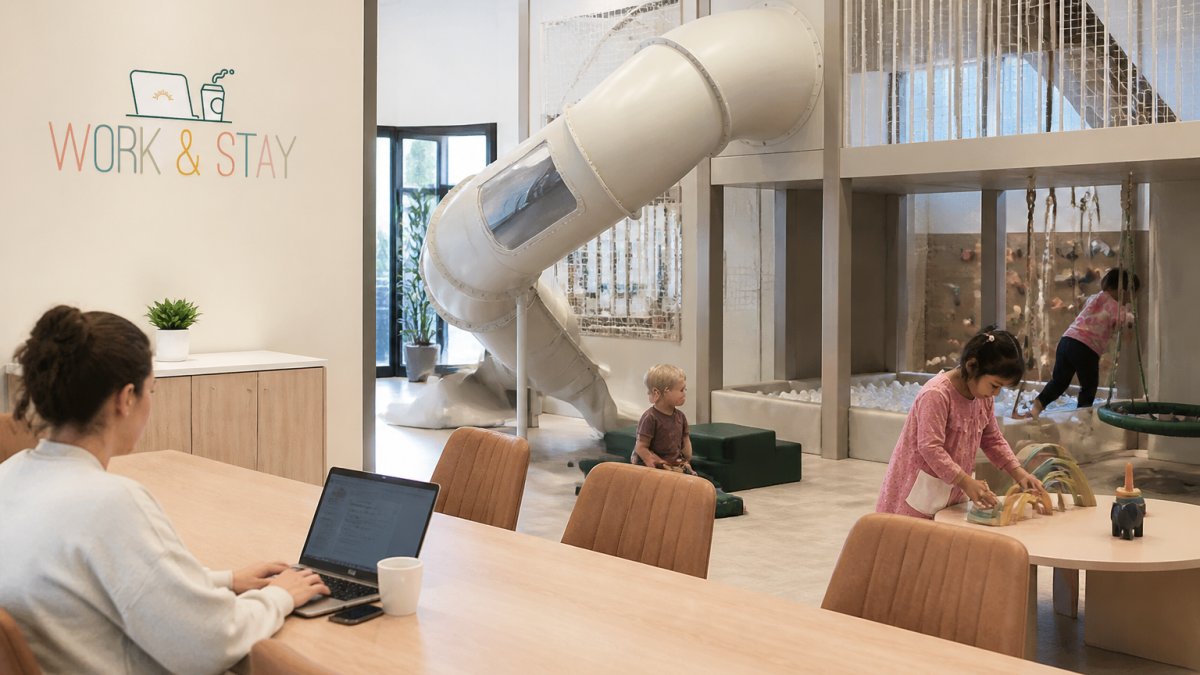
Choosing a safe indoor play space comes down to asking the right questions before you commit. Play & Stay offers supervised open play and age-separated areas for children 0-6. Work & Stay provides curriculum-based classroom time and staff who treat safety routines as the job, not an afterthought. For parents who need to work while their kids play, the connected Work & Stay side pairs a coworking lounge with supervised childcare just steps away, so you can take a call and still be minutes from your child.
Whether you're booking a day pass or considering a membership, tour the space and ask about inspections, ratios, and cleaning schedules. The answers tell you everything.
Frequently Asked Questions
What should parents look for when evaluating indoor playground safety?
Look for posted inspection logs, clean surfaces, visible staff monitoring, and age-segregated zones. Ask whether staff are background-checked and first aid certified. Check that equipment has secure padding and no exposed bolts. Play & Stay maintains daily inspection checklists and trained staff so parents can see safety protocols in action.
How often should indoor playground equipment be inspected for safety?
Most facilities inspect equipment daily before opening, with deeper preventative maintenance weekly and monthly. Daily checks cover wear and tear, loose hardware, and cleanliness. Monthly audits review structural stability and surfacing. Ask to see the inspection log at any indoor playground you visit.
How do indoor playgrounds ensure a sanitary environment for toddlers?
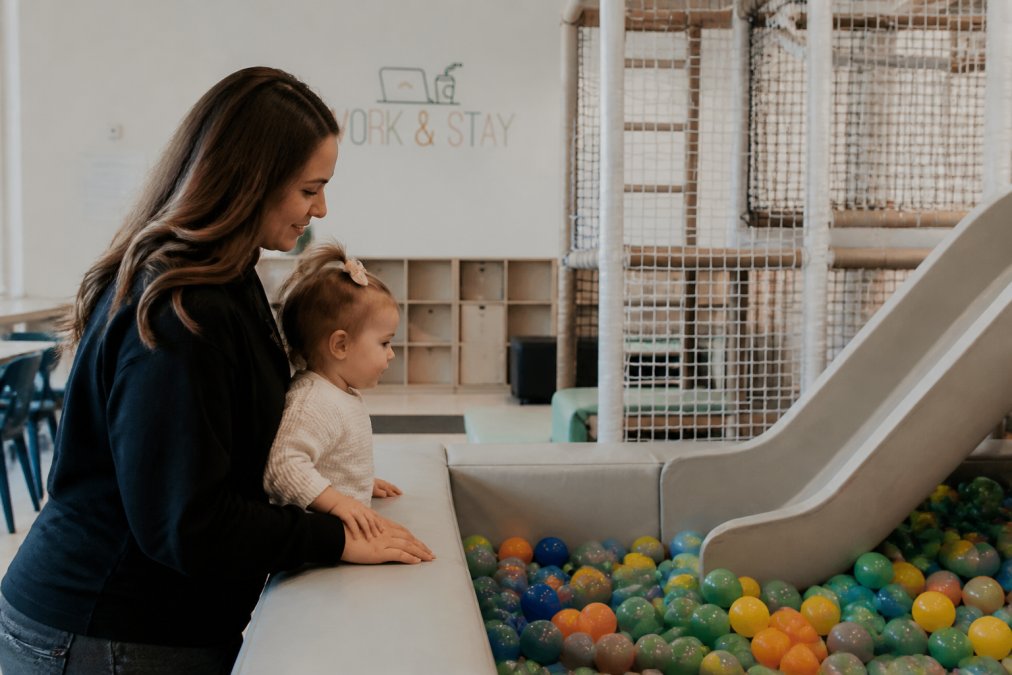
Sanitation standards include frequent wiping of high-touch surfaces, non-toxic cleaning agents, and scheduled deep cleans. Ball pits and soft play areas need extra attention. Play & Stay uses child-safe sanitization schedules throughout the day, especially in areas for children under two.
Are there specific federal guidelines for indoor play structures?
The Consumer Product Safety Commission publishes the Public Playground Safety Handbook, and ASTM International sets voluntary standards for play equipment. Many states and insurers reference these. Facilities that follow them demonstrate stronger compliance documentation and lower liability risk.
Finding a play space where you can actually relax, or focus on work, starts with trusting the safety systems behind the fun. Play & Stay offers supervised open play, age-separated zones for children 0-6, and flexible memberships and day passes with no long-term contract, while Work & Stay gives parents a coworking lounge with childcare just steps away. Sign up for your membership today and see what a genuinely safe, welcoming play space feels like.