 how-to
Flexible Drop-In Childcare In Scottsdale: What Parents Need to Know
Table of Contents
- What Flexible Drop-In Childcare Actually Is
- How to Find Safe Childcare in Your Area
- Coworking With Childcare: A Game-Changer for Remote Parents
- Backup Childcare Options When Your Regular Care Falls Through
- Hourly Childcare Services: Pricing and What to Expect
- Questions to Ask Before You Commit
- Is Flexible Drop-In Childcare Right for Your Family?
- Frequently Asked Questions
Last Updated: August 18, 2026
What Flexible Drop-In Childcare Actually Is
Flexible drop-in childcare lets parents bring children for a few hours or a full day without long-term contracts or weekly commitments. Unlike traditional daycare, you pay only for what you use, when you use it.
This is a supervised, structured environment where trained staff care for children while parents work, handle errands, or focus on personal time. Many facilities serve children ages 0-6 with separate spaces for infants and toddlers versus older preschoolers.
Work & Stay combines flexible childcare with a coworking space designed for parents. Children stay in a supervised, curriculum-based classroom just steps away while parents work in a quiet, focused environment. It's structured, teacher-led activities designed for early childhood development, not just supervision.
How to Find Safe Childcare in Your Area
Finding safe childcare starts with asking the right questions. Focus on staff training, facility cleanliness, safety protocols, and supervision ratios, not just cost or convenience.
Ask what certifications staff hold. Childcare providers should have CPR and first aid certification at minimum. Staff-to-child ratios matter enormously: infants and toddlers under 2 typically need 1:4 or better; older toddlers and preschoolers can be in groups of 1:6 or 1:8 depending on state regulations.

Visit any facility in person before committing. Look for cleanliness, organized spaces, age-appropriate toys, and how staff interact with children. Are they engaged and warm? Are bathrooms accessible and clean? Is the facility safe and temperature-controlled?
Ask about illness policies. What symptoms require pickup? How do they handle communicable illnesses? A good facility has clear, written policies.
Safety questions are essential. Ask about emergency procedures, incident reporting, and injury protocols. Do they have liability insurance? How do they communicate with parents during the day?
Ask about activities and curriculum. What does a typical day look like? Are children engaged in structured activities and unstructured play?
Coworking With Childcare: A Game-Changer for Remote Parents
Traditional remote work assumes parents can work undisturbed while kids entertain themselves. Coworking with childcare solves this by putting professional workspace and supervised childcare under one roof.
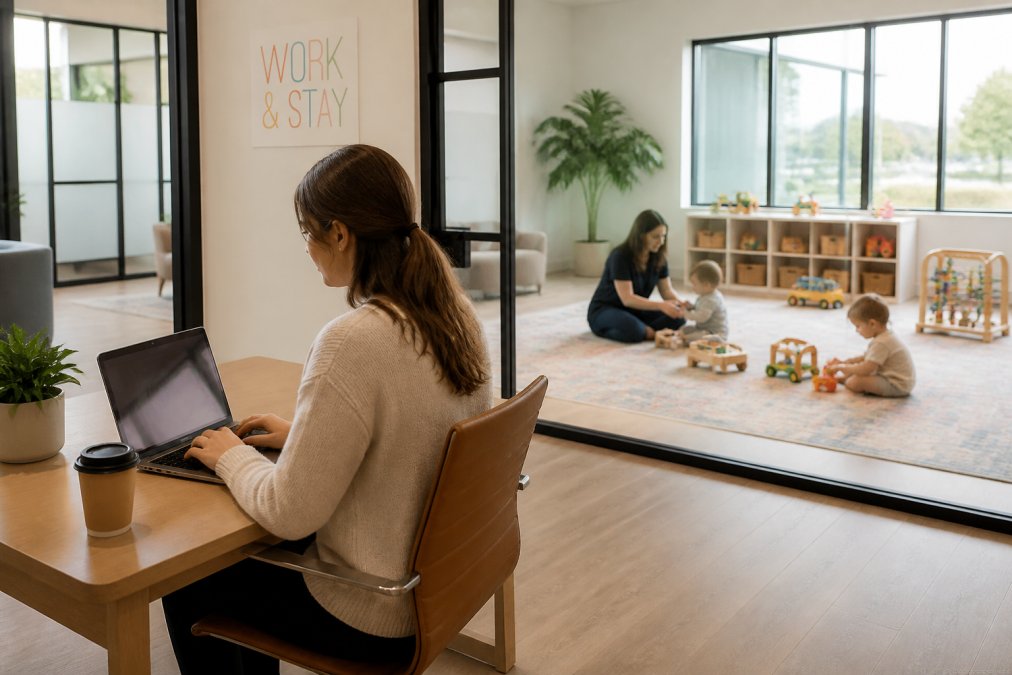
Parents drop children off in a separate childcare environment where trained staff lead curriculum-based activities, then work in a quiet, professional space designed for focus. Unlike working from home where a child might interrupt a call, or hiring a babysitter where parents feel guilty for the cost, this setup lets parents work productively while staying close by.
Work & Stay operates exactly this way. The childcare side features structured, teacher-led programming for children ages 18 months-6. While a parent is in a meeting or focused on deep work, their child engages in age-appropriate activities designed for early childhood development. Parents aren't juggling both roles simultaneously; they're actually working.
The cost-benefit shifts dramatically compared to hiring full-time childcare or traditional daycare. Parents can sign up for a monthly membership or use the space only when they need it. A parent working from home three days a week doesn't pay for five days of childcare. This flexibility often costs less than traditional arrangements while providing better focus and childcare quality.
The social element matters too. Children benefit from structured peer interaction and teacher-led activities. Parents benefit from being around other working parents, reducing the isolation of remote work and providing a built-in community.
Backup Childcare Options When Your Regular Care Falls Through
Every parent faces this scenario: regular childcare falls through, work commitments can't move, and you need coverage today. Backup childcare options prevent panic.
Common options include family members, informal parent swaps, and paid backup services. Each has trade-offs. Family is often free but may not be available on short notice. Parent swaps work with trusted friends and compatible schedules. Paid backup services cost more but provide professional supervision and reliability.
Flexible drop-in childcare is one of the strongest backup options because it requires no advance planning. If your regular provider gets sick or your schedule shifts unexpectedly, a flexible drop-in facility can often accommodate you the same day. This is especially valuable for parents with unpredictable work schedules or those without family support nearby.
Identify backup options before you need them. Research flexible drop-in facilities in your area now, understand their availability, and know how to book quickly. Some facilities maintain space for walk-ins; others require advance booking but can fit you in within 24 hours. flexible childcare solutions.
Work & Stay functions well as backup childcare because it operates on memberships and day passes with no long-term commitment. A parent can use the space regularly or sporadically. For parents who need occasional backup coverage rather than daily childcare, this flexibility removes a major source of stress.
Hourly Childcare Services: Pricing and What to Expect
Hourly childcare services charge by the hour or half-hour, letting parents pay only for the time they use. A parent needing three hours of care on a Tuesday pays for three hours. There's no monthly minimum, no unused-day waste, and no long-term contracts.
Pricing varies by location, facility quality, and whether the service includes activities or just supervision. Many facilities offer tiered pricing: lower rates for drop-in open play, higher rates for structured programming with curriculum-based activities. Some charge differently for infants and toddlers versus older preschoolers.
Many facilities offer membership options alongside hourly rates. A parent might buy a membership that includes a certain number of hours per month at a discounted rate, plus the option to add extra hours at a higher rate. This hybrid model works well for parents with somewhat predictable needs but occasional unpredictability.
What to expect: arrival and check-in procedures (usually 5-10 minutes), a safe, clean environment with age-appropriate activities, snack and bathroom breaks, and regular communication about your child's session. Plan for a few minutes of transition time at pickup.
SIGN UP FOR YOUR MEMBERSHIP TODAY →
Ask whether the facility provides meals and snacks, or if parents need to send them. Ask about supplies like diapers and wipes for infants and toddlers. Clarify what happens if a parent is late for pickup; most have late fees that start after 15-30 minutes.
Questions to Ask Before You Commit
Before enrolling in any flexible drop-in childcare, ask these specific questions.
About staffing and training: What certifications do staff hold? How long has the average staff member worked here? What's the staff-to-child ratio? How do they handle staff absences?
About safety and health: What's your illness policy and which symptoms require pickup? How do you handle injuries or medical emergencies? Do you have liability insurance? What's your incident reporting process?
About daily operations: What does a typical day look like? What activities are included? Are meals and snacks provided? What supplies do parents need to provide? What's your late pickup policy?
About your specific child: Does your facility have experience with separation anxiety? Can parents stay nearby initially if a child struggles with transitions? How do you handle allergies or dietary restrictions?
About flexibility and billing: What's your cancellation policy? Can parents book same-day if space is available? How is billing handled? Are there minimum time requirements?
About communication: How do you update parents during the day? Do you provide photos, written reports, or both? How do parents reach staff during the day?
A facility that answers these questions clearly and welcomes follow-ups shows they take safety, communication, and transparency seriously.
Is Flexible Drop-In Childcare Right for Your Family?
Flexible drop-in childcare solves specific problems exceptionally well. Consider whether your situation matches these scenarios.
It works best if you need occasional childcare rather than full-time care. If you work from home three days a week or need a few hours to run errands, this model gives you exactly what you need without paying for unused days.
It's ideal if your schedule is unpredictable. Sales professionals, consultants, freelancers, and others with variable work hours benefit from booking childcare when they need it rather than committing to fixed days.
It's valuable if you need backup childcare coverage. When your regular arrangement falls through, flexible drop-in options provide immediate solutions.
It works well for parents seeking structured activities and early childhood development. If you want your child in a curriculum-based environment, facilities offering guided activities serve that need.
Flexible drop-in childcare may not be ideal if you need full-time, consistent childcare five days a week. Traditional daycare or nanny care might be more cost-effective for that scenario. However, if your needs are truly flexible, some weeks full-time, other weeks part-time, drop-in care might still win.
It's worth considering if you work from home and struggle to stay productive while managing kids. Coworking with childcare solves this by giving parents a professional workspace and children a supervised, engaging environment.
Many families find that a hybrid approach works best: a part-time traditional arrangement for consistent needs, plus flexible drop-in options for unpredictable days.
Flexible drop-in childcare solves a real problem for working parents: the need for reliable, quality care without long-term commitments or inflexible contracts. Whether you're managing an unpredictable work schedule, need occasional backup care, or want to work productively while your child engages in structured activities, this model eliminates the stress of traditional childcare logistics.
Work & Stay brings this concept together with a professional workspace designed for parents. Parents get a quiet, focused environment for work. Children get supervised, curriculum-based activities in a separate, safe space. No long-term contracts. No unused-day fees. Just flexibility that actually works for real families. Learn more about memberships and day passes at playandstayaz.com and discover how combining workspace and childcare transforms how parents approach productivity.
Frequently Asked Questions
What is the difference between flexible drop-in childcare and traditional daycare?
Drop-in childcare offers no long-term commitment—you pay for the hours you use, whether that's a few hours weekly or daily. Traditional daycare typically requires multi-week or monthly enrollment and set schedules. Flexible drop-in childcare works best for parents with unpredictable schedules, part-time remote work, or occasional backup care needs. Many facilities combine both models, allowing members to book time flexibly while maintaining a structured, curriculum-based program for the children.
How do I verify the safety standards of a drop-in childcare facility?
Ask about staff qualifications, background checks, and child-to-staff ratios. Request to see their health and safety certifications, cleaning protocols, and incident documentation. Tour the facility unannounced if possible and observe staff interactions with children. Check online reviews and ask for references from current parents. Verify that the facility meets state licensing requirements and ask about their emergency procedures, first aid training, and how they handle medical needs like diaper changes and allergies.
Are there flexible childcare options that include workspace for parents?
Yes. Some facilities now combine coworking spaces with on-site childcare, allowing you to work while your child is supervised just steps away. This model is ideal for remote workers and entrepreneurs who need focused work time without the cost of separate childcare and office memberships. You get a productive workspace, your child receives curriculum-based care and social interaction, and you eliminate commute time between locations. These combined spaces often offer hourly or membership flexibility, so you only pay for what you use.
Can I use flexible drop-in childcare for occasional remote work days?
Absolutely. Drop-in childcare is designed for exactly this use case—parents who work from home but need uninterrupted focus time for calls, meetings, or deep work. You can book just a few hours on the days you need it most, without paying for full-time care. This approach is much more affordable than hiring a babysitter for occasional use and gives your child social interaction and structured activities while you work productively in a separate space.
This article was written using GrandRanker