 how-to
Indoor Playground with Coworking Space: A Parent's Guide
Table of Contents
- What Is an Indoor Playground with Coworking Space?
- How Coworking with Childcare Works in Practice
- How to Work from Home with Toddlers: The Hybrid Approach
- Flexible Childcare Options for Working Parents
- Safety, Supervision, and Peace of Mind
- Designing a Productive Work Zone While Kids Play
- Is This Right for Your Family?
- Frequently Asked Questions
Last Updated: September 3, 2026
What Is an Indoor Playground with Coworking Space?
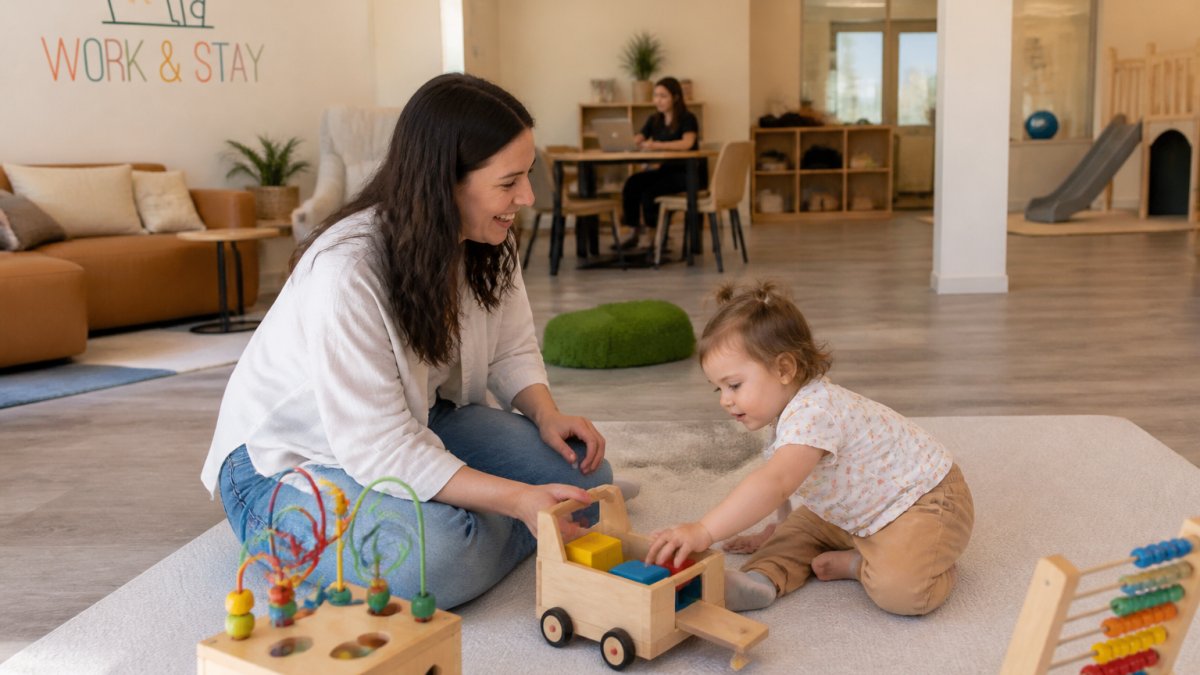
An indoor playground with coworking space combines a safe, climate-controlled play environment for young children with a productive workspace for adults, solving a persistent problem for remote-working parents: supervising children while maintaining work focus.
Unlike traditional daycare or standalone coworking spaces, this hybrid model bridges the gap. Parents get a dedicated work zone with reliable internet and quiet areas for calls, while knowing their children are steps away in a supervised, enriching environment. Children benefit from structured activities, social interaction, and guided play led by trained staff.
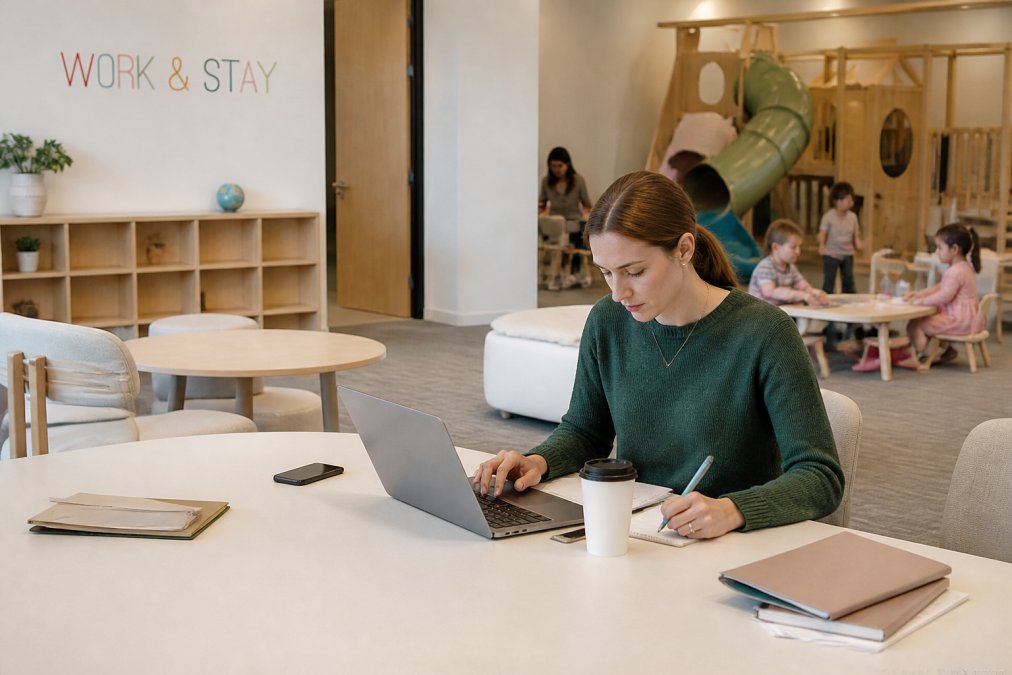
Work & Stay exemplifies this model with separate but adjacent spaces: a coworking lounge and private offices paired with a curriculum-based childcare environment for ages 0-6. This proximity means parents work productively while remaining close enough to respond if needed, without guilt or distance.
The appeal is straightforward: remote work and parenting are simultaneous demands requiring simultaneous solutions. This model removes the false choice between being present for your kids and being present for your work.
How Coworking with Childcare Works in Practice
The workspace and play areas must be physically separated to protect work focus, yet connected enough that parents feel secure and can respond quickly if needed.
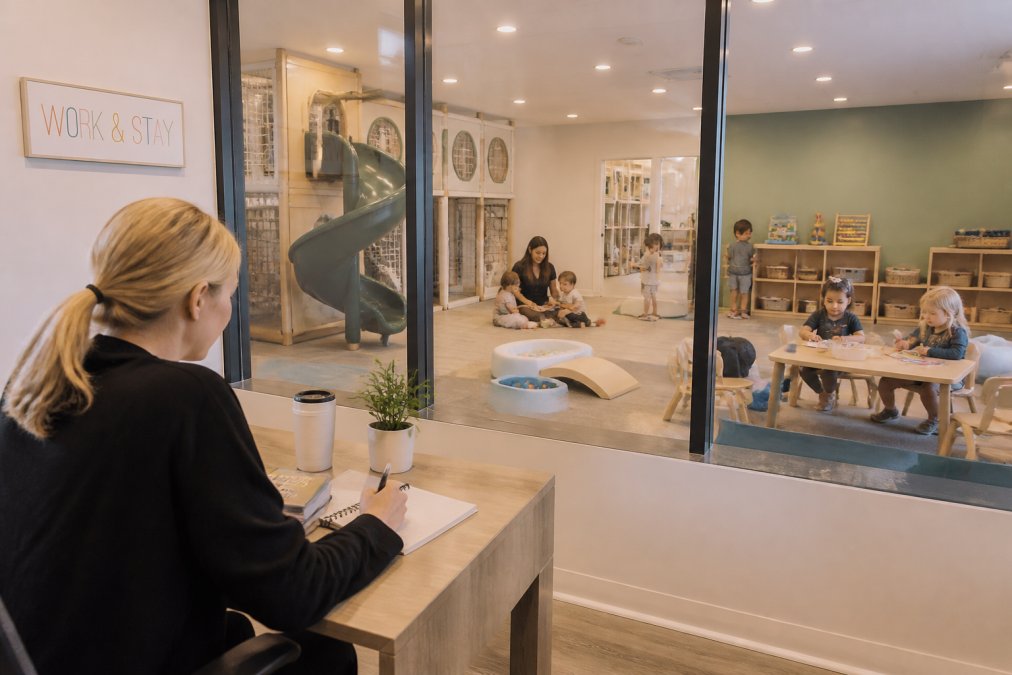
Most facilities operate on a membership or day-pass basis with flexible commitment. Parents book time in advance or drop in on available days, selecting how many hours they need. This flexibility matters because parenting schedules are unpredictable, a sick babysitter, school closure, or deadline surge all create sudden need for childcare paired with workspace.
The childcare component is staffed by trained supervisors who manage activities, transitions, and safety. Teachers lead curriculum-based activities like music, arts, movement, and language development. Children aged 0-6 have separate zones appropriate to their developmental stage.
For parents, the coworking side functions like any professional workspace: high-speed internet, private offices or lounge seating, meeting rooms, and phone booths for confidential calls. Intentional soundproofing and layout design prevent children's voices from disrupting adult work.
The revenue model typically combines membership tiers (unlimited monthly access, part-time passes, or hourly rates) with ancillary services like birthday party rentals or specialized programming. This diversification balances different peak-demand patterns.
How to Work from Home with Toddlers: The Hybrid Approach
Working from home with toddlers is often presented as a binary choice: hire full-time childcare or abandon professional ambitions. The hybrid approach offers a third path.
The reality is that interruptions are constant and unpredictable. The hybrid model acknowledges this by providing structured, supervised time when kids are engaged elsewhere, combined with flexible access that lets parents adjust as circumstances change.
Practically, a parent might book two full days per week at the facility, plus occasional additional hours as needed. On those days, the parent works in a distraction-free environment while the child engages in age-appropriate activities with trained staff. Two focused days of work often accomplish more than five fragmented days at home.
This approach also normalizes social interaction for young children. Peer play, group activities, and exposure to different adults supports development in ways that home-based care cannot replicate. It protects against caregiver burnout by creating space for parents to recharge, improving patience and presence during family time.
Flexible Childcare Options for Working Parents
Not all working parents need the same childcare arrangement. An indoor playground with coworking space accommodates different schedules and needs.
Full-time membership works for parents who work outside the home but need backup childcare for school closures, sick days, or schedule gaps.
Part-time memberships suit remote workers who need focused work time several days per week but manage some childcare at home on other days.
Hourly or daily passes serve parents with unpredictable schedules, freelancers, gig workers, or those with variable shift work.
Seasonal or temporary access appeals to parents who need childcare only during specific periods: summer break, holiday weeks, or while traveling for work.
The curriculum-based element matters. This isn't just supervised play; it's structured learning. Teachers lead activities that support language development, motor skills, social-emotional growth, and creativity.
Work & Stay offers both membership and day-pass options with no long-term contract required. This flexibility means parents can test the model, adjust as their needs change, and avoid overpaying for capacity they don't use.
Safety, Supervision, and Peace of Mind
The primary concern for any parent is safety. But beneath immediate questions lies a more complex layer: the legal and insurance framework that protects both children and the business.
Licensing and Regulatory Requirements
Facilities that combine childcare with coworking must navigate state and local childcare licensing regulations. Any facility providing childcare to more than a certain number of children (typically four to six, depending on the state) requires a childcare license.
Licensing requirements typically include:
- Staff-to-child ratios mandated by state law, varying by age group
- Background checks for all staff, including fingerprinting and checks against state and federal databases
- Health and immunization records for all children
- Facility inspections covering physical safety, sanitation, emergency preparedness, and curriculum
- Staff training and certification requirements, including CPR/first aid certification and mandatory reporter training
- Documentation and record-keeping standards, including incident reports and activity records
Work & Stay operates as a licensed childcare facility, meeting state requirements. Parents should always verify that any facility holds current, valid licensing from the state childcare licensing agency.
Insurance and Liability Coverage
A facility combining childcare with coworking faces unique liability exposures requiring specialized coverage.
Childcare liability insurance is essential and separate from general commercial liability. This covers claims arising from child injuries, allegations of abuse or neglect, and other childcare-specific incidents.
General liability insurance covers the coworking side: slip-and-fall injuries, property damage, and standard business risks.
Professional liability or abuse and molestation coverage covers legal defense costs and settlements related to allegations of abuse or inappropriate conduct by staff, even if allegations are unfounded.
Workers' compensation insurance is mandatory in most states.
Parents should ask to see proof of current insurance before enrolling. A facility that cannot produce a current certificate of insurance is a red flag.
Health, Sanitation, and Illness Policies
State regulations mandate specific health and sanitation standards. Facilities must maintain documented cleaning schedules, use approved sanitizing agents, and follow protocols for handling bodily fluids.
SIGN UP FOR YOUR MEMBERSHIP TODAY →
Illness policies are part of licensing compliance. Most facilities require that children with fever, active cough, or contagious symptoms stay home. Parents should understand the facility's illness policy before enrolling, including pickup timelines and return requirements.
Emergency Preparedness and Incident Response
Licensing regulations require documented emergency plans covering fire, severe weather, lockdown, and evacuation procedures. Staff must be trained and drills conducted regularly. Parents should know where children are taken during evacuation, how they're notified in emergencies, and how medical emergencies are handled.
Incident documentation is mandatory. Any injury, illness, or safety concern must be documented and reported to parents.
What Parents Should Verify
Before enrolling, parents should:
- Request proof of current licensing from the state childcare licensing agency
- Ask about staff qualifications: CPR/first aid certification, child development training, and director experience
- Review the facility's most recent inspection report, which is public record in most states
- Understand the illness policy in writing before enrolling
- Ask about incident procedures: How are minor injuries handled? How are parents notified?
- Request references from current families if possible
The peace of mind comes from knowing the facility operates within a legal framework designed to protect children, that staff are trained and vetted, and that clear protocols exist for health, safety, and emergency response.
Designing a Productive Work Zone While Kids Play
Physical separation between work and play areas is critical to the model's success. Without intentional design, parents hear constant noise and feel pulled between two environments. Good design allows genuine, undisturbed work.
Acoustic Design and Noise Management
Soundproofing is the most underestimated element. Standard drywall and doors provide minimal sound isolation.
Effective acoustic separation requires:
- Sound-absorbing materials in the play area: carpet, foam panels, and acoustic ceiling tiles absorb sound before it travels
- Insulated walls between spaces using double-stud walls, resilient channels, or mass-loaded vinyl barriers
- Sealed doors and thresholds with acoustic seals, automatic door bottoms, and solid-core doors
- Floating floors in the play area to reduce impact noise
- Vibration isolation for mechanical systems to prevent transmission through the building structure
The goal is not silence but reduction in sudden, loud interruptions that break concentration. A well-designed space achieves 40-50 decibels in the work area, roughly equivalent to a quiet office or library.
Spatial Layout and Visual Separation
Physical proximity is a feature, but visual access can undermine focus.
Effective layout strategies include:
- Solid partitions or walls between spaces rather than glass
- Offset entries and exits so parents don't have direct sightlines to the play area
- Different floor levels if the facility layout permits
- Dedicated parent zones with no view into childcare areas
- Separate HVAC zones so air flow doesn't carry noise or odors
The layout should also support different work modes: private offices for confidential calls, open lounge seating for collaborative work, meeting rooms for client calls, and quiet zones for focused work.
Technology Infrastructure
For remote work, technology is non-negotiable.
Internet reliability requires:
- High-speed, dedicated connectivity with sufficient bandwidth for multiple simultaneous users (at least 100 Mbps download and 20 Mbps upload for 10 working parents)
- Redundant internet service from two different providers with automatic failover
- Mesh Wi-Fi or enterprise-grade access points distributed throughout the workspace
- Wired ethernet connections in private offices and meeting rooms for maximum stability
- Network monitoring and support to identify and resolve issues quickly
Other technology considerations:
- Video conferencing setup: Meeting rooms should have large monitors, quality cameras, and microphones
- Printing and document management: Access to printers, scanners, and secure document storage
- IT support: A contact for technical issues with quick response time
Ergonomics and Workspace Design
Parents working several hours per week deserve ergonomic standards comparable to office workers.
Desk and seating standards:
- Adjustable-height desks allow alternating between sitting and standing
- Ergonomic chairs with lumbar support, adjustable height, and armrests
- Monitor positioning at eye level and arm's length away
- Keyboard and mouse placement at elbow height when arms are relaxed
- Lighting that minimizes glare and provides adequate illumination
Climate Control and Air Quality
A productive work environment requires comfortable temperature and air quality.
- Separate climate zones for work and play areas allow different temperature settings
- Humidity control maintains ideal range of 40-60% relative humidity
- Air filtration with HEPA filters removes allergens and airborne particles
- Ventilation provides fresh air exchange without creating drafts or noise
Amenities That Support Productivity
Beyond the core workspace:
- Break room or kitchenette with water, coffee, and snacks
- Restrooms that are clean, well-stocked, and separate from childcare areas
- Lockers or secure storage for personal items and work materials
- Convenient, secure parking
Parents evaluating a facility should test the workspace themselves: Can you hear the play area? Is the internet fast and stable? Is the seating comfortable for a 4-hour work session? Does the layout support focus? These practical tests reveal whether the facility prioritizes work productivity.
Is This Right for Your Family?
This model works best for specific situations and parenting styles.
An indoor playground with coworking space makes sense if:
- You work remotely or have flexible work hours
- You need childcare several days per week but not full-time
- Your child is between ages 0-6
- You value both work productivity and parental presence
- You prefer not to commit to a long-term childcare contract
- Your schedule varies week to week
It may be less ideal if:
- You need full-time, all-day childcare five days per week
- Your child has specialized needs requiring one-on-one care or specific therapies
- Your work requires completely uninterrupted focus for 8+ hours per day
- You prefer your child's primary caregivers to be family members
The model also depends on your child's temperament. A child who separates easily from parents and engages well with peers will thrive. Most children adapt over time, though the adjustment period varies.
Cost-effectiveness depends on your alternatives. Each family's situation is different.
The biggest advantage is flexibility. Unlike traditional daycare with fixed schedules and contracts, an indoor playground with coworking space accommodates changing needs without penalty.
An indoor playground with coworking space solves a real problem: the impossible task of being fully present as both parent and professional. Work & Stay brings this model to life with curriculum-based childcare for ages 0-6 paired with coworking and private offices designed for focused work. The facility offers flexible memberships and day passes with no long-term contract, so families can access what they need when they need it. Learn more about Work & Stay memberships and day-pass options to see how this hybrid approach fits your family's unique schedule and work style.
Frequently Asked Questions
Q: What is the difference between an indoor playground with coworking space and traditional daycare?
A: An indoor playground with coworking space combines a supervised play environment for children with a productive workspace for parents in one location. Unlike traditional daycare focused solely on childcare, this hybrid model integrates curriculum-based activities, teacher-led classroom time, and open play for children ages 0-6, while parents work in a separate, soundproofed area. Parents can access memberships or day passes with no long-term contracts, making it ideal for flexible schedules and remote workers.
Q: How do I work from home with toddlers when they need supervision?
A: Working from home with toddlers becomes manageable when you have structured childcare nearby. An indoor playground with coworking space solves this by placing your child in a supervised, play-based environment just steps away. You work in a quiet zone designed for focus while trained staff manage activities, play, and curriculum-based learning. This arrangement allows you to handle calls, emails, and focused work without constant interruptions while knowing your child is safe and engaged.
Q: What if my child has separation anxiety or won't stay without me?
A: Many facilities design layouts so parents can remain nearby while children adjust to supervised play. Some spaces offer a gradual transition approach where you can observe from a comfortable distance, allowing your child to build confidence over time. Talk with the facility about their approach to separation anxiety and whether they offer flexible start options like shorter initial sessions or parent-child transition time. This ensures your child feels secure while you gain productive work time.
Q: Is an indoor playground with coworking space safe for infants and toddlers in diapers?
A: Yes, facilities designed for ages 0-6 include separate areas for the youngest children with changing stations and staff trained in diaper care, feeding, and infant supervision. Staffing ratios follow state childcare licensing requirements to ensure adequate supervision. Look for facilities with clear safety protocols, liability insurance, incident procedures, and transparent staff certifications. Ask about their cleaning standards, health screening policies, and how they manage children with special needs or dietary requirements.
This article was written using GrandRanker