 ultimate-guide
How to Find Safe Childcare: A 2026 Guide
Table of Contents
- What Makes Safe Childcare: Types of Settings to Know First
- How to Check Daycare Inspection Reports Before You Visit
- Your Childcare Safety Checklist for Facility Tours
- Daycare Interview Questions for Parents to Ask Every Provider
- Navigating Waitlists, Deposits, and Non-Traditional Hours
- Handling Separation Anxiety During the Transition
- Coworking Spaces with Onsite Childcare: A Flexible Alternative
- Conclusion
Last Updated: August 15, 2026
Finding safe childcare is one of the most consequential decisions a parent makes, and most guides make it harder than it needs to be. At Work & Stay, we talk to parents every day who are overwhelmed by licensing jargon, conflicting advice, and the sheer number of options available. This guide cuts through that noise and gives you a practical, step-by-step framework for evaluating any childcare provider, from large daycare centers to in-home options, so you can make a confident decision for your child.
Below, we'll walk you through exactly how to check provider records, what to look for on a tour, which questions actually reveal whether a facility is safe, and how to handle the harder parts of the process that most guides skip entirely.
What Makes Safe Childcare: Types of Settings to Know First
Safe childcare starts with understanding what you're actually choosing between. The setting type determines the regulatory framework, the staff-to-child ratio, and the level of oversight your child will receive.
Center-Based Care vs. Family Daycare vs. In-Home Providers
Center-based care is a licensed facility operating out of a dedicated building, typically with multiple classrooms, separate staff for different age groups, and structured programming. These centers are subject to the most rigorous licensing requirements and inspections.
Family daycare refers to a provider caring for a small group of children in their own home. These are still licensed in most states, but the inspection frequency and child-to-teacher ratio requirements differ from center-based programs.
In-home providers (nannies, au pairs, babysitters) operate in your home and are largely unregulated from a licensing standpoint. Background checks and reference verification fall entirely on you as the parent.
For most families, center-based care or licensed family daycare offers the most built-in accountability. That said, the right choice depends on your child's age, temperament, and your own schedule.
Licensed vs. Unlicensed Childcare: Why It Matters
A licensed childcare provider has met minimum state standards for health and safety, caregiver certification, staff-to-child ratios, and facility conditions. Licensing also means the provider is subject to unannounced inspections and must maintain immunization records for enrolled children.
Unlicensed providers are not inherently unsafe, but there is no regulatory agency monitoring their compliance. If something goes wrong, your recourse is limited. For children under age three especially, licensed care is worth prioritizing.
How to Check Daycare Inspection Reports Before You Visit
Before you ever schedule a tour, pull the provider's inspection history. This step takes about ten minutes and tells you more than any marketing brochure.
Finding Your State's Regulatory Agency and Quality Rating System
Every state has a licensing agency responsible for childcare oversight. Most states now publish inspection reports and compliance violations online through a searchable database. The Child Care Aware of America provider search tool connects parents to their state's specific regulatory agency, making it easy to find the right portal no matter where you live.
Many states also operate a Quality Rating and Improvement System (QRIS), which rates providers on a tiered scale based on factors like staff qualifications, curriculum quality, and family engagement. A provider that participates in the QRIS and holds a high rating has voluntarily exceeded minimum licensing requirements, which is a meaningful green flag.
Understanding Compliance Violations and Provider History
When you pull a provider's inspection report, you'll see a record of any compliance violations cited during past inspections. Not all violations are equal. A single administrative note about a missing form is very different from a repeated citation for inadequate supervision or unsanitary conditions.
Look for:
- Patterns of repeat violations in the same category
- Any citations related to supervision policies or child-to-teacher ratios
- How recently violations were cited and whether they were corrected
A provider with a clean multi-year history is a strong signal. A provider with three citations for supervision failures in the past 18 months is a hard stop, regardless of how nice the facility looks.
Your Childcare Safety Checklist for Facility Tours
A facility tour is not a formality. It's your single best opportunity to assess whether a provider's real-world environment matches what their website promises. Go in with a checklist, and don't let a friendly tour guide rush you past the things that matter.

Green Flags to Look For
The early learning environment should feel calm, organized, and genuinely child-centered. Here's what signals a well-run facility:
- Staff interactions with children. Are caregivers getting down to the child's level, making eye contact, and responding to cues? Warm, attentive interactions are the clearest sign of quality care.
- Visible emergency preparedness. Posted evacuation routes, first aid kits in accessible locations, and staff who can explain the emergency protocol without hesitation.
- Sanitation protocols in action. Clean diaper-changing stations with individual liners, handwashing procedures posted near sinks, and toys that are visibly maintained.
- Age-appropriate environments. Separate areas for infants, toddlers, and older children reflect an understanding of developmental milestones and genuine commitment to appropriate supervision.
- Accreditation status. National accreditation from organizations like the National Association for the Education of Young Children signals a higher standard than licensing alone requires. According to NAEYC accreditation standards, accredited programs meet rigorous criteria across ten program standards.
Red Flags That Should Stop You Cold
Some things you see on a tour should end the conversation entirely:
- Staff on phones while children are in their care
- Locked or inaccessible areas you're told you "can't see today"
- A director who can't immediately tell you the child-to-teacher ratio for your child's age group
- No visible sign-in/sign-out procedure
- Outdated or broken equipment left in play areas
- Evasive answers about staff turnover or background check procedures
Trust your instincts here. If something feels off during a tour when the facility is on its best behavior, it will be worse on a random Tuesday in November.
Daycare Interview Questions for Parents to Ask Every Provider
The best daycare interview questions for parents cut straight to accountability. Don't accept vague answers, and don't feel rude for pressing for specifics. A provider who gets defensive about direct questions is telling you something important.
Here are the questions that matter most:
SIGN UP FOR YOUR MEMBERSHIP TODAY →
| Question | What You're Actually Testing |
|---|---|
| What is your child-to-teacher ratio for my child's age group? | Compliance with state minimums and commitment to quality |
| How do you handle a child who is sick or injured? | Emergency preparedness and incident protocol |
| Can I see your most recent state inspection report? | Transparency and regulatory compliance history |
| What is your staff turnover rate? | Stability and quality of caregiver relationships |
| What background check process do you use for all staff? | Thoroughness of screening beyond minimum requirements |
| How do you communicate with parents throughout the day? | Parental involvement and transparency |
| What is your curriculum philosophy? | Whether programming supports developmental milestones |
| How do you handle a child with separation anxiety? | Staff training and approach to transitions |
A provider who answers these questions confidently, specifically, and without hesitation is one worth trusting. Vague answers like "we follow all state guidelines" without specifics are a yellow flag.
Navigating Waitlists, Deposits, and Non-Traditional Hours
Here's the part most childcare guides skip: even after you've found a great provider, the enrollment process has its own obstacles.
Waitlists at high-quality center-based care can run anywhere from a few weeks to over a year. The National Institute of Child Health and Human Development childcare research has documented persistent shortages of quality infant and toddler care in particular. The practical advice is to get on multiple waitlists simultaneously, even before your child is born if you're planning ahead.
Deposits vary widely. Ask explicitly whether a deposit is refundable if a spot doesn't open, and get the answer in writing before you pay anything.
Non-traditional hours are a genuine gap in the childcare market. Most licensed centers operate on a standard Monday-Friday, 7am-6pm schedule. Parents who work early mornings, evenings, weekends, or irregular shifts often find that traditional center-based care simply doesn't fit their lives. Options worth exploring include:
- Family daycare providers, who sometimes offer more flexible scheduling
- Drop-in childcare facilities, which allow hourly or half-day use without a set schedule
- Employer-sponsored childcare programs, which occasionally include extended hours
- Coworking spaces with onsite childcare (more on this below)
Don't assume your only options are full-time enrollment or nothing. The enrollment process has become more flexible in recent years, and many providers now offer part-time and hybrid arrangements.
Handling Separation Anxiety During the Transition
Separation anxiety is developmentally normal in children between roughly 8 months and 3 years old, and it's one of the most emotionally difficult parts of starting childcare. What most guides miss is that the transition process matters as much as the facility itself.
A few things that genuinely help:
- Visit together first. Many quality providers offer a "settling-in" period where a parent stays on-site for the first few sessions, gradually reducing their presence. Ask specifically whether this is available.
- Keep goodbyes short and consistent. Long, uncertain goodbyes increase anxiety. A warm, confident, brief goodbye followed by a consistent routine helps children regulate faster.
- Communicate with caregivers. Let staff know your child's specific triggers, comfort objects, and what typically helps them calm down. Caregivers who have this information can intervene earlier and more effectively.
- Give it time. Most children adjust within two to four weeks. If anxiety is severe and persistent beyond that window, it's worth discussing with your pediatrician.
The facility's approach to this transition is something to ask about directly during your tour. Staff who have a clear, thoughtful answer have clearly navigated this before. Staff who seem surprised by the question have not.
Coworking Spaces with Onsite Childcare: A Flexible Alternative
For parents who need safe childcare without committing to a full enrollment contract, coworking spaces with onsite childcare represent a genuinely different model.

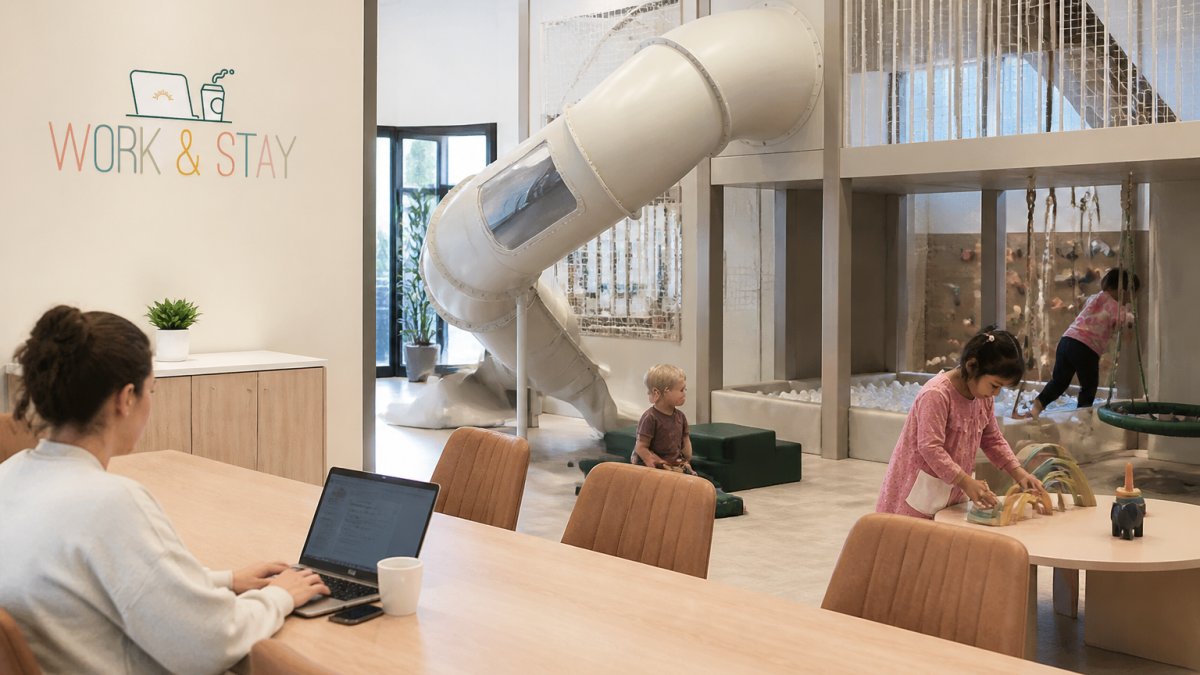
Work & Stay is built around exactly this concept. The workspace and the childcare are under one roof, so parents can be productive, focused, and close by simultaneously. The childcare side offers curriculum-based, teacher-led classroom time for children ages 0-6, not just supervised play. For parents whose children have separation anxiety, the proximity matters enormously: your child is steps away, not across town.
The model is available on memberships or day passes with no long-term contract, which solves the non-traditional hours problem directly. Parents who work irregular schedules, travel seasonally, or simply need flexible childcare without a full enrollment commitment have a workable option that traditional center-based care rarely offers.
The Child Care and Development Fund overview recognizes flexible childcare models as an important part of addressing workforce participation barriers for parents, particularly those with non-standard work schedules.
For children 18 months and under, the facility includes changing stations and staff trained to support the youngest guests, not just older children who can play independently. The space is designed with separate areas for different age groups, which supports appropriate developmental programming and supervision ratios.
Finding safe childcare is genuinely hard, and the stakes are high enough that it's worth doing methodically. Check licensing and inspection history before you visit. Ask direct questions on tour and expect direct answers. Plan ahead for waitlists, and think honestly about whether traditional enrollment hours actually fit your life. If you need a more flexible arrangement, Work & Stay offers supervised, curriculum-based childcare for children ages 0-6 alongside a proper workspace for parents, with memberships and day passes and no long-term commitment. Visit Work & Stay to see membership options and get started.
Frequently Asked Questions
What are the biggest red flags to look for in a daycare?
Watch for staff who seem inattentive, a facility that feels chaotic or poorly maintained, and providers who resist letting you tour unannounced. Other warning signs include a child-to-teacher ratio that exceeds your state's licensing requirements, expired caregiver certifications, no posted emergency preparedness plan, and vague answers about sanitation protocols or background checks. Any provider who discourages questions during the enrollment process deserves extra scrutiny.
How do I verify a childcare provider's licensing status?
Every state has a regulatory agency that maintains a public database of licensed childcare facilities. Search your state's child care licensing office website and enter the provider's name or address. You can confirm whether their license is current, view their accreditation status, and pull up recent inspection reports. For family daycare and in-home providers, the same state database applies. Always verify before your first visit, not after you've already paid a deposit.
How do I check a daycare's inspection history?
State regulatory agencies publish provider inspection history online, usually on the same portal where licensing records are held. Look for the date of the most recent inspection, any compliance violations cited, and whether those violations were corrected. A single minor citation that was resolved quickly is very different from repeated violations around supervision policies, immunization records, or sanitation. If a facility's inspection history is hard to locate, ask the director directly, a quality provider will hand it over without hesitation.
What questions should I ask during a childcare facility tour?
Ask about the child-to-teacher ratio and how it changes during nap or outdoor time. Request to see staff qualifications and caregiver certification documents. Ask how the facility handles illness, injury incidents, and emergency preparedness. Find out the curriculum philosophy and how developmental milestones are tracked. Ask specifically about supervision policies when children transition between spaces, and confirm that all staff have passed background checks. Getting these answers in person tells you as much as the answers themselves.
What should I do if my child has separation anxiety when starting daycare?
Start with shorter sessions so your child builds trust with caregivers gradually. Establish a consistent, brief goodbye routine rather than lingering or sneaking away, both of which increase anxiety. Ask the provider how they handle a child who is upset after drop-off, and request photo or text updates during your child's first few days. Many quality facilities offer a transition period where a parent can stay nearby. Separation anxiety is normal in children ages 0-3 and typically eases within a few weeks with consistent, warm caregiving.
What is the difference between licensed and unlicensed childcare?
Licensed childcare providers have met their state's minimum standards for health and safety, staff-to-child ratios, facility conditions, and caregiver certification. They submit to regular inspections by the state regulatory agency and must maintain compliance to keep their license. Unlicensed providers operate outside this oversight, which means no mandatory background checks, no required training, and no inspection history you can review. Some states allow unlicensed care under specific limits, but parents have far less visibility into what is actually happening in those settings.
This article was written using GrandRanker