 how-to
Work From Home Parent Support Groups: Find Your Community
Table of Contents
- Why Work From Home Parent Support Groups Matter
- How to Work From Home With Toddlers: The Reality
- Finding Local Support Groups for Remote-Working Parents
- Virtual Support Groups for Work-From-Home Parents
- Coworking Spaces With Childcare as a Support Solution
- Remote Work Productivity Tips for Parents
- Vetting Support Groups for Safety and Fit
- Overcoming Isolation and Building Real Community
- Frequently Asked Questions
Last Updated: September 1, 2026
Why Work From Home Parent Support Groups Matter
Remote work promised freedom. What it often delivers is isolation. Parents juggling work-from-home responsibilities face a unique challenge: the boundary between professional focus and parenting duties dissolves the moment the home office door closes. A child's cry interrupts a client call. A toddler's meltdown derails an important email. The mental load of managing both simultaneously creates a pressure that no amount of productivity hacks can solve.
This is where work from home parent support groups become essential. These communities, whether virtual or in-person, offer something remote work cannot provide on its own: connection with others navigating the exact same chaos. They're spaces where a parent can admit that working from home with young children is harder than it looks, where strategies are shared, and where the isolation that often accompanies remote work dissolves.
Support groups do more than provide sympathy. They offer practical solutions, mental health benefits, and a network of peers who understand the specific pressures of balancing career and family under one roof. For parents struggling with work-life balance, finding the right community can be the difference between burnout and sustainable productivity.
How to Work From Home With Toddlers: The Reality
Working from home with toddlers is not the same as working from home with older children. Toddlers demand constant supervision, frequent interruptions, and emotional regulation that doesn't pause for Zoom calls. The fantasy of productive work hours while children nap rarely survives contact with reality.
The real challenge isn't time management, it's attention management. A toddler's needs are unpredictable. One moment they're content with blocks; the next, they need food, a diaper change, or comfort. Parents trying to deliver quality work while meeting these demands experience constant task-switching, which research shows significantly reduces focus and productivity.
Many parents discover that the traditional work-from-home setup doesn't work when young children are home. Background noise becomes a professional liability. Interruptions break concentration at critical moments. The mental energy required to manage both roles simultaneously leaves little left for either one.
This is why many remote-working parents are rethinking their approach. Some invest in childcare support during work hours. Others adjust their work schedules to match their child's rhythm. Still others seek out coworking spaces with integrated childcare, environments designed specifically for parents who need both a professional workspace and supervised care for their children just steps away.

The key insight is this: working from home with toddlers requires structural support, not just willpower. Parents who acknowledge this need and seek solutions, whether through childcare, community support, or dedicated workspace, report better outcomes for both their work and their mental health.
Finding Local Support Groups for Remote-Working Parents
The first step toward building community is knowing where to look. Support groups for remote-working parents exist in multiple formats, each serving different needs.
In-Person Groups in Your Area
In-person groups offer the advantage of face-to-face connection and often include childcare or family-friendly meeting spaces. Many communities host parent meetup groups organized through platforms like Meetup.com, which allow you to filter by location and interests. Library systems frequently host parent support groups, often at no cost. Faith-based organizations, community centers, and pediatric offices often maintain bulletin boards listing local parent groups.
When searching locally, look for groups that specifically mention remote work, work-from-home parents, or flexible employment. General parenting groups may not address the unique challenges of managing work and childcare in the same physical space.
A practical tip: attend at least two meetings before deciding if a group is the right fit. The first visit can feel awkward; the second gives you a better sense of the group's culture and whether the members' challenges align with yours.
Niche-Specific Communities
Not all parent support needs are the same. Parents of children with developmental differences, single parents working remotely, or parents in specific career fields often benefit from communities tailored to their circumstances.
Niche-specific groups address issues that broader groups may not. A parent raising a neurodivergent child has different concerns than a parent managing typical development. A single parent working from home faces financial and logistical pressures that differ from dual-income households. A parent in tech, healthcare, or creative fields may find peer advice more relevant from others in the same industry.
Finding niche groups requires more targeted searching. Professional associations sometimes host parent networks. Online communities organized by condition, family structure, or career field often have local chapters. Specialized childcare providers or parenting coaches may maintain referral lists.
The advantage of niche communities is relevance. Advice from someone in your exact situation carries more weight than generic parenting guidance.
Virtual Support Groups for Work-From-Home Parents
Virtual support groups remove geographic barriers and time constraints, making them accessible to parents with inflexible schedules or those living in areas without local options.
Online groups operate through video conferencing, forums, or messaging apps. Some meet at scheduled times; others use asynchronous communication, allowing members to participate when their schedule permits. This flexibility is especially valuable for parents managing unpredictable childcare schedules.
Virtual communities excel at peer-to-peer advice. A parent struggling with boundary-setting between work and family can post at 11 PM when the kids are asleep and receive responses from others in similar situations. The written format also creates a searchable archive of solutions and strategies.
The trade-off is that virtual connection, while valuable, lacks the in-person presence that some parents need. A video call is not the same as sitting across from someone who understands your stress. However, for parents with limited local options or those who prefer asynchronous communication, virtual groups provide essential community.
Many remote-working parents use both formats: a virtual group for regular connection and occasional in-person meetups for deeper relationship-building.
Coworking Spaces With Childcare as a Support Solution
Beyond traditional support groups, a growing number of parents are discovering that the physical environment where they work significantly affects both their productivity and their mental health. Coworking spaces designed specifically for parents, with integrated childcare, offer a different kind of support: the structural support that allows parents to work effectively while knowing their children are safe and engaged nearby.
These hybrid spaces address the core problem that many work-from-home parents face: the inability to focus on professional work while managing young children at home. By separating the workspace from the childcare environment, parents can deliver quality work while remaining close enough to know their children are cared for.
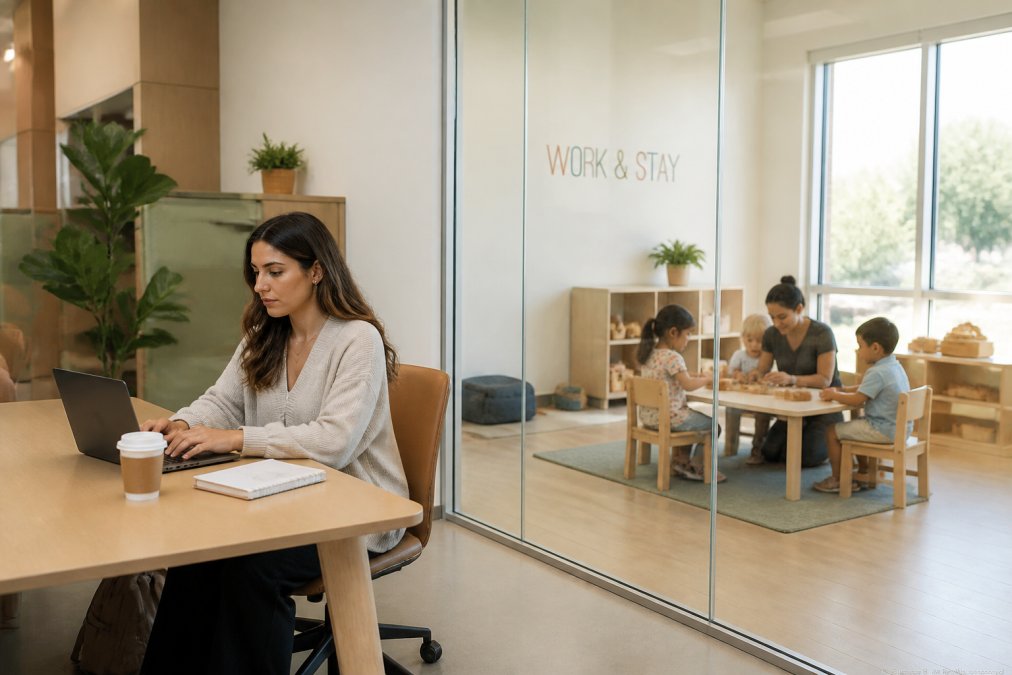
Work & Stay exemplifies this approach. It's a flexible coworking environment designed for parents, with curriculum-based childcare for ages 0-6 available on-site. Unlike traditional daycare, which operates on fixed schedules, or traditional coworking, which offers no childcare, this model combines both. Parents can work during the hours they need, with childcare available to match. There's no long-term contract, memberships and day passes offer flexibility for families whose schedules change.
The psychological benefit of this setup is significant. Parents working in the same building as their children experience less anxiety about their child's wellbeing and fewer guilt-driven interruptions to check in. They can focus on work knowing that their child is in a safe, engaging environment with trained staff. And when a child needs the parent, the response time is seconds, not hours.
SIGN UP FOR YOUR MEMBERSHIP TODAY →
For many remote-working parents, this model solves the isolation problem differently than traditional support groups. Instead of connecting with peers who understand the struggle, parents find themselves in an environment designed to eliminate the struggle in the first place.
Remote Work Productivity Tips for Parents
Even with support systems in place, remote work with young children requires intentional strategies for maintaining focus and meeting professional obligations.
Set boundaries with your schedule. Establish specific work hours and communicate them to your family. If possible, arrange childcare or structured activities during these hours. When your child knows that 9 AM to noon is "parent's work time," they're more likely to respect that boundary.
Create a dedicated workspace. A home office separated from living areas helps your brain shift into work mode. If space is limited, a corner with a door or partition signals to both you and your child that work is happening here.
Build in transition time. Many parents find that 10 minutes between childcare drop-off and work start, or between work end and family time, reduces the mental friction of switching roles. Use this time to shift your mindset, not to catch up on work.
Batch similar tasks. Group calls together, batch email responses, and schedule deep-focus work during your peak energy hours. This reduces the number of context switches your brain has to make.
Accept imperfection. A child will interrupt. A call will be derailed. A deadline will slip. Remote-working parents who build flexibility into their expectations experience less stress than those who demand flawless execution.
use peer support. This is where work from home parent support groups prove invaluable. When you hit a wall, when the guilt of not being fully present at work, or not being fully present with your child, becomes overwhelming, talking to someone in the same situation normalizes the struggle and often surfaces practical solutions you hadn't considered.
Vetting Support Groups for Safety and Fit
Not every support group is the right fit, and safety should always be a priority when joining any community, especially one involving children.
Before joining a group, research its structure and leadership. Who runs it? Do they have experience facilitating parent groups? Is there a clear code of conduct? Legitimate groups are transparent about their purpose, membership, and how they handle confidentiality.
For in-person groups, visit before committing. Observe the physical space, meet the organizers, and assess whether the group's focus aligns with your needs. Pay attention to how members interact, do they seem supportive and non-judgmental?
For online groups, check the platform's privacy settings. Where is your information stored? Who has access to conversations? Reputable groups use secure platforms and clearly communicate their data practices.
Red flags include pressure to recruit others, requests for money beyond nominal fees, leaders who discourage outside relationships or professional help, and groups where members share identifying information without clear consent.
A healthy support group should feel inclusive, non-judgmental, and focused on practical support. Members should feel free to leave without pressure. Leadership should be transparent about the group's purpose and operations.
Overcoming Isolation and Building Real Community
The deepest benefit of work from home parent support groups is their role in combating the isolation that remote work can create. Working from home is efficient. It's flexible. But it can also be lonely, especially for parents whose social interaction is limited to video calls and quick exchanges with children.
Isolation among remote workers is well-documented. The absence of casual office interactions, the lack of physical presence in a shared space, and the blurring of work and home life all contribute to feelings of disconnection. For parents, this isolation is compounded by the demands of childcare, which can limit opportunities for adult interaction.
Support groups create intentional space for community building. Whether through regular meetups, online forums, or hybrid models, they provide opportunities for parents to connect with peers, share experiences, and build relationships that extend beyond the immediate problem-solving.
The most effective communities are those where parents feel genuinely known. This happens over time, through repeated interaction, and through the willingness to be vulnerable about the real challenges of balancing work and parenting.
For many parents, the community aspect becomes as important as the practical advice. Knowing that others are struggling with the same guilt, the same time pressures, and the same conflicting demands normalizes the experience and reduces the shame that often accompanies the feeling of not doing either role well enough.
Building real community also means showing up consistently. Attend meetings regularly. Engage in conversations. Offer your own experience and advice. The groups that thrive are those where members actively contribute, not just consume support.
Finding the right support system as a remote-working parent requires intention and experimentation. Not every group will fit, and what works in one season of parenting may not work in another. The goal is to build a network, whether through traditional support groups, online communities, or physical spaces designed for parents, that sustains you through the specific challenges of managing work and family simultaneously. For many parents, that network includes access to structured childcare combined with professional workspace. Learn more about flexible childcare and coworking options designed for working parents by exploring Work & Stay, which combines both in a single environment tailored to families with young children.
Frequently Asked Questions
How do I find local support groups for remote-working parents?
Start by searching community centers, libraries, and parenting organizations in your area for parent support groups. Many communities host in-person meetups through social media groups or Meetup.com. Ask your pediatrician or local schools for referrals. Online platforms like Facebook groups and Reddit communities connect remote-working parents nationwide. When evaluating groups, check safety protocols, verify moderators' backgrounds, and read member reviews before joining.
What are the benefits of joining a parent support group while working remotely?
Support groups reduce isolation, a major challenge for remote-working parents. You gain peer-to-peer advice from others managing the same work-life balance struggles, emotional validation, and shared strategies for productivity. Members often exchange practical tips for managing childcare challenges, parental burnout, and scheduling flexibility. Regular connection with others in similar situations strengthens mental health and builds a reliable support network beyond your immediate family.
How can coworking spaces with childcare help reduce parental burnout?
Coworking spaces with childcare provide dedicated, distraction-reduced work environments while your children receive supervised care nearby. This eliminates the guilt of juggling responsibilities at home and creates physical separation between work and parenting roles. You gain uninterrupted focus time for professional tasks while children benefit from structured activities and social interaction. Many spaces offer community connection with other working parents, adding a support network element to your routine.
What strategies help parents manage productivity while working from home?
Establish clear boundaries between work and family time by designating a dedicated workspace and specific work hours. Use asynchronous communication tools to accommodate childcare interruptions. Break work into focused blocks between childcare tasks rather than attempting full 8-hour stretches. Build buffer time into deadlines and communicate your schedule to clients or managers. Consider flexible scheduling options, backup childcare for important meetings, and time-efficient participation in support groups to maintain both professional progress and parental presence.
This article was written using GrandRanker