 how-to
How to Find Productive Coworking Spaces: A Parent's Guide
Table of Contents
- Assess Your Work Style and Needs
- Evaluate Coworking Spaces With Childcare for Working Parents
- Test the Technical Environment: Internet Speed and Connectivity
- How to Stay Focused in a Shared Office Environment
- Understand Coworking Space Day Pass Benefits Before Committing
- Assess Community, Networking, and Workspace Amenities
- Make Your Final Decision: Trial Period and Lease Flexibility
- Frequently Asked Questions
Last Updated: August 30, 2026
Assess Your Work Style and Needs
Finding productive coworking spaces starts with understanding what you actually need from a workspace. Remote-working parents often juggle competing demands: focus time for deep work, flexibility for childcare interruptions, and ideally, a solution that combines both. 🎯
Before evaluating any coworking space, ask yourself: Do you need quiet time for calls and concentration? How many hours per week will you realistically work from a dedicated space? Do you work best in silence or with ambient activity? Are you looking for a membership or prefer day pass flexibility?
A bustling community hub might energize one parent but derail another's focus. A hot desk offers affordability but no consistency. A private office guarantees quiet but eliminates cost savings. Consider your industry too, client calls demand acoustic control; solo writing thrives in collaborative atmospheres.
Evaluate Coworking Spaces With Childcare for Working Parents
The biggest game-changer for working parents is finding a productive coworking space where you can actually focus because childcare is handled right there. 👨👩👧👦

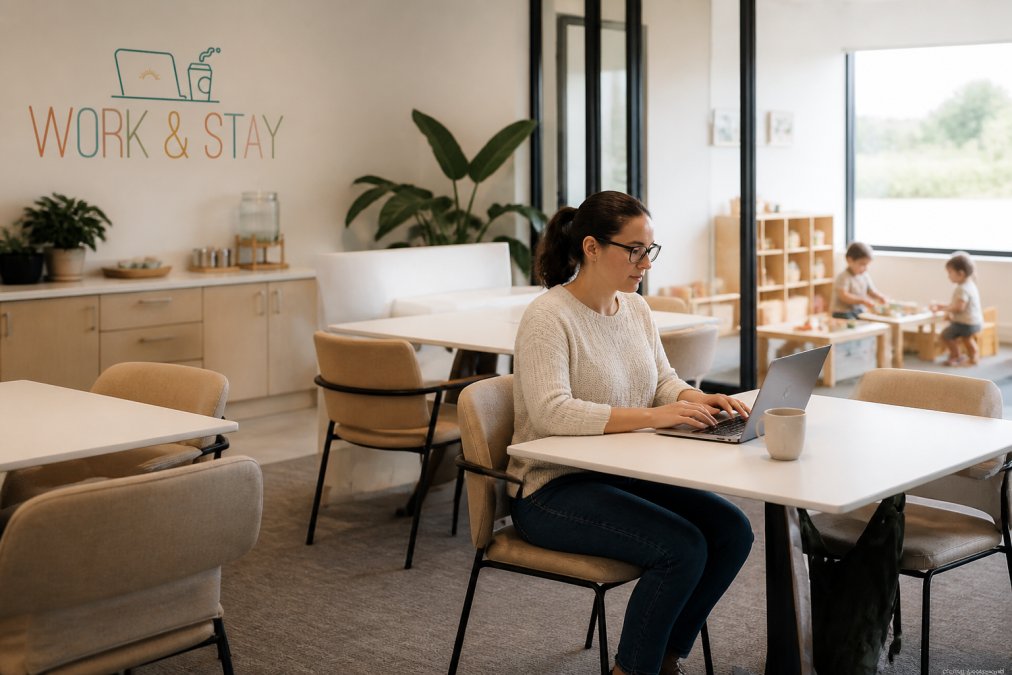
When evaluating coworking spaces with childcare, the setup matters enormously. Some facilities position childcare in a separate, supervised environment, meaning you can work without distraction while your children are safe and engaged just steps away. This hybrid approach lets you be nearby if needed but gives you genuine, uninterrupted work time.
Ask these specific questions during your tour:
- How are the childcare areas separated from work zones? Can you see into the play space, or is it completely isolated?
- What's the staff-to-child ratio? Curriculum-based childcare with teacher-led activities keeps kids engaged longer than simple supervised play.
- Are there changing stations and support for very young children? Confirm staff can handle diaper changes and feeding.
- What happens if your child gets sick or has separation anxiety? Understand protocols and whether parents can step in quickly if needed.
- How flexible is the schedule? Can you drop in for two hours, or do you need full-day commitments? Do they offer hourly childcare options?
Work & Stay combines coworking with supervised, curriculum-based childcare for ages 0-6 in a separate environment. This setup lets parents work from a quiet lounge or private workspace while children participate in teacher-led activities just steps away. It's specifically designed for this dual need, not a traditional daycare, but a childcare solution built into a workspace.
Test the Technical Environment: Internet Speed and Connectivity
You can have the perfect quiet space and reliable childcare, but if your internet cuts out during a client call, none of it matters. 🌐
Before committing to any productive coworking space, test the actual technical environment:
Run a speed test during your visit. Don't just ask the manager; bring your phone and laptop and run a real speed test. Download speeds below 50 Mbps will stall video calls. Upload speeds below 10 Mbps will make you appear frozen on camera.
Test from the exact spot where you'll work. WiFi signal strength varies wildly depending on location. Test from a private office, a hot desk, and the lounge if you'll use multiple areas.
Ask about backup internet. What happens if the primary connection fails? Do they have a secondary connection or mobile hotspot backup?
Clarify bandwidth sharing. In shared spaces, peak hours matter. If 50 people are video conferencing at 9 a.m., your connection slows. Ask whether the facility has dedicated bandwidth for video conferencing.
Check for VPN compatibility. Some corporate networks block certain traffic types. Confirm the facility's network allows your company's VPN if you need it.
A common mistake is assuming "high-speed internet" means the same thing everywhere. Test it yourself, not their word for it.
How to Stay Focused in a Shared Office Environment
Even the best productive coworking space has ambient activity. The question isn't whether distraction exists, it's how to manage it. 🎧
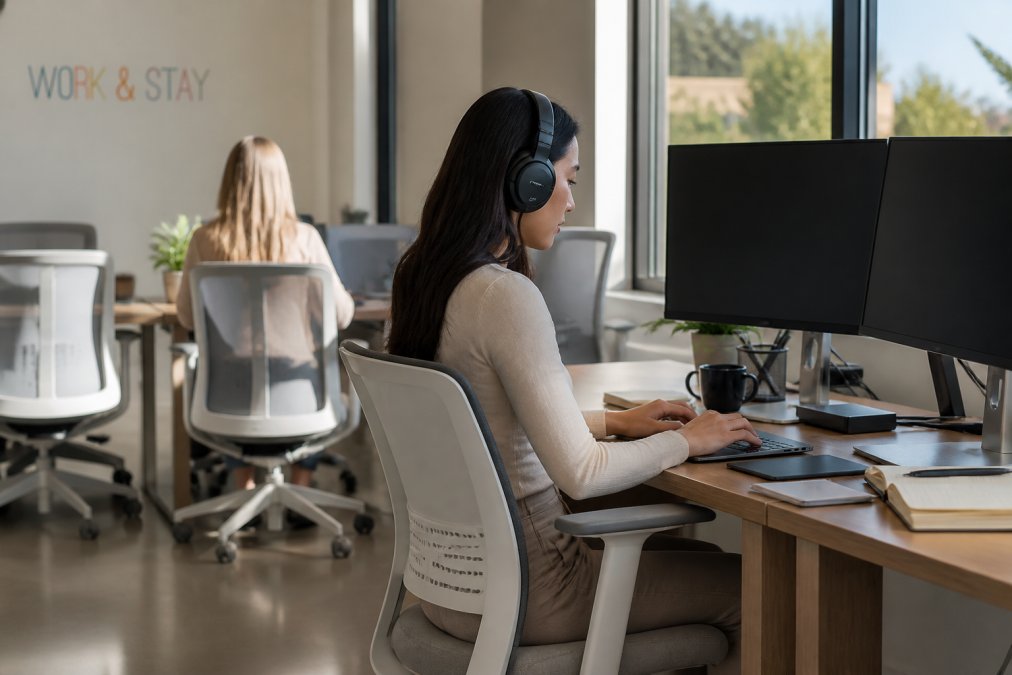
Acoustic management is underrated. Noise-canceling headphones aren't just for music; they're a focus tool. Even without sound playing, they signal to others that you're in deep work mode. Some facilities have dedicated "quiet zones" with sound-dampening walls. If focus is your priority, ask about these areas specifically.
Dedicated desk beats hot desk for focus. Hot desks are cheaper and flexible, but you never settle into a rhythm. A dedicated desk becomes your territory. Your brain knows: this desk means focus time.
Establish "do not disturb" protocols. Some coworking spaces have visual signals, a red card on your desk, a closed door, headphones on. Use them. Consistent signals reduce interruptions dramatically.
Schedule deep work during off-peak hours. If the space is busiest 9-11 a.m., work during those hours only if you need community energy. If you need silence, come early or stay late.
Separate work zones from social zones. The best productive coworking spaces have this built in: a lounge for casual collaboration, a quiet area for focused work, meeting rooms for calls. Know which zone you need each day.
Your ability to focus depends partly on whether others around you are also focused. If everyone is visibly working, focus becomes contagious.
Understand Coworking Space Day Pass Benefits Before Committing
Not every working parent needs a membership. Day passes let you test whether a productive coworking space actually fits your life before you commit. 💳
SIGN UP FOR YOUR MEMBERSHIP TODAY →
What day passes give you: Access to the facility for a single day (usually 8-10 hours), use of shared amenities, WiFi, and often a dedicated or hot desk. Some facilities include coffee, printing, and lounge access.
Why test with day passes first: A membership sounds good in theory. In practice, you might find the commute eats your productivity gains, or the space doesn't match your focus style, or your childcare needs change. A few day passes cost far less than three months of unused membership fees.
Frequency matters. If you plan to work from a coworking space only once or twice per month, day passes make sense. If you're there four days per week, a membership usually offers better value. Calculate your actual usage before committing.
Flexibility is the real benefit. Life with young children is unpredictable. A membership locks you in; day passes let you work from home when your kid is sick, take a week off when schedules shift, or pause when you're overwhelmed. For many parents, that flexibility is worth more than cost savings.
Trial periods matter too. Some facilities offer a free day or discounted first week. Use this. Spend a full day there, including during the times you'd normally work. Bring your laptop, do real work, test the WiFi, observe the noise level. A single trial day tells you more than any tour.
Work & Stay offers both memberships and day passes with no long-term contract, letting parents choose what fits their actual schedule.
Assess Community, Networking, and Workspace Amenities
Productive coworking spaces aren't just desks and WiFi. The community and amenities shape whether you actually want to show up. 🤝
Community and networking opportunities vary wildly. Some spaces host regular events, coffee hours, skill-shares, workshops. Others are purely transactional: you rent a desk, you work, you leave. Neither is wrong, but they're different experiences.
If you're an extrovert or building a business that needs connections, community matters. If you're an introvert who just needs focus, events might feel like an obligation. Be honest about what energizes you versus what drains you.
Workspace amenities are the details that make daily work tolerable:
- Meeting rooms: Are they bookable in advance? Can you book one for a 30-minute call?
- Phone booths: If you take confidential calls, a private booth is essential.
- Printing and supplies: Does the facility provide these, or do you bring your own?
- Kitchen and beverages: Coffee, tea, water, these matter for eight-hour days.
- Parking: Is it free, paid, or validated? If you're driving in daily with a young child, logistics matter.
- Lounge space: A comfortable place to take a break, eat lunch, or decompress between focus blocks.
The best productive coworking spaces reduce friction so you're not thinking about where to print or whether you can take a call, you're just working.
Make Your Final Decision: Trial Period and Lease Flexibility
After evaluating multiple spaces, you're ready to decide. But before you commit, understand the terms. 📋
Trial periods are your friend. Most facilities offer a one-week or one-month trial at a reduced rate. Use it. One week of real work in the space tells you far more than any tour. You'll discover whether the commute is feasible, whether you can focus, whether childcare integration works, and whether the community fits.
Lease flexibility matters for parents. Your needs change. Your child starts school. You get a new job with different hours. A facility that locks you into a 12-month contract is riskier than one offering month-to-month flexibility or the option to pause your membership.
Ask explicitly:
- Can you pause your membership if life changes?
- What's the cancellation policy if you need to leave?
- Can you downgrade (e.g., from five days to two days per week)?
- Do they offer flexibility between day passes and memberships?
The best productive coworking spaces for working parents understand that flexibility is a feature, not a cost.
Make a final checklist before signing:
| Factor | Your Priority | Space A | Space B | Space C |
|---|---|---|---|---|
| Childcare integration | High/Med/Low | Yes/No | Yes/No | Yes/No |
| Internet speed tested | High/Med/Low | ✓ | ✓ | ✓ |
| Quiet focus zones | High/Med/Low | Yes/No | Yes/No | Yes/No |
| Day pass option | High/Med/Low | Yes/No | Yes/No | Yes/No |
| Lease flexibility | High/Med/Low | Yes/No | Yes/No | Yes/No |
| Commute time | High/Med/Low | ___ min | ___ min | ___ min |
| Community vibe | High/Med/Low | Strong/Weak | Strong/Weak | Strong/Weak |
Weight each factor by your actual priorities, not what you think should matter. If commute time will make you skip days, it's a dealbreaker. If you don't care about networking, don't let a vibrant community sway you.
Finding productive coworking spaces as a working parent requires balancing focus, flexibility, and childcare. The right space doesn't just give you a desk, it gives you permission to work without guilt because your children are safe and engaged nearby. Work & Stay combines both, offering flexible coworking with supervised, curriculum-based childcare for ages 0-6 in a separate environment. Whether you're testing with day passes or committing to a membership, prioritize spaces with reliable internet, acoustic separation, and genuine flexibility. Learn more about Work & Stay memberships and day passes to see if this model fits your family's needs.
Frequently Asked Questions
What should I look for in a productive coworking space trial day?
During a trial visit, test the internet speed by running a video call and uploading files. Observe the ambient noise level at different times of day. Check whether the workspace has dedicated quiet zones or focus areas. Evaluate the ergonomic furniture and lighting. If you're a parent, ask about how childcare is supervised and whether you can observe the environment. Most productive coworking spaces offer day passes so you can experience the actual work environment before committing to a membership.
How can coworking spaces with childcare help parents balance remote work and childcare?
Coworking spaces with childcare combine supervised, curriculum-based activities for children in a separate environment with dedicated workspace for parents. This eliminates the constant interruptions of working from home while keeping your child nearby in a safe, climate-controlled setting. You can focus on deep work during scheduled childcare hours, then transition to parenting time without a commute. This model works especially well for parents who need quiet for calls and emails but want flexibility without long-term daycare contracts.
What makes a quiet environment so important for coworking productivity?
Ambient noise directly impacts focus and cognitive performance. Constant background noise forces your brain to work harder to concentrate, leading to faster mental fatigue and lower output quality. When evaluating coworking spaces, listen for HVAC hum, neighboring conversations, and foot traffic. Ask whether the space has acoustic panels, white noise systems, or designated quiet zones. If you work on client calls or detailed analysis, acoustic environment assessment should be a top priority in your selection process.
Is a coworking space day pass worth trying before getting a membership?
Yes. Day passes let you test the actual work environment, internet reliability, community fit, and commute-to-productivity ratio without financial commitment. You'll experience peak and off-peak hours, observe the member base, and assess whether the amenities and atmosphere match your work style. Many productive coworking spaces offer flexible day pass options, making it easy to visit multiple times before deciding on membership terms. This trial approach eliminates the risk of signing a long-term lease that doesn't fit your needs.
This article was written using GrandRanker