 how-to
How to Manage Toddler Separation Anxiety
Table of Contents
- Understanding Toddler Separation Anxiety and When It Starts
- Separation Anxiety in Toddlers: Timeline and Developmental Milestones
- Creating Goodbye Rituals and Consistent Routines
- How to Handle Drop-Off Anxiety at Daycare or Preschool
- Separation Anxiety Scripts for Parents: What to Say and How to Say It
- Activities to Build Toddler Independence and Confidence
- When to Seek Professional Help
- Frequently Asked Questions
Last Updated: August 26, 2026
Understanding Toddler Separation Anxiety and When It Starts
Toddler separation anxiety is a developmentally normal fear that emerges when young children realize their parents can leave them, and that separation feels genuinely threatening. It peaks between 12-24 months but can intensify again around ages 3-4 when children develop stronger awareness of time and absence (peer-reviewed research).
This isn't a behavioral problem or a sign of poor parenting, it's a milestone. Children who show separation anxiety typically have secure attachment relationships with their caregivers, which is actually a strength (apa.org). The challenge is managing the anxiety without avoiding the separations that help children grow.
Separation anxiety becomes problematic when it prevents normal daily activities, when drop-offs become daily meltdowns, or when parents feel unable to step away for any reason. This guide covers practical, research-backed strategies to help toddlers and parents navigate this phase with confidence.
At Work & Stay, we work with parents managing separation anxiety daily while building careers. The strategies covered here reflect what actually works in real-world situations. 🎯
Separation Anxiety in Toddlers: Timeline and Developmental Milestones
Separation anxiety emerges in predictable stages tied to cognitive development. Understanding the timeline helps parents recognize what's normal.
Ages 6-8 months: Babies begin recognizing that their parent is a separate person. They may fuss when parents leave but calm quickly with a different caregiver.
Ages 9-18 months: Anxiety intensifies noticeably. Toddlers understand that parents can leave and that they don't like it. They cling and cry at drop-off. This is peak separation anxiety for many children.
Ages 18-36 months: Language develops, and toddlers begin understanding time concepts like "mommy comes back after snack time." Anxiety often decreases with consistent routines, though it can resurface during transitions.
Ages 3-4 years: A secondary wave sometimes emerges as children develop imagination and can worry about things that might happen. Bedtime separation anxiety is common at this age.
Ages 4-6 years: Most children have developed secure understanding that parents return. However, major life changes, starting kindergarten, or family stress can reignite anxiety.
The timeline varies significantly. Neurodivergent children, highly sensitive children, and those with anxious temperaments may experience longer or more intense phases. Consistency and predictability matter more than the specific age milestone. 💙
Creating Goodbye Rituals and Consistent Routines
A goodbye ritual is one of the most powerful tools for managing toddler separation anxiety because it creates predictability. Children's brains calm when they know exactly what's coming.
The structure of an effective goodbye ritual:
A goodbye ritual should be SHORT, SPECIFIC, and REPEATED identically every single time. This consistency is what makes it work.
Examples of simple goodbye rituals:
- Three kisses (one on each cheek, one on the forehead)
- A special handshake or hand wave
- A phrase repeated word-for-word ("Mommy comes back after snack time")
- A song or sound effect
- A physical object exchange (trading a stuffed animal)
Why ritual works: When toddlers know exactly what happens next, their nervous system doesn't need to panic. Repetition creates safety.
The critical rule: Once you establish a goodbye ritual, use it consistently every single time. If you sometimes sneak away without saying goodbye, you've broken the predictability. Children learn they can't trust the routine, and anxiety increases.
What NOT to do:
- Extended goodbyes that drag out the separation
- Promising things you can't guarantee
- Returning during the ritual if your child cries
- Changing the ritual frequently
Pairing routine with environment: The physical space matters too. If drop-offs happen in a bright, engaging environment where activities immediately capture attention, anxiety decreases faster. Work & Stay's play-based environment helps with this transition, children see familiar toys and caregivers they recognize, which signals safety. The goodbye ritual plus engaging environment combination is more powerful than either alone.
Consistency also extends to timing. Dropping off at the same time each day, using the same entrance, and seeing the same caregiver when possible build the secure base that helps toddlers tolerate separation. 🔄
How to Handle Drop-Off Anxiety at Daycare or Preschool
Drop-off time triggers the most visible separation anxiety for many parents. Your toddler clings, cries, or refuses to let go. Here's what actually helps.
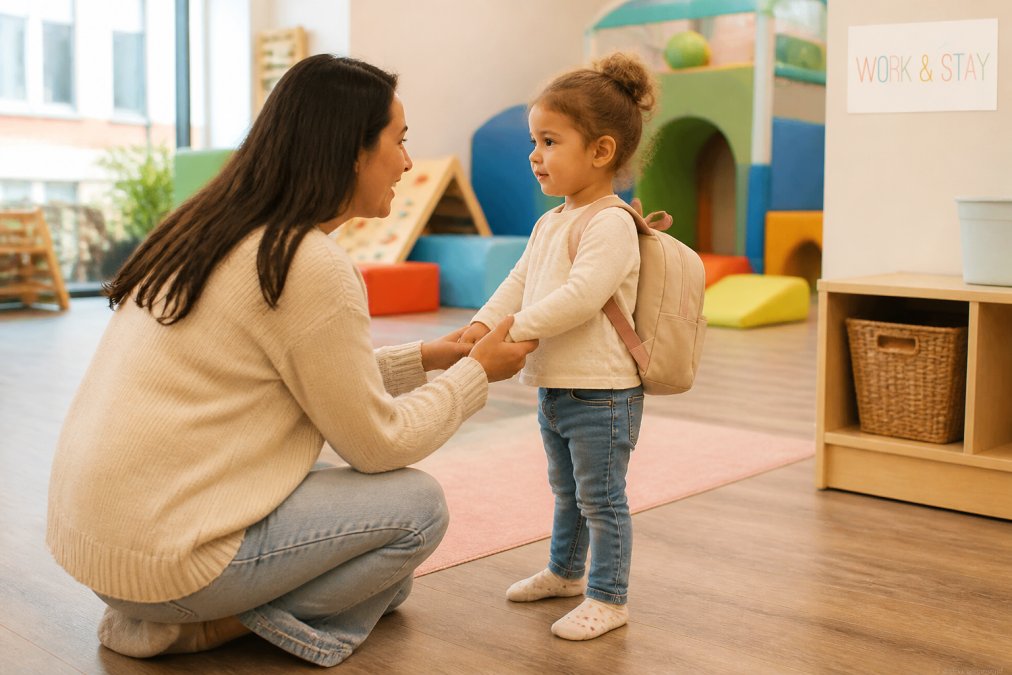
The science of the drop-off: When toddlers cry at separation, their nervous system is genuinely activated. Your job isn't to prevent the tears; it's to create conditions where their nervous system can regulate and calm.
Step 1: Arrive early and transition slowly. Arriving 10-15 minutes early gives your toddler time to notice the environment, see familiar caregivers, and begin playing before you leave.
Step 2: Use your goodbye ritual. Keep it SHORT, 30-60 seconds maximum. Longer goodbyes don't reduce anxiety; they extend it.
Step 3: Leave while your child is engaged, not while they're watching you. If you wait until your toddler is calm and looking at you, they'll restart crying when you actually leave. Time your exit for when they're distracted by a toy or activity.
Step 4: Follow through on your promise. If your ritual includes "I come back after snack time," actually return around snack time. Consistency builds trust.
Step 5: Don't return during drop-off time. If your child is crying and you come back to comfort them, you've accidentally taught them that crying brings you back. Trust the caregiver to soothe your child.
What happens after you leave: Most toddlers cry for 5-15 minutes after parents leave, then calm and engage in activities (peer-reviewed research). This is normal. Caregivers validate feelings without trying to convince children that separation is fine.
If drop-off anxiety persists for weeks: Some children need extra support. Shorter initial separations (30 minutes instead of 8 hours) can help build confidence. Gradual increases in separation length allow the nervous system to adjust. If your child is in a new environment, ask the caregiver to send photos or videos during the day.
The role of the caregiver environment: The quality of the drop-off space matters significantly. A calm, organized, engaging space with familiar caregivers and low child-to-staff ratios decreases toddler anxiety. This is why the environment at Play & Stay is designed specifically for this transition, with separate, bright spaces and curriculum-based activities that capture attention immediately. 👋
Separation Anxiety Scripts for Parents: What to Say and How to Say It
What you say during separation shapes how your toddler experiences it. Your tone, calm, matter-of-fact, confident, matters more than the exact words. Your child reads your emotional state.
Script 1: The Simple Goodbye "I'm going to work now. You're going to stay here and play. I come back after snack time. I love you."
Why this works: It's clear, specific, and includes a concrete time marker.
Script 2: Validating Feelings "I see you're feeling sad about me leaving. That's okay. Your body is feeling big feelings. I'm coming back. You're safe here."
SIGN UP FOR YOUR MEMBERSHIP TODAY →
Why this works: It names the emotion without trying to fix it. Children need you to acknowledge what they're feeling.
Script 3: Building Confidence "You stayed here yesterday and played with blocks. You're so good at playing with [caregiver name]. I'll be back after snack."
Why this works: It references past success and names the caregiver, building trust in that relationship.
Script 4: For Bedtime Separation "It's time for sleep now. Your body needs rest. I'm in the next room. If you need me, I'm here."
Why this works: It explains the separation as temporary and reassures that you're accessible if genuinely needed.
What NOT to say:
- "Don't cry" or "Be brave" (invalidates feelings)
- "I'll be back in 5 minutes" (if it's not true)
- "You're fine without me" (contradicts what your child is experiencing)
- "Stop being a baby" (shaming language increases anxiety)
- "If you're good, I'll come back early" (implies love is conditional) managing childhood nerves.
Tone matters most: Speak in a calm, warm, matter-of-fact voice. Not cheerful (which feels fake). Not anxious (which signals something scary is happening). Confident and kind, like you're stating a simple fact that's been true a hundred times before.
Practice the script beforehand: Knowing what you'll say reduces your own anxiety, which your child will sense. 🗣️
Activities to Build Toddler Independence and Confidence
The deeper issue underlying separation anxiety is often low confidence in independence. Toddlers who believe they can handle challenges tolerate separation more easily.
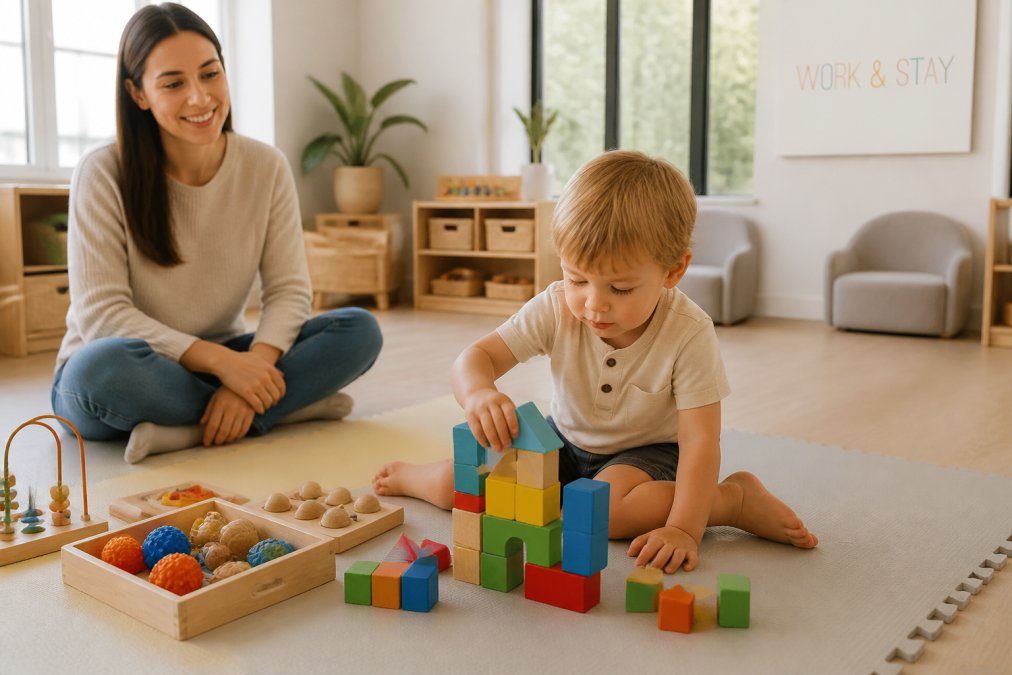
Independence-building activities are different from typical play. The goal is to create situations where your toddler solves small problems, makes choices, and experiences success without your immediate help.
Sensory play with minimal guidance: Set up bins with safe sensory materials, dried pasta, kinetic sand, water with cups and funnels. Let your toddler explore without instruction. Don't narrate or correct technique. Just watch. This builds confidence in their ability to figure things out.
Choice-based activities: Instead of "Let's build a tower," ask "Do you want blocks or balls?" Giving choices builds a sense of agency. Children who feel they have some control experience less anxiety.
Problem-solving without rescue: When your toddler can't fit a block in a shape-sorter, resist the urge to do it for them. Instead: "That one doesn't fit. What could you try?" Let them experiment. The struggle is where confidence builds.
Parallel play in group settings: Playing alongside other children builds comfort in group environments. Play & Stay's open play environment becomes valuable here, children see other toddlers playing, notice that separation is normal and manageable, and develop peer awareness.
Practicing short, planned separations: Intentionally leave your toddler with a trusted caregiver for short periods (15-30 minutes) in low-stakes situations. Brief, predictable separations build the neural pathways that support longer ones.
Emotional regulation activities: Simple practices help toddlers recognize and calm their own nervous systems:
- "Smell the flower, blow out the candle" (deep breathing with a visual)
- Tense and relax muscle groups ("Make your arms tight like a robot, then loose like spaghetti")
- Naming emotions in picture books
These tools give toddlers language and strategies for managing big feelings when you're not present.
Nighttime independence building: Bedtime separation anxiety responds to similar strategies. Gradually increasing distance (starting with you in the room, then near the door, then outside the room) allows nervous systems to adjust. Transitional objects like a stuffed animal or blanket with your scent provide comfort during nighttime separations.
Regular practice with these activities builds confidence faster than occasional attempts. 💪
When to Seek Professional Help
Most toddler separation anxiety resolves with consistent routines, predictable caregiving, and time. However, some children need additional support.
Consider consulting a child psychologist or developmental pediatrician if:
Anxiety is severe and persistent: Your toddler has intense, uncontrollable crying or panic responses that don't decrease after 20-30 minutes, lasting more than 2-3 months despite consistent routines.
Anxiety is expanding: Separation anxiety that began at daycare drop-off is now affecting bedtime, car rides, and other routine separations.
Your child shows signs of anxiety disorder: Excessive worry about harm, physical symptoms (stomachaches, headaches) before separations, or avoidance behaviors that limit their life.
There's been a recent trauma or major change: A new sibling, parental separation, moving homes, or loss can trigger or intensify separation anxiety beyond what typical routines can address.
Your child is neurodivergent: Children with autism, ADHD, or sensory processing differences may experience separation anxiety differently and need tailored strategies.
You're struggling emotionally: If your own anxiety about separation is preventing you from following through on routines, a therapist can help. Your emotional regulation directly impacts your child's ability to regulate.
Professional support isn't a sign of failure, it's a sign of taking this seriously. A skilled professional can assess whether anxiety is developmental or clinical and teach specific techniques tailored to your child's temperament. 🤝
Managing toddler separation anxiety requires patience, consistency, and trust in your child's capability to grow. The routines, scripts, and activities covered here work because they create predictability and build confidence.
Work & Stay's environment is designed specifically to support this transition. With curriculum-based activities led by trained caregivers, separate age-appropriate spaces, and consistent routines, children develop the independence and confidence that make separation anxiety manageable. Learn about flexible memberships and day passes at Work & Stay to see how a supportive environment can make this phase easier for your family.
Frequently Asked Questions
Is it normal for a toddler to have separation anxiety?
Yes, separation anxiety is a normal part of toddler development. It typically emerges around 6-8 months and peaks between 12-24 months as children develop object permanence and understand that people exist even when out of sight. Most toddlers experience some degree of separation anxiety, and it's a sign of healthy attachment. The intensity and duration vary by child, but with consistent, patient responses, most toddlers learn to manage it by age 3-4.
What are the best ways to practice short, planned separations with a toddler?
Start with very brief separations in a safe, familiar environment. Leave your toddler with a trusted caregiver for just 5-10 minutes while you step into another room. Gradually increase the duration as your child becomes comfortable. Use a consistent goodbye ritual every time, and always return when promised. Predictability and consistency are key to building your child's confidence that you will come back. Practice these short separations regularly, not just before major transitions like starting preschool.
How long does toddler separation anxiety typically last?
Separation anxiety typically peaks between 12-24 months and gradually improves as toddlers develop independence and emotional regulation skills. Most children show significant improvement by age 3-4, though some may experience brief flare-ups during stressful transitions like starting school or welcoming a new sibling. The timeline varies widely depending on temperament, attachment style, and how consistently caregivers respond. Patience and predictable routines help shorten the duration and reduce intensity.
Can activities help reduce toddler separation anxiety?
Yes, structured activities and play are powerful tools for building independence and emotional regulation. Sensory activities, guided music and movement, and supervised open play help toddlers develop confidence in their own abilities. When children experience success in a safe, supervised environment like an indoor play space, they build a sense of security and competence that transfers to separation situations. Consistent exposure to positive peer interactions also strengthens their sense of belonging and reduces anxiety.
This article was written using GrandRanker