 ultimate-guide
Childcare Franchise Guide: Costs, Models & Steps for 2026
Table of Contents
- What the Childcare Franchise Landscape Looks Like in 2026
- The Childcare Business Model: Traditional Daycare vs. Hybrid Concepts
- Investment Costs and Financial Requirements for a Childcare Franchise
- Licensing, Safety Standards, and Regulatory Compliance
- How to Open a Childcare Franchise: Steps and Support Systems
- Exit Strategy and Long-Term Value in Childcare Franchising
- Conclusion
- Frequently Asked Questions
Last Updated: September 11, 2026
What the Childcare Franchise Landscape Looks Like in 2026
The childcare franchise sector has shifted dramatically in the past five years. Remote work reshaped where families live and how they schedule their days, and that shift created demand for childcare that traditional daycare centers were never built to serve. This guide examines what a childcare franchise actually costs, how the models differ, and what it takes to open one in 2026.
Traditional daycare franchises still dominate the market by location count. They rely on full-day enrollment, waitlists, and monthly tuition. That model works, but it requires large facilities, deep staffing benches, and a tolerance for thin margins during the ramp-up period.
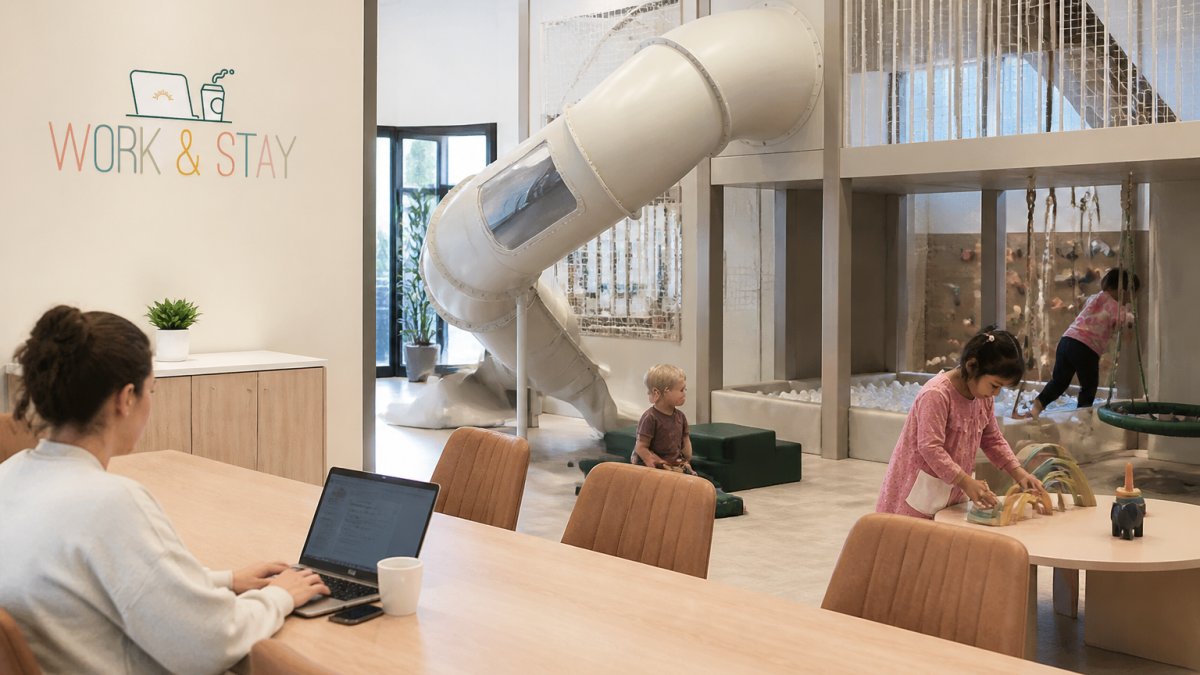
Hybrid concepts have entered the picture with a different structure entirely. The most interesting of these combines a coworking space with childcare under one roof, so a parent can work on site while their child attends a supervised, curriculum-based classroom steps away.
That hybrid structure is the concept Play & Stay is licensing through its Founding Partner program, and it is worth understanding why it exists.
The Childcare Business Model: Traditional Daycare vs. Hybrid Concepts
A childcare business model is the combination of services, pricing structure, staffing plan, and facility design that determines how a location earns revenue and covers its costs. The model matters more than the brand name on the door.
Traditional daycare centers generally run on one engine: tuition. Parents pay weekly or monthly for a full-day slot, and the center's revenue rises and falls with enrollment. Empty slots are pure loss, which is why operators obsess over enrollment management and waitlist depth.
How Revenue Streams Differ Between Models
Traditional centers generate revenue from full-time and part-time tuition, plus occasional add-ons like early pickup or summer programs. use is everything. A classroom licensed for twelve children running at eight is a classroom losing money.
Hybrid concepts stack multiple revenue streams in the same square footage:
- Workspace memberships and day passes for parents
- Supervised childcare or classroom time billed alongside workspace access
- Drop-in play sessions for families who are not members
- Private party room rentals on weekends
- Guided programming such as arts, music, and dance sessions
That stacking is the core advantage. A single facility serves two paying audiences at once, and the slower weekday mid-morning hours that hurt a pure play space can be filled by parents who need a desk and a quiet room.
Why the Coworking Space with Childcare Model Is Gaining Ground
The coworking space with childcare model works because it solves two problems with one lease. Parents who work remotely still need focus time, and they need somewhere safe and engaging for a young child during that time. Splitting those needs across a babysitter plus a coffee shop plus a play space costs more and delivers less.
There is a real operational difference here that most people miss. A hybrid location is not a daycare with desks bolted on, and it is not a play space with a laptop corner. The childcare side runs on curriculum and staff-to-child ratios, while the workspace side runs on membership retention and quiet. Getting both right in one building is the hard part, and it is the part a franchise system is supposed to solve for you.
Investment Costs and Financial Requirements for a Childcare Franchise
Childcare franchise investment varies widely by model, facility size, and market. A Franchise Disclosure Document, or FDD, is the legal document a franchisor must provide to prospective buyers, and it contains the actual investment ranges, fee schedules, and financial performance representations for that system. The FDD is where every serious cost question gets answered.
Typical cost categories that appear in a childcare franchise FDD include:
| Cost Category | What It Covers | When It's Paid |
|---|---|---|
| Initial franchise fee | Right to use the brand and territory | On signing |
| Real estate and build-out | Leasehold improvements, play surfaces, safety fixtures | Pre-opening |
| Furniture and equipment | Workspace desks, classroom furniture, toys, storage | Pre-opening |
| Licensing and permits | State and local childcare licensing, inspections | Pre-opening |
| Initial training | Franchisee and key staff training program | Pre-opening |
| Grand opening marketing | Local launch campaign and signage | Pre-opening |
| Royalty fee | Ongoing percentage of gross revenue | Monthly |
| Brand fund contribution | System-wide marketing pool | Monthly |
The Federal Trade Commission's Franchise Rule guidance explains what franchisors must disclose and what buyers are entitled to review before signing anything. Read it before taking a sales call.
Two numbers drive whether a lender or franchisor will approve a candidate: net worth requirement and liquid capital. Net worth is total assets minus liabilities. Liquid capital is the cash and near-cash you can access quickly. Most systems set a liquid capital floor because the first several months of a new location consume cash before enrollment stabilizes.
Financing Options and SBA Loan Guidance
The Small Business Administration's 7(a) loan program is the most common path for franchise financing, and many franchisors maintain a relationship with SBA-approved lenders. A 7(a) loan can cover startup costs, equipment, and working capital, and it typically requires a personal guarantee and a down payment.
The SBA maintains a directory of SBA-backed franchise lending resources that explains eligibility, documentation, and the lender match process. The practical advice: get your personal financial statement, tax returns, and business plan assembled before you talk to a lender. Applications stall on paperwork, not on credit.
Beyond SBA lending, buyers commonly use home equity lines, retirement account rollovers through a recognized structure, and equipment financing for the furniture and playground build-out. Each has different collateral and repayment implications, so run the numbers with an accountant who has closed franchise deals before.
Licensing, Safety Standards, and Regulatory Compliance
Childcare licensing is handled at the state level, and requirements differ enough between states that a location in one market may need a different facility layout than the same brand in another. Licensing requirements typically cover staff-to-child ratios, background checks, health and safety inspections, facility square footage per child, and staff training hours.
Child safety standards go beyond the licensing checklist. Operators need documented incident protocols, secure check-in and check-out procedures, allergy and medication policies, and liability insurance sized to the number of children on site. Accreditation through a recognized early childhood education body is optional for many centers but signals quality to parents and can support higher enrollment.
SIGN UP FOR YOUR MEMBERSHIP TODAY →
Compliance is not a one-time event. State agencies conduct renewal inspections, and staffing ratios must hold every hour the doors are open. A franchise system's operational support usually includes compliance templates, inspection prep, and updates when regulations change.
For hybrid concepts, the regulatory picture adds a layer. The childcare side is licensed and inspected as childcare. The workspace side is a commercial occupancy. Both have to satisfy their own code requirements in the same building, and site selection has to account for zoning that permits both uses.
How to Open a Childcare Franchise: Steps and Support Systems
Opening a childcare franchise follows a sequence that most systems formalize into a discovery process, a signed agreement, a build-out phase, and a launch. Skipping steps in that sequence is the most common way buyers lose money.

Here is the sequence in the order it should happen:
- Self-assessment. Confirm your liquid capital, net worth, and tolerance for a ramp-up period before you look at any brand.
- Franchise research. Request the FDD, read Items 5 through 7 carefully, and talk to existing franchisees listed in Item 20.
- Discovery day. Visit the concept in operation. Watch how staff handle transitions, pickup, and a busy classroom.
- Territory review. Confirm the territory definition, population thresholds, and any protected radius in the franchise agreement.
- Financing. Get a written commitment before signing.
- Site selection. Work with the franchisor's real estate criteria on zoning, parking, and visibility.
- Build-out and licensing. Complete construction, then pass state licensing inspections.
- Franchisee training. Complete the training program, then hire and train local staff.
- Grand opening. Run the launch marketing plan and open enrollment.
Operational support varies by system but usually includes site selection assistance, build-out specifications, franchisee training, curriculum development, enrollment management systems, and ongoing coaching. The quality of that support is the single biggest differentiator between franchisors, and it is the thing to interrogate hardest during discovery.
Technology Integration for Modern Childcare Operations
Technology integration is where newer concepts have a real edge over legacy systems. Modern childcare operations run on a parent app for check-in and daily updates, a billing platform that handles recurring tuition and drop-in charges, classroom tablets for curriculum tracking, and a workspace booking system if the model includes coworking.
The operational efficiency gain is not marketing fluff. Automated billing reduces late payments, digital check-in creates a verifiable attendance record for licensing, and parent communication tools cut the phone calls that eat a director's morning. When evaluating a franchisor, ask what software is included, what it costs monthly, and whether the system integrates or requires manual re-entry.
Exit Strategy and Long-Term Value in Childcare Franchising
Exit strategy is the topic almost no franchise buyer thinks about on day one, and it is the one that determines whether the business builds wealth or just pays a salary. A childcare franchise with stable enrollment, documented systems, and a trained director can be sold as an operating business. A location that depends entirely on the owner being present every day sells at a discount, if it sells at all.
Business scalability and resale value come from the same source: systems that run without the owner in the building. Documented curriculum, trained staff, clean financials, and a membership base with low churn all raise the multiple a buyer will pay. Real estate development matters too, since a favorable long-term lease with renewal options is an asset that transfers with the sale.
The post-pandemic operational shift plays into this. Parents now expect flexible scheduling, digital communication, and hybrid options that did not exist in 2019. Concepts built around that expectation have a stronger retention story to tell a future buyer than a center still running on paper sign-in sheets.
Conclusion
Building a childcare franchise from scratch means navigating licensing, financing, site selection, and staffing decisions that most first-time owners have never made before. A proven concept with a real support system shortens that learning curve considerably.
Play & Stay is licensing its combined coworking and supervised childcare concept to a limited number of Founding Partners in new markets. The model pairs a coworking lounge and private workspaces with curriculum-based, teacher-led classroom time for children ages 0-6, plus a separate indoor play space with guided arts, music, and dance programming and private party room rentals. Founding Partners get access to the operating playbook behind both sides of the business.
Qualified operators can learn more about the Founding Partner opportunity and apply at Play & Stay Founding Partner program.
Frequently Asked Questions
How much does it cost to franchise a daycare?
Costs vary widely by brand and model, and there is no single industry figure that applies to every opportunity. Typical expenses include an initial franchise fee, build-out and equipment, licensing costs, and working capital. The best way to get accurate numbers is to review the Franchise Disclosure Document (FDD) from any brand you are considering. It lists all required fees and estimated initial investment ranges. Play & Stay provides detailed investment information directly to qualified Founding Partner applicants.
How profitable is owning a daycare?
Profitability depends on enrollment numbers, tuition rates, staffing costs, and local demand. Centers that maintain full enrollment and control staff-to-child ratios tend to have healthier margins. The childcare business model benefits from recurring revenue since families pay weekly or monthly. However, no franchise can guarantee earnings, and any brand that promises specific profit figures should be treated with caution. Review the FDD's financial performance representations carefully and build your own projections.
What should prospective partners look for in a childcare franchise disclosure document?
Start with the initial franchise fee, ongoing royalty fee, and the estimated initial investment range. Check the territory protection terms to confirm your area will not be oversaturated. Review the litigation history and bankruptcy disclosures in Items 3 and 4. Look at the franchisor's training and operational support commitments. Finally, examine any financial performance representations and the basis for those claims. An attorney experienced in franchise law should review the full FDD before you sign a franchise agreement.
What are the essential regulatory requirements for operating a supervised childcare facility?
Licensing requirements vary by state and often by county. Most jurisdictions require background checks for all staff, CPR and first aid certification, health and safety inspections, and compliance with staff-to-child ratio rules. You will also need to meet local zoning, fire code, and building accessibility standards. Some states require curriculum development guidelines and annual training hours for caregivers. Your franchisor should provide guidance on licensing, but verifying requirements with your state's childcare licensing agency is your responsibility.
What are the primary differences between traditional daycare franchises and hybrid coworking-childcare models?
Traditional daycare franchises focus solely on early childhood education and full-day enrollment. A coworking space with childcare model adds a workspace component, serving parents who need a productive environment while their children are supervised nearby. This dual-concept approach can create multiple revenue streams and appeal to remote-working parents. It also requires managing two distinct operations under one roof, which means different staffing, licensing, and facility considerations than a standalone daycare center.
How does the dual-concept model of workspace and childcare impact business scalability?
The dual-concept model can improve business scalability by diversifying revenue across workspace memberships and childcare fees. This reduces reliance on a single income source and can smooth out seasonal enrollment fluctuations. However, scaling requires finding markets with enough remote-working parents to support both sides. Site selection becomes more complex because you need a location that works for office space and licensed childcare. Franchisors with experience in this model can help new owners navigate those decisions.