 Listicle
How to Plan Indoor Birthday Party Themes for Six Year Olds
Last Updated: November 5, 2026
Quick Summary
Plan an indoor birthday party for six year olds around a theme with a clear storyline, such as space explorer, pirate treasure hunt, or superhero training camp, then build five or six fast-moving games at roughly 15 minutes each. Keep the party to two hours and set up three zones: activity, open movement, and quiet.
- Six-year-olds can follow three- or four-step instructions and accept losing a round without the party ending.
- Run the highest-energy game first, then cool down toward crafts and cake.
- Cap teams at four or five kids so everyone gets a turn.
- Push furniture to the walls and create activity, open, and quiet zones.
- Ask parents about allergies when they RSVP, not on party day.
Table of Contents
- Why Six Is the Sweet Spot for an Indoor Party
- Indoor Birthday Party Themes That Work for Six Year Olds
- Indoor Party Games for 6 Year Olds That Keep the Room Moving
- Matching Themes to Developmental Milestones
- Small-Space Setups for an Indoor Party
- How Long Should a Birthday Party Last for Kids?
- Your Birthday Party Planning Checklist
- What Indoor Playground Birthday Party Packages Include
- Frequently Asked Questions
Why Six Is the Sweet Spot for an Indoor Party
Six-year-olds are ready for a real party.
Younger toddlers need constant shadowing. Six-year-olds need a host with a plan and room to run.
Weather decides the rest. An indoor venue removes heat, wind, and rain from the equation entirely.
CDC guidance on physical activity for children notes that active play supports coordination and social skills at this age. A well-built party delivers both.
Indoor Birthday Party Themes That Work for Six Year Olds
The best themes for this age fall into three families: character and adventure, fantasy and creative, and active and sensory. Each one gives kids a clear role to step into, and that role is what keeps them engaged for two hours.
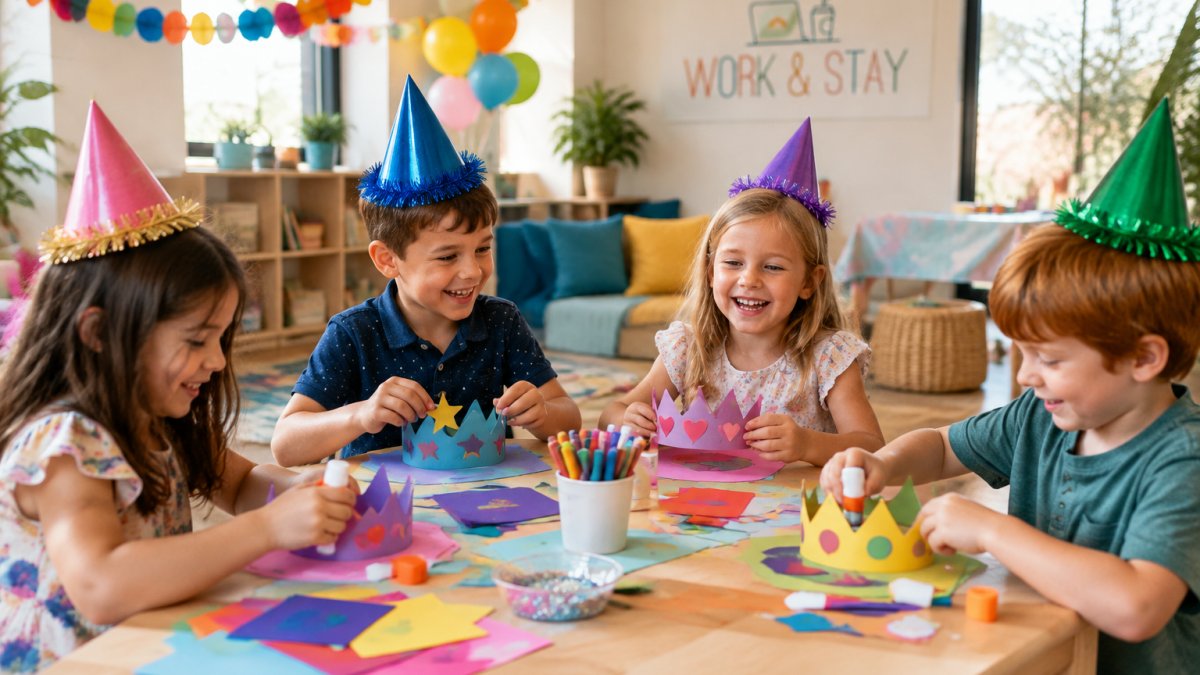
Character and Adventure Themes
Kids this age love stepping into a known story. Popular directions include space explorer, jungle safari, pirate treasure hunt, and superhero training camp. The trick is to give the theme a job: guests aren't just dressed as explorers, they're completing a mission. Party-idea roundups from Catch My Party's six-year-old theme guide show how far a single storyline can stretch across decorations, games, and cake.
Fantasy and Creative Themes
Unicorns, mermaids, fairies, and rainbow parties remain favorites because they invite open-ended play. Set up a wand-making station, a face-painting corner, or a "potions lab" with colored water and safe mix-ins. Creative themes work well in smaller rooms because the activity happens at tables, not across the floor.
Active and Sensory Themes
For kids who can't sit still, build the party around movement. A slime lab, a dance party, a mini obstacle course, or a sensory bin station all burn energy indoors. These themes also suit mixed-age guest lists, since younger siblings can join the sensory stations while older kids tackle the course.
Indoor Party Games for 6 Year Olds That Keep the Room Moving
Six-year-olds need games with short rules and fast resets. Anything with a long explanation loses the room in under a minute.
The problem with most game lists is that they don't tell you what each one actually costs you in prep time and floor space.
| Game | Setup time | Space needed | Why it works at six |
|---|---|---|---|
| Balloon relay | 5 minutes | A clear 10-foot lane | Kids carry a balloon between their knees across the room and back; simple rules, big laughs |
| Freeze dance | 5 minutes | Open floor, roughly 8x8 feet | Music stops, everyone freezes; builds self-regulation without feeling like a lesson |
| Picture-card treasure hunt | 15 minutes | Any room; cards hidden around it | Hide picture cards and send teams to find them; rewards cooperation over speed |
| Cushion obstacle course | 20 minutes | A loop through one or two rooms | Cushions, tape lines, and hoops arranged in a loop; burns energy and resets fast |
| Craft station | 10 minutes to set up, 20 to run | One table | Decorate a paper crown, picture frame, or party bag; gives shy guests a low-pressure role |
| Parachute games | 5 minutes | Open floor, 6+ feet across | A bedsheet works if you don't own a parachute; group lifting and waving is genuinely cooperative |
| Slime lab | 25 minutes | One table with a wipeable surface | Measuring and mixing is fine-motor work disguised as mess; keep it to four kids at a time |
| Balloon volleyball | 5 minutes | A couch or tape line as the net | Two teams, one balloon, keep it off the floor; the net makes the rules obvious |
A few practical notes that separate a smooth rotation from a chaotic one:
- Run the highest-energy game first. Kids arrive with a full tank. Put the obstacle course or balloon relay in the first slot, then cool down toward crafts and cake.
- Have the next game set up before the current one ends. A two-minute gap between activities is where the room falls apart. Stage supplies in a laundry basket you can carry from zone to zone.
- Cap teams at four or five kids. Six-year-olds can hold a turn in a small group; in a group of eight, half of them check out.
- Keep one quiet option running the whole time. A craft table that never closes gives the overwhelmed guest somewhere to go without leaving the party.
Watch out: freeze dance with elimination rules can end in tears at this age.
Curious what activities the venue itself runs for this age group? kids activities in Scottsdale covers the guided arts, music, and movement programming on offer.
Matching Themes to Developmental Milestones
Most theme guides lump every child under six into one bucket, which is why so many parties feel either babyish to the birthday kid or over the heads of the younger siblings. Segmenting by age fixes that. Here's what actually changes between four and six, and how to build a theme around it.
What a six-year-old can typically do that a four-year-old cannot:
- Follow a three- or four-step instruction without being walked through it
- Take turns in a game with a rule, not just a shared toy
- Cut along a line with scissors and string beads with intent
- Cooperate on a small team goal, like finishing a puzzle or finding all the cards
That last one is the real dividing line. A four-year-old's party is parallel play with cake. A six-year-old's party can have winners, missions, and a storyline, because the guests can handle it.
Age-segmented theme picks:
SIGN UP FOR YOUR MEMBERSHIP TODAY →
- Ages 1-2 (younger siblings): soft sensory bins, a bubble station, and a low climbing mat. Keep them in a gated corner with a supervising adult so the big kids' games don't bowl them over.
- Ages 3-4 (mixed guests): pretend-play themes like a bakery or a vet clinic, plus a coloring table. Rules should be optional; the play is the point.
- Ages 5-6 (the birthday cohort): mission-driven themes, space explorer, pirate treasure hunt, superhero training camp, with a clear objective and a team structure. This is where a storyline pays off.
Filter by the skill you want to exercise:
- Fine motor focus → craft parties, slime labs, decorating stations, bead jewelry
- Gross motor focus → obstacle courses, dance parties, relay races, balloon volleyball
- Social focus → treasure hunts, team challenges, pretend-play storylines with assigned roles
A party that mixes all three keeps every guest engaged, including the shy ones and the ones who never stop moving. The practical move is to assign each guest a role in the theme, navigator, builder, artist, so the quiet kid has a job that doesn't require being loud.
Watch out: a theme pitched at the birthday child's exact age can leave a younger sibling feeling left out.
Small-Space Setups for an Indoor Party
A living room can host a great party. The constraint isn't square footage, it's traffic flow.
Push furniture to the walls and create three zones: an activity zone for tables and crafts, an open zone for movement games, and a quiet zone for kids who need a break. Clear the floor completely in the open zone, and remove anything breakable before guests arrive. Tape a boundary line if the space is tight; kids respect a visible edge.
For water play, skip it entirely indoors unless the room has hard flooring. A "dry splash" station with water beads or a covered sensory bin delivers the same sensory hit with a fraction of the cleanup.
How Long Should a Birthday Party Last for Kids?
Two hours is the standard birthday party duration for six-year-olds, and it's the right call. Ninety minutes feels rushed once you factor in cake and presents. Three hours pushes past most kids' attention span and turns into meltdown territory.
A workable two-hour structure:
| Time | Activity |
|---|---|
| 0:00-0:20 | Arrival, free play, guest greeting |
| 0:20-1:00 | Organized games and activities |
| 1:00-1:25 | Cake and singing |
| 1:25-1:45 | Presents and craft or quiet activity |
| 1:45-2:00 | Wind-down, pickups |
Build in a buffer. Parents arrive at different times, and a schedule with no slack creates stress for the host.
Your Birthday Party Planning Checklist
Use this checklist to work backward from the party date. Print it and cross items off as you go.
- Pick the theme and confirm it with the birthday child
- Set the guest list and send invitations two to three weeks out
- Book the venue and confirm the room setup and time slot
- Plan five or six games and gather supplies
- Order or bake the cake and confirm any allergy needs with parents
One thing most guides miss: ask parents about allergies when they RSVP, not on party day. It changes what you order for cake and snacks, and it's far easier to plan around in advance.
What Indoor Playground Birthday Party Packages Include
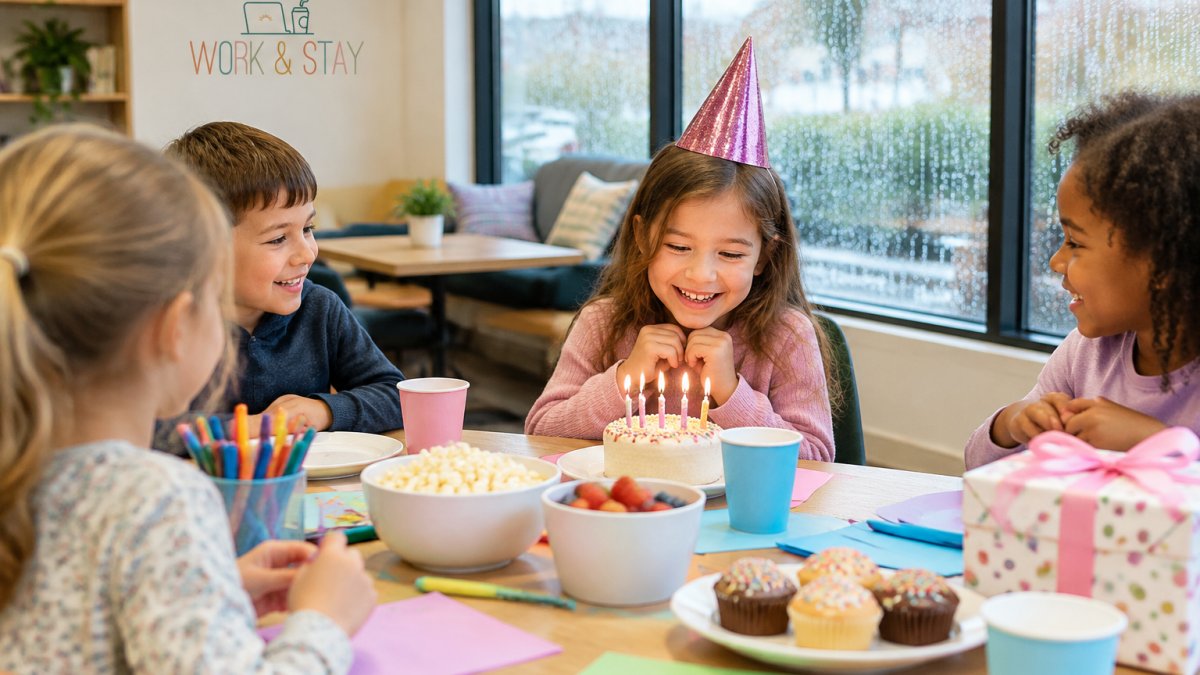
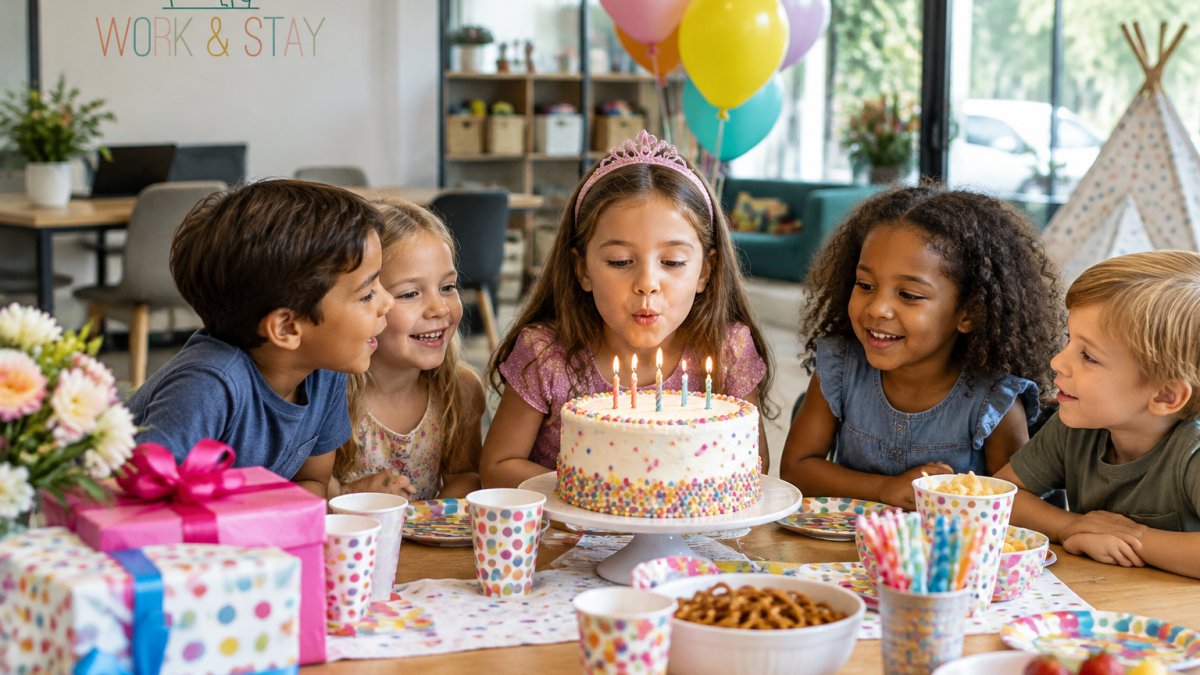
Play & Stay offers private party room rentals for exactly this kind of celebration, with the indoor play space attached. Families who want to see how the room is set up and reserve a date can book a party room rental directly.
If you're still weighing an indoor venue against a home party, this guide on why indoor birthday party venues suit preschoolers walks through the space, safety, and cleanup trade-offs in more detail.
Planning an indoor birthday party for a six-year-old doesn't require a huge budget or a perfect house. It requires a theme with a clear storyline, five or six fast-moving games, and a two-hour schedule with room to breathe.
Frequently Asked Questions
What are some fun indoor birthday party themes for 6-year-olds?
Six year olds respond well to themes they can act out. Character and adventure themes like Bluey, superheroes, pirates, or an ocean explorer setup give kids a role to play. Fantasy themes such as unicorns, mermaids, fairies, and rainbows suit kids who love dress-up and storytelling. Active themes work too: a slime lab, a dance party, a bowling lane, or a gymnastics-style obstacle course burn energy indoors. Pick one theme and repeat it across invitations, tableware, and one main activity so the party feels cohesive without costing more.
What indoor party games for 6 year olds work best in a small space?
Choose games that move kids in short bursts rather than across a long room. Freeze dance, musical chairs, balloon volleyball with a low string, and a pillow-and-cushion obstacle course all fit in a living room. A scavenger hunt with picture clues works in tight quarters because kids search a defined area. Relay races can be done in place, such as a spoon-and-cotton-ball carry across a rug. Rotate between an active game and a quiet one like a craft station to keep the group calm.
How long should an indoor birthday party be for 6-year-olds?
Two hours is the standard window for a six year old's party, and it fits most attention spans. A workable breakdown: 20 to 30 minutes for arrival and free play, 30 minutes for games or the main activity, 20 minutes for food and cake, and 20 to 30 minutes for gifts and wind-down. Going past three hours tends to produce meltdowns, especially indoors where noise builds up. If you book a venue, confirm the party duration for kids included in the package before you send invitations.
What should go on a birthday party planning checklist for an indoor party?
Start four weeks out with the guest list, theme, and venue or party room booking. Three weeks out, send invitations and plan the food and cake order. Two weeks out, buy supplies and confirm the activity plan and any helpers. One week out, confirm headcount, charge cameras, and prep game materials. The day before, set up decorations and chill drinks. On the day, arrive early, assign one adult to games and one to food, and keep a trash bag and cleaning supplies on hand for the room.