 How-to
How to Manage Daycare Drop-Off Routine Stress Without the Tears
Last Updated: November 13, 2026
Quick Summary
Manage daycare drop-off stress with a short, identical goodbye script every morning: one hug, a clear statement that you'll return after nap time, then hand off to a teacher and leave without a second round of hugs. Predictability, not longer goodbyes, is what calms the transition.
- Keep the first drop-off short and boring, and never sneak out without saying goodbye.
- Lay out clothes and pack the bag the night before, including the comfort object.
- Give a two-minute warning before each switch, then use one cue phrase: shoes on, then we go.
- Arrive five to ten minutes early for shy children so they can watch the room before joining.
- Watch the trend over a week or two rather than judging a single tearful morning.
Table of Contents
- Why Daycare Drop-Off Stress Happens and What It Really Means
- First Daycare Drop-Off Tips for a Calmer Start
- Building a Consistent Daycare Morning Routine at Home
- A Daycare Drop-Off Goodbye Script You Can Say Out Loud
- Daycare Morning Meltdown Strategies That Actually Work
- How Long Do Daycare Drop-Off Tears Last and When to Get More Support
- Coordinating the Handoff With Teachers and Tracking Progress
- Using a Nearby Workspace to Ease the Daycare Transition
- Frequently Asked Questions
Why Daycare Drop-Off Stress Happens and What It Really Means
Daycare drop-off stress is the tension a parent and child feel during the morning handoff at childcare.
Here's what many guides get wrong: they treat drop-off tears as a behavior problem to fix. Often they aren't.
The stress cuts both ways. A child feels the change in scenery and routine.
Below, a step-by-step plan covers the goodbye script, the morning routine, meltdowns, and how to tell when tears are a phase versus a signal for more support.
First Daycare Drop-Off Tips for a Calmer Start
The first drop-off sets a template, so keep it short and boring on purpose. A calm, brief handoff teaches a child what to expect every morning after.
Try this sequence:
- Visit the room together before the first real day if the provider allows it.
- Walk in with a confident face, even if nerves are running high.
- Do one short goodbye ritual, then leave.
- Don't sneak out. A quiet exit feels safer to a parent, but it teaches a child that a caregiver can vanish.
A common mistake is lingering at the door to watch. Kids read that hesitation fast. A parent who looks unsure makes a child feel unsure too.
For help picking the right room and provider, this guide on choosing the right drop-in daycare for toddlers walks through what to look for.
Building a Consistent Daycare Morning Routine at Home
Predictability starts before the car ride. A short, repeatable morning routine at home does more for drop-off calm than any single trick at the door.
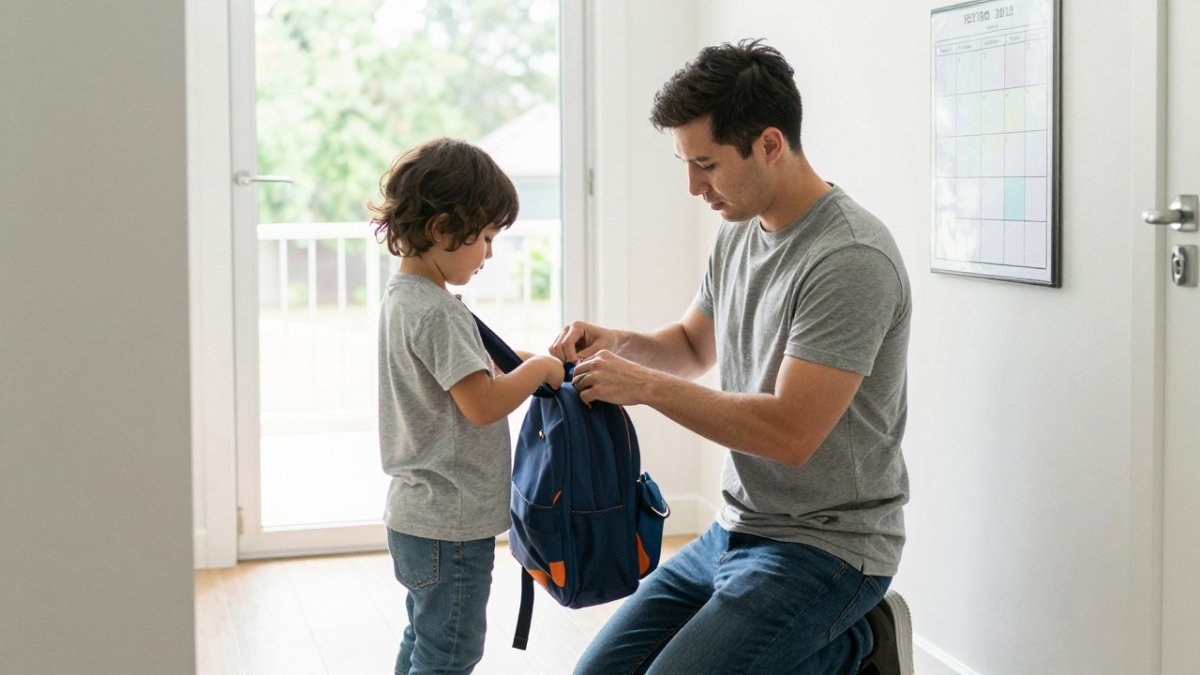
Start with the shared skeleton, then adapt it by age and temperament.
The shared skeleton (works for every age):
- Lay out clothes and pack the bag the night before, including the comfort object.
- Eat breakfast in the same spot each morning.
- Use one cue phrase: "Shoes on, then we go."
- Play the same song in the car on the way.
- Keep the order identical every day, even on rushed mornings.
Ages 0-18 months. Babies can't follow a picture schedule, but they do track sequence and tone.
Ages 18 months-3 years. This is the age of wanting control, so build choices into the routine. Let the child pick between two shirts, two breakfast options, or which bag strap goes on first. A picture schedule on the wall helps toddlers track the steps without a parent repeating them. Many families find that a child who knows what's coming next fights the transition less.
Ages 3-6 years. Older kids can own part of the routine. Assign a morning job, feeding the pet, zipping their own bag, carrying the comfort object to the car, so they arrive at drop-off already feeling capable. A simple checklist on the fridge (pictures for pre-readers, words for early readers) lets them self-manage instead of being nagged.
Adapting for temperament:
- Shy or slow-to-warm children: Add buffer time. Arrive five to ten minutes early so the child can stand near the door and watch the room before joining. Rushing a shy child into a busy room almost guarantees a meltdown.
- Highly sensitive children: Reduce sensory load in the morning. Fewer screens, softer lighting, quieter voices, and the same breakfast food can all lower the baseline before drop-off even starts.
- Highly independent children: Give them a leadership role. Let them lead the walk to the car, press the button, or hand the teacher the bag. Independence channeled into a task is easier to manage than independence channeled into a power struggle.
Working parents balancing a baby and a job may want more structure around the morning. This guide on managing remote work with infants pairs well with a drop-off routine.
Here is how the shared morning skeleton adapts by age and temperament.
| Age or temperament | What to do | Watch out for |
|---|---|---|
| Ages 0-18 months | Keep 15-20 minutes of active getting-ready; narrate steps in same words | Changing the order resets predictability |
| Ages 18 months-3 years | Offer two choices; use a picture schedule; give a two-minute warning | , |
| Ages 3-6 years | Assign a morning job and a fridge checklist | , |
| Shy or slow-to-warm | Arrive five to ten minutes early to watch the room | Rushing into a busy room almost guarantees a meltdown |
| Highly sensitive | Fewer screens, softer lighting, quieter voices, same breakfast | , |
| Highly independent | Give a leadership role, like leading the walk to the car | , |
A Daycare Drop-Off Goodbye Script You Can Say Out Loud
A daycare drop-off goodbye script is a short, repeated set of words that tells a child what's happening and that a parent is coming back.
Use this template:
"I'm giving you a big hug. You're going to play and have fun. I'll be back after nap time. I love you. Bye-bye."
Then hand off and go. No second round of hugs. No "one more minute."
The script works because it's predictable. A child hears the same words in the same order and learns the ending: parent leaves, parent returns. That's the whole lesson.
Watch out: adding "I'll be right back" when the return is hours away can backfire. Say when, not just that.
Daycare Morning Meltdown Strategies That Actually Work
A morning meltdown at daycare is a young child's stress response to a transition, not a sign a parent did something wrong. The goal isn't to stop the tears.
The calm-morning sequence (when you have time):
- Get low. Kneel to eye level before talking.
- Name the feeling. "You're sad I'm leaving. That's okay."
- Keep the body calm. A slow hug beats a rushed one.
- Hand off to a teacher, not the floor. A warm handoff to a familiar adult helps a child settle faster.
- Leave on the goodbye, not the rescue. Walking back in to check teaches a child that crying brings a return.
A common mistake is turning the meltdown into a negotiation. Snacks, extra hugs, and "five more minutes" all stretch the goodbye and make the next one harder.
The running-late plan (when you don't). Most drop-off advice assumes a calm morning. Real mornings have traffic, a lost shoe, and a meeting in twenty minutes. When you're behind, the routine has to get shorter, not looser. Use this stripped-down version:
- Skip the extra warnings. Go straight to the cue phrase: "Shoes on, then we go." Fewer transitions mean fewer chances to stall.
- Do the goodbye in the car if the room is chaotic. A short, complete goodbye in the parking lot, hug, script, hand off at the door, is better than a rushed, half-finished one inside.
- Hand off fast and mean it. A teacher who knows the script can take a crying child and start a preferred activity within seconds. Lingering to soothe is what stretches the morning.
- Don't add a rescue stop. No circling back, no second goodbye through the window. The child reads the return, not the reason for it.
Managing your own stress in the moment. The keyword is drop-off stress, and a lot of it belongs to the parent. A few things that help:
- Decide the goodbye before you arrive. Pick the script and the number of hugs in advance so you're not negotiating with yourself at the door.
- Use a physical reset. Three slow breaths in the car before you walk in lowers your own arousal, and children pick up on a calm adult faster than a calm voice.
- Name your own feeling silently. "I feel guilty and rushed" is easier to carry than an unnamed knot in the chest.
- Give yourself a landing plan. Knowing you have somewhere to go, a workspace, a coffee shop, a call, makes leaving feel less like abandonment and more like a next step.
Watch out: apologizing at the door ("I'm so sorry I have to go") tells a child the goodbye is something to feel bad about. Keep the language neutral and confident instead.
How Long Do Daycare Drop-Off Tears Last and When to Get More Support
Many drop-off tears fade soon after a parent leaves, and the pattern often eases over the first few weeks as a child settles in. Every child is different, so watch the trend rather than a single morning.
Signs the routine is working:
- Crying gets shorter over a week or two.
- A child settles into play soon after a parent leaves.
- Mornings get calmer at home.
- A teacher reports a happy child by mid-morning.
Signs it's time to check in with a teacher or pediatrician:
- Distress lasts most of the day, not minutes.
- A child stops eating or sleeping at daycare.
- The pattern gets worse after several weeks, not better.
- A parent feels stuck and unsure what to try next.
If more support is needed, browsing the Play & Stay blog is a low-pressure place to start.
Coordinating the Handoff With Teachers and Tracking Progress
The handoff works best as a team effort between parent and teacher. A quick, consistent exchange at the door helps a child move from one safe adult to another.
What to coordinate:
- Agree on who greets the child each morning.
- Share the goodbye script so the teacher can pick up right after.
- Ask the teacher for a quick update at pickup: how long the tears lasted, how the child settled.
- Keep a simple log for two weeks to spot the trend.
A short note in a phone app or a paper log works fine. The point is to see progress, not to grade a child. When a parent can point to "crying dropped from ten minutes to two," the morning feels less overwhelming.
Using a Nearby Workspace to Ease the Daycare Transition
Staying close after drop-off can make the first weeks easier on everyone.
That's where Work & Stay fits.
A parent who wants to stay nearby after drop-off can find a quiet workspace close by and get real work done instead of circling the parking lot.
Drop-off stress doesn't have to run the morning. A short routine, one steady goodbye script, and a calm handoff can change the whole week.
Frequently Asked Questions
How long does it take for kids to stop crying at daycare drop-off?
Most children settle within a few weeks of a consistent routine, though every child is different. The key is predictability: the same short goodbye, the same handoff, and the same pickup time each day. If tears continue past a month or intensify, talk with your child's teacher about what happens after you leave. Many children stop crying within minutes of a parent exiting, which is a good sign the routine is working.
What should I say when my child cries at daycare drop-off?
Keep it short, warm, and confident. Try a script like: 'I love you. You're safe here. I'll be back after snack time.' Then hand your child to the teacher and leave. Avoid sneaking out, which can deepen anxiety, and avoid long negotiations. Naming the feeling helps too: 'It's okay to feel sad. I'll see you soon.' The goal is a brief, positive goodbye your child can predict.
Should I stay with my child if they cry at daycare drop-off?
A brief stay can help on the first few days, but prolonged goodbyes often make separation harder. A better approach is a short transition ritual: one book, one hug, then handoff. Ask the teacher to engage your child in a specific activity right after you leave. A workspace with onsite childcare nearby, like Work & Stay, can let you work close by while your child is in supervised care.
When should I be concerned about daycare drop-off anxiety?
Occasional tears are normal, especially in the first weeks. Talk with your child's teacher or pediatrician if distress lasts most of the day, if your child stops eating or sleeping well, or if anxiety interferes with daily life for more than a month. Persistent distress that does not ease after you leave is worth a closer look. A consistent routine and teacher communication are the first steps; professional support is the next if needed.