 listicle
Quiet Outdoor Workspaces in Summer: A Parent's Guide
Table of Contents
- Why Quiet Outdoor Workspaces Matter for Summer Work 🌞
- Essential Features of Quiet Outdoor Workspaces ✨
- Coworking Spaces with Childcare: The Parent's Solution 👨👩👧
- Drop-In Childcare for Working Parents: Flexibility When You Need It 🎯
- Managing Heat and Ambient Noise in Summer Outdoor Work 🌡️
- Data Security and Privacy in Shared Outdoor Environments 🔒
- Frequently Asked Questions
Last Updated: September 24, 2026
Working outside during summer in Scottsdale presents a unique challenge: heat, glare, and noise can derail productivity faster than any distraction indoors. Yet quiet outdoor workspaces offer real benefits for parents juggling work and childcare. The right setup combines shade, power, connectivity, and genuine silence. Here's what actually works, and what most guides overlook.
Why Quiet Outdoor Workspaces Matter for Summer Work 🌞
Remote work has untethered millions from traditional offices, but outdoor productivity isn't automatic. Parents juggling client calls and summer schedules face heat exhaustion, screen glare, ambient noise, and anxiety about childcare happening elsewhere.
Quiet outdoor workspaces solve a specific problem. They let working parents stay connected to their children while maintaining the professional environment their jobs require. Unlike a backyard setup (where interruptions are constant) or a traditional office (where childcare is separate), a dedicated quiet outdoor workspace with nearby childcare means parents aren't choosing between presence and productivity.
Parents benefit most from arrangements where they can access their children without abandoning focus. A quiet outdoor workspace paired with supervised childcare steps away removes that mental load. Work & Stay combines this: coworking spaces for parents with curriculum-based childcare for ages 0-6 in a separate, supervised environment just steps away.
Essential Features of Quiet Outdoor Workspaces ✨
Not every outdoor patio qualifies as a productive workspace. Five specific features distinguish a genuine quiet outdoor workspace from pleasant seating.

Shade Coverage and Sun Protection
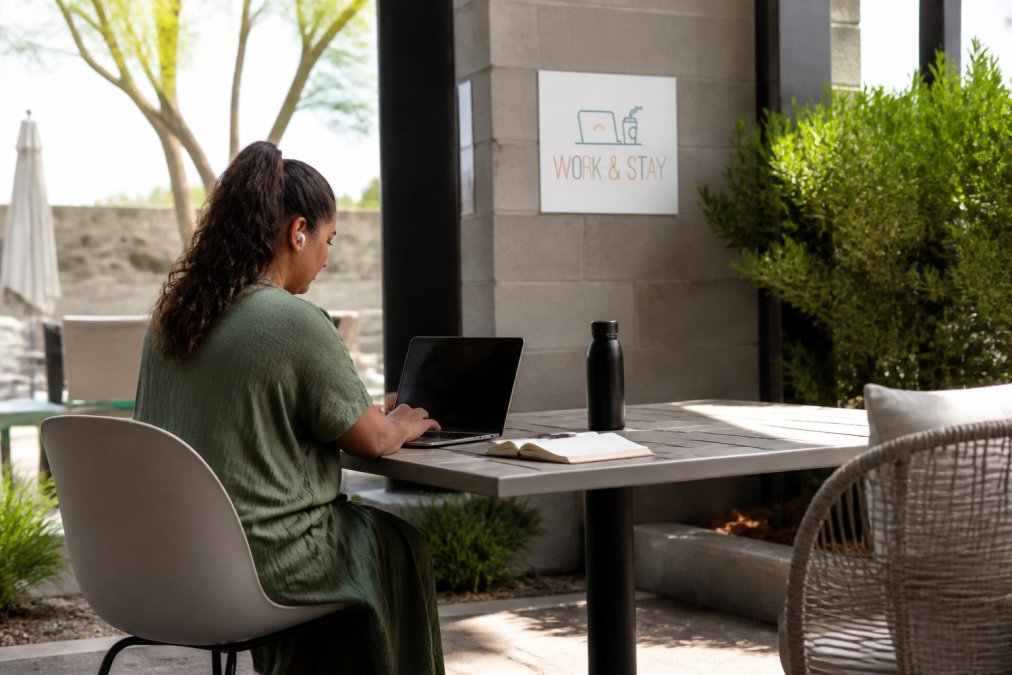
Shade is the foundation of any viable outdoor workspace. Direct sun exposure makes focus impossible within 30-45 minutes. The best quiet outdoor workspaces use permanent shade structures: large umbrellas (minimum 9 feet diameter), pergolas with adjustable slats, or retractable awnings.
Shade quality matters as much as quantity. A thin umbrella or pergola with wide slats creates dappled light that bounces glare onto screens. Look for dense shade that blocks 90%+ of direct sunlight. Pergolas with adjustable slats let workers control light as the sun angle changes.
Position matters: morning shade on the east side becomes direct sun by mid-afternoon. The best workspaces offer multiple shaded zones or adjustable structures. If a workspace offers only one fixed shade area, verify it aligns with your work hours.
Power Availability and Connectivity
Reliable power is non-negotiable for any productive workspace.
Quality quiet outdoor workspaces offer weatherproof outlets within 6 feet of seating, with GFCI protection for safety. Some use outdoor-rated power strips or charging stations built into shade structures.
Outdoor Wi-Fi coverage can be spotty. The best setups use mesh networks or cellular backup. Test connectivity at your exact seating location, not just near the building, a workspace 30 feet from the router may show full bars but experience latency during calls.
For video conferencing, upload and download speeds matter more than signal strength. Ask facilities about bandwidth prioritization for professional use.
Ergonomic Furniture and Glare-Free Visibility
Ergonomic outdoor furniture, a proper desk at 28-30 inches high, a chair with lumbar support, and a monitor stand at eye level, makes the difference between a short break and an actual work session.
Glare is the silent productivity killer. Even under shade, screens reflect light off concrete, water, glass, or light-colored walls. The best quiet outdoor workspaces position seating to minimize glare, using furniture that angles monitors away from reflective surfaces.
Outdoor seating needs different specifications: surfaces that don't heat in sun, materials that resist weather and UV degradation, and positioning that accounts for shifting light angles. Test furniture at the time of day you'd work.
Noise Isolation and Sound Quality
A workspace with perfect shade and power is useless if ambient sound prevents concentration. Genuine quiet requires distance from noise sources and intentional sound dampening.
A workspace 50 feet from a busy street experiences 65-75 dB background noise. The same space 200 feet away drops to 55-60 dB. Above 60 dB requires noise-canceling headphones; below 55 dB, most workers focus without them.
Landscaping, water features, and building placement naturally absorb sound. Visit at peak times (10 a.m. on a weekday) to hear the actual noise environment.
Climate Control and Proximity to Indoor Refuge
Outdoor spaces adjacent to air-conditioned buildings provide critical relief. A 5-10 minute break in air conditioning can extend afternoon productivity by 2-3 hours.
The best setups offer seamless transition to climate-controlled areas for breaks or afternoon work. For parents, the ability to step inside briefly without losing sight of nearby childcare removes major stress.
Coworking Spaces with Childcare: The Parent's Solution 👨👩👧
For working parents, the ideal quiet outdoor workspace is integrated with childcare. Parents work with genuine focus while children are supervised and engaged nearby.
SIGN UP FOR YOUR MEMBERSHIP TODAY →
Work & Stay operates this exact model. The workspace side offers coworking lounges and private offices with high-speed internet and professional-grade furniture. The childcare side, steps away in a separate, climate-controlled environment, provides curriculum-based programming for ages 0-6, not just supervised play.
The advantage over traditional setups: parents don't coordinate separate childcare and office locations. A quick break to check on a child takes seconds, not a 20-minute drive. For parents managing remote work, this proximity removes anxiety and interruption.
Memberships and day passes offer flexibility. Parents can work a few hours one day, a full day the next, without long-term contracts. This matches the unpredictable reality of parenting.
Drop-In Childcare for Working Parents: Flexibility When You Need It 🎯
Backup childcare is one of the top stressors for working parents. A child gets sick, a school schedule shifts, or a project deadline lands unexpectedly, and suddenly childcare falls apart.
Drop-in childcare solves this by design. No advance booking, no contracts, no guilt about "wasting" a membership slot. Parents show up when they need to, work for as long as they need to, and pick up their child when done.
The best drop-in childcare isn't just a holding area. Curriculum-based programming, guided arts, music, structured play, means children develop skills and enjoy their time, not just survive it. Work & Stay offers both: drop-in childcare with teacher-led activities, and a quiet workspace where parents can actually focus.
For parents who work unpredictable hours or manage variable schedules, this flexibility is transformative. It removes the need to plan weeks in advance or maintain expensive full-time childcare for part-time work needs.
Managing Heat and Ambient Noise in Summer Outdoor Work 🌡️
Summer heat in the region transforms outdoor work from pleasant to dangerous without proper planning. The challenge isn't just temperature, it's the combination of direct solar radiation, humidity, and screen glare that compounds fatigue and reduces cognitive performance. Strategic workspace selection and timing turn outdoor summer work from impossible to sustainable.
Heat Index and Shade Reliability
Air temperature alone doesn't tell the story. Heat index, the "feels like" temperature when humidity is factored in, can exceed 120°F on summer afternoons. A workspace rated for summer productivity must offer shade that keeps workers in the 95-105°F range, not the full sun equivalent of 125°F+.
Evaluate shade structures by three criteria:
Density and coverage. A thin umbrella or pergola with wide slats creates dappled light that still allows significant solar radiation to reach skin and equipment. Dense shade (pergolas with adjustable slats, solid awnings, or multi-layer umbrellas rated for 95%+ UV blockage) reduces radiant heat by 20-30 degrees compared to open air. Test this: place your hand under the shade at midday. If you can see a sharp shadow of your hand, the shade is too thin.
Orientation and movement. Morning shade on the east side of a building becomes direct sun by 2 p.m. The best workspaces offer multiple shaded zones so workers can migrate as the sun angle shifts. Some facilities use retractable awnings or movable shade structures that adjust throughout the day. If a workspace only offers one fixed shade area, it's only viable for early morning or late afternoon work.
Proximity to cooling. Outdoor spaces adjacent to air-conditioned buildings or with misting systems provide micro-climate relief.
Ambient Noise Assessment
Noise is the overlooked variable. A workspace with perfect shade and power is useless if ambient sound makes concentration impossible. The difference between a "quiet" space and a genuinely productive one comes down to noise sources and their distance from seating.
Timing Strategy for Summer Productivity
Early morning (6:30-10 a.m.) is prime time for outdoor work. Temperatures are 15-25 degrees cooler, shade is abundant on the east side of buildings, and ambient noise from neighbors and traffic is minimal. Many remote workers shift their schedule to complete focus-intensive work outdoors in the morning, then move indoors for collaborative calls or administrative tasks in the afternoon.
Data Security and Privacy in Shared Outdoor Environments 🔒
Working outdoors in a shared space raises legitimate privacy concerns. Sensitive client information, confidential emails, or financial data displayed on a screen visible to others creates risk.
Frequently Asked Questions
Is it really possible to work outdoors in summer heat while staying productive?
Yes, but success depends on three factors: adequate shade coverage, proximity to power outlets for cooling fans or laptop charging, and access to refreshments. Many remote workers find that morning hours (before 10 AM) and late afternoon (after 4 PM) offer the most comfortable outdoor work windows. Choosing a quiet outdoor workspace with mature trees, shade structures, or covered patios makes a significant difference in sustaining focus during hot months.
What should I look for in a coworking space with childcare for summer?
Prioritize spaces offering separate, climate-controlled childcare environments so your children stay comfortable while you work. Look for curriculum-based activities rather than just supervised play, flexible day-pass options with no long-term contracts, and proximity between workspace and childcare areas. This setup lets you maintain productivity in a professional environment while your children engage in guided learning and social development nearby.
How do drop-in childcare options help working parents manage summer schedules?
Drop-in childcare for working parents eliminates the need for rigid, long-term commitments. You can book hours as needed for client calls, focused work, or personal errands without paying for unused time. This flexibility is especially valuable during summer when school schedules shift and childcare needs become unpredictable. Many facilities offer hourly rates and same-day availability, making it easier to balance work demands with parenting responsibilities.
How can I protect sensitive work information in a shared outdoor workspace?
Use a privacy screen protector on your laptop to prevent shoulder surfing, position your screen away from foot traffic, and avoid discussing confidential details in open areas. For video calls, choose a quieter corner or use a private workspace during sensitive meetings. When working with client data, ensure your Wi-Fi connection is secure and consider using a VPN. Many professional coworking spaces offer private offices or focus zones specifically designed for confidential work.