 How-to
How to Choose Age-Segregated Play Areas for Toddlers
Last Updated: November 1, 2026
Quick Summary
Age-segregated play areas are play zones designed for a narrow range of ages, so each child can use equipment, surfaces, and activities made for their own development. Toddlers need low climbing structures, short slides, and soft surfaces, and separating them from older children reduces collisions and overwhelm.
- Toddlers need low climbing structures, short slides, and soft surfaces they can safely fall onto.
- Older children move quickly and often do not notice a small child in their path.
- Separation should cover how children move through the room, not just where equipment sits.
- Clear sightlines let a caregiver see the whole toddler zone from a seated position.
- A separated toddler zone plus planned, supervised mixed-age time is the practical answer most designers choose.
Table of Contents
- Why Age-Segregated Play Areas Matter for Toddlers
- How Toddler Safety Changes When Older Children Share the Space
- What Makes a Playground Age-Appropriate for Toddlers
- How Separate Zones Support Toddler Social Development Through Play
- Indoor Play Area Design for Different Age Groups
- Inclusive Design and Supervision in Separated Areas
- Choosing an Indoor Play Space for Your Toddler This Week
- Frequently Asked Questions
Toddlers and older children move, climb, and play in very different ways, and that gap shapes how safe and how fun a space feels for each of them. Age-segregated play areas, with separate zones for toddlers and older kids, are one of the simplest ways to address that gap. At Play & Stay, the indoor play space in Scottsdale built for children ages 0-6, we believe little ones do best with room that fits their size and pace.
Age-segregated play areas are simply play zones designed for a narrow range of ages, so each child can use equipment, surfaces, and activities made for their own development. The idea is not about keeping kids apart. It is about giving a 20-month-old and a five-year-old each a space where they can explore without being knocked over or overwhelmed.
Why Age-Segregated Play Areas Matter for Toddlers
Toddlers are still building balance, coordination, and confidence. Equipment built for older kids can be too tall, too fast, or too hard to grip, which makes falls and bumps more likely.
- Toddlers need low climbing structures and short slides
- They need soft surfaces they can safely fall onto
- They need room to walk, crawl, and wander without being crowded
- They learn best when the activities match what they can already do
When these needs are met, toddlers tend to try more, stay engaged longer, and build the skills they need for later play.
How Toddler Safety Changes When Older Children Share the Space
Mixed-age play is not automatically dangerous, but it changes the risk profile in ways that are easy to underestimate. Older children move quickly, swing hard, and often do not notice a small child in their path. A toddler standing at the bottom of a slide can be hit before a parent even sees the collision coming. Playground safety guidance generally treats mixed-age collisions as a design concern as well as a supervision concern, since equipment, fall heights, and movement patterns differ between age groups.
A common mistake is assuming that a parent nearby is enough protection. Parents can only watch one child at a time, and a toddler can change direction in a second. Separate zones reduce these collisions because the fastest movement happens away from the youngest children.
The safety details that actually change outcomes
- Fall zones and surfacing. Safety guidance generally calls for a clear use zone around stationary equipment, with surfacing matched to fall height. Surfacing still has to be maintained, since worn, compacted, or displaced surfacing is a common hazard.
- Age and height labeling. Many public and commercial play areas post recommended age ranges and height limits at each zone entrance. Clear labeling lets caregivers self-select the right zone before a child runs in, rather than after a near miss.
- Sightlines and caregiver access. Good separation keeps toddlers out of fast-movement paths while keeping them visible. Seating placed so an adult can see the entire toddler zone from a seated position, and reach it in a few steps, matters more than a decorative barrier.
- Supervision ratios. For childcare settings, the principle is consistent: the younger the group, the closer the supervision.
- Movement routes, not just equipment. Watch out for a "toddler corner" that shares an entrance, bridge, or exit path with a big-kid structure. That still puts toddlers in the path of older kids. Separation has to cover how children move through the room, not only where the equipment sits.
Reducing collisions without isolating toddlers
The goal is not a wall. It is a layout where the fastest, highest-energy movement is physically separated from the slowest, least stable movement. Low, soft-surfaced toddler zones placed away from swing arcs, slide exits, and open running lanes do most of the work. When older and younger children do share time, during a planned activity, for example, a caregiver-led structure with clear turn-taking rules keeps the interaction positive rather than accidental.
What Makes a Playground Age-Appropriate for Toddlers
An age-appropriate play space for toddlers is defined less by a theme or a color scheme and more by a set of measurable features. When you evaluate a space, or plan one, these are the details that separate a genuinely toddler-friendly zone from a corner that merely has small equipment in it.
Equipment sized to the child
- Low platforms and short slides. Toddler slides are generally kept short, with gentle slopes and wide, enclosed steps or a short ramp. Platforms low enough that a toddler can climb up and down without a boost build confidence and reduce the temptation to jump from height.
- Easy-to-grip handles and rails. Small hands need rails they can wrap around. Look for rounded edges, no pinch points, and openings sized so a head cannot pass through but a limb cannot get trapped.
- Multiple ways in and out. A toddler who can enter and exit a structure independently is less likely to panic or take a risky shortcut. Ramps, low steps, and open sides all help.
Surfaces and fall protection
- Cushioned flooring under and around equipment. Padded or poured-in-place surfacing should extend through the use zone, not stop at the edge of the climber. Worn or compacted surfacing is a maintenance issue worth checking on every visit.
- Clean, intact surfaces. Tears, gaps, and lifted edges are trip and fall hazards, and they are easy to spot if you look.
Layout and sightlines
- Clear sightlines from seating. A caregiver should be able to see the whole toddler zone from a seat nearby, without standing or leaning around equipment.
- Open floor space for walking and crawling. Toddlers need room to move between activities without being crowded. A zone packed with equipment leaves no safe path.
- Separation from fast-movement areas. The toddler zone should sit away from swing arcs, slide exits, and open running lanes used by older children.
The trade-off worth knowing
Separation is not automatically better in every case. Mixed-age play has real benefits, younger children watch and imitate older peers, and older children practice patience and helping. The practical answer most designers land on is a separated toddler zone plus planned, supervised mixed-age time, rather than permanent isolation. That gives toddlers a safe base and still lets them learn from older kids in a structured setting.
If everything in the room is built for children who are four feet tall or taller, toddlers are not the intended users, no matter what the sign says.
The article breaks down the measurable features that separate a genuinely toddler-friendly zone from one that merely has small equipment.
| Feature | What to look for | Why it matters |
|---|---|---|
| Slides | Short, gentle slopes, wide enclosed steps | Builds confidence and reduces falls |
| Platforms | Low enough to climb without a boost | Avoids jumping from height |
| Handles and rails | Rounded edges, no pinch points | Small hands can grip safely |
| Cushioned flooring | Extends through the use zone | Softens falls around equipment |
| Sightlines | Whole zone visible from a seat | Lets caregivers supervise easily |
| Open floor space | Room to walk and crawl | Prevents crowding and unsafe paths |
| Separation | Away from swing arcs and slide exits | Reduces collisions with older kids |
How Separate Zones Support Toddler Social Development Through Play
Separate zones do not stop social learning. They make it easier. Toddlers learn to share, take turns, and notice other children best when they are playing near kids at a similar stage.
SIGN UP FOR YOUR MEMBERSHIP TODAY →
A toddler who is still working on walking can join a game with peers who are also learning to balance. This builds the early social skills that prepare children for preschool and beyond. Older children, meanwhile, can practice patience and helping roles when they play with younger kids in supervised, planned activities.
Toddlers often feel less pressure when the other children are at a similar level, and bolder kids can learn to lead without knocking others down.
Indoor Play Area Design for Different Age Groups
Good indoor design separates age groups without making the room feel divided or cut off. Many well-designed spaces use:
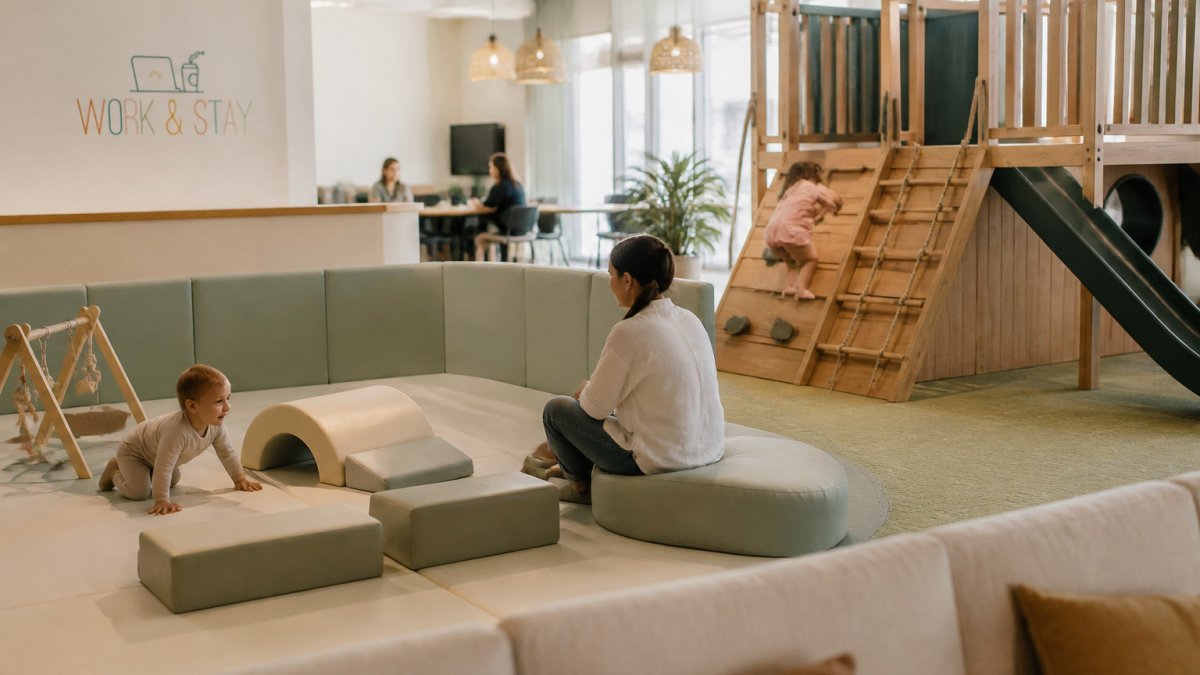
- A low, soft-surfaced area for toddlers
- A short wall, padded barrier, or change in flooring between zones
- A separate zone with larger climbing equipment for older children
- Seating for parents placed where they can watch both areas
The goal is a layout where the youngest children can explore freely and parents can keep an eye on everyone without crossing the room. Clear signage and consistent rules help everyone understand where each age group should play.
Inclusive Design and Supervision in Separated Areas
Separated play areas should work for every child, including those with mobility needs, sensory sensitivities, or developmental delays. When comparing spaces, look for wide pathways, equipment with multiple ways to enter and exit, and quiet corners where a child can take a break.
Supervision matters just as much as layout. Staff or caregivers should be able to see every zone at once, and the rules should be easy to explain to a child.
Choosing an Indoor Play Space for Your Toddler This Week
Start by visiting a space in person if you can. Watch how the toddler area is laid out, whether the surfaces look soft and clean, and whether a parent can see the whole room from a seat.
Use this quick checklist when comparing options:
- Is there a separate, low-level zone for toddlers?
- Are the floors soft and in good repair?
- Can parents see their child from a seated position?
- Does the space have clear rules and supervision?
- Does the layout keep older kids away from the youngest?
Once you have a shortlist, plan a short visit with your toddler. Notice how they respond, and choose the space where they look the most relaxed and curious. If you are also planning a celebration, see how timing fits into a toddler birthday party. At Play & Stay, families can explore our indoor play space in Scottsdale with day passes or memberships. Visit https://playandstayaz.com/ for current options.
Frequently Asked Questions
How important is outside play for toddlers?
Outdoor play gives toddlers room to move, practice balance and coordination, and build confidence with motor skills such as running, climbing and jumping. Indoor play areas can supplement this, especially during hot Scottsdale summers or when outdoor time is limited. Combining both gives toddlers the most varied physical activity. Parents can use Play & Stay's supervised open play as a structured way to keep young children active when outdoor conditions are not ideal.
Why should playgrounds have separate areas for toddlers?
Toddlers and older children move, climb and play at very different speeds and strengths. Separate zones reduce the chance that a toddler gets knocked over or hurt by a larger child on faster equipment. Separate areas also let toddlers explore at their own pace without feeling overwhelmed. Look for clearly marked, lower-height zones with soft surfacing when choosing an indoor play space for a young child.
What should parents look for in an indoor play area for toddlers?
Start by checking whether the space has a distinct area for the youngest children, with equipment sized for their height and softer surfacing underneath. Ask about staff supervision during open play and what the incident protocol is if a child gets hurt. Clean, well-maintained equipment and a clear layout that lets you see your child from a seat are also important. Ask the facility directly about these details before your first visit.
How do age-separated play areas support toddler development?
Separated areas let toddlers practice gross motor skills, social skills like taking turns, and early problem-solving without being outpaced by older children. Guided activities in a smaller group can help toddlers build confidence and communication. Play & Stay offers guided arts, music and dance programming that supports these early developmental goals for children ages 0-6.