 comparison
Is Indoor Play Worth It for Toddlers? A Honest Review
Table of Contents
- The Real Value of Indoor Play for Toddlers
- Indoor Playground Benefits for Toddlers: What the Research Shows
- Indoor Playground Safety for Toddlers: What You Need to Know
- How Long Should Toddlers Play at an Indoor Playground
- Toddler Indoor Activities: Beyond Open Play
- The Trade-Offs: When Indoor Play May Not Be the Right Fit
- Is It Worth It? Making the Decision for Your Family
- Frequently Asked Questions
Last Updated: October 18, 2026
The Real Value of Indoor Play for Toddlers
When parents ask is indoor play worth it for toddlers, they're really asking: Will my child benefit? Is it safe? Does it fit our family?
There's no simple yes or no. Indoor play spaces offer real developmental advantages, from physical activity to social interaction, but come with trade-offs: cost, germ exposure, and whether the same benefits happen at home or outdoors.
This guide breaks down the honest case for and against indoor play: benefits, safety, and when other options work better.
Indoor Playground Benefits for Toddlers: What the Research Shows
Indoor play spaces designed for toddlers let young children move freely, explore safely, and interact with peers. But which benefits actually matter?
Physical Development and Motor Skills
Toddlers develop gross motor skills, the large muscle movements needed for running, climbing, and balance, through active play, and an indoor playground offers structured opportunities a living room might not.
Navigating climbing structures, slides, and soft play equipment builds strength and coordination, laying the foundation for sports and posture later.
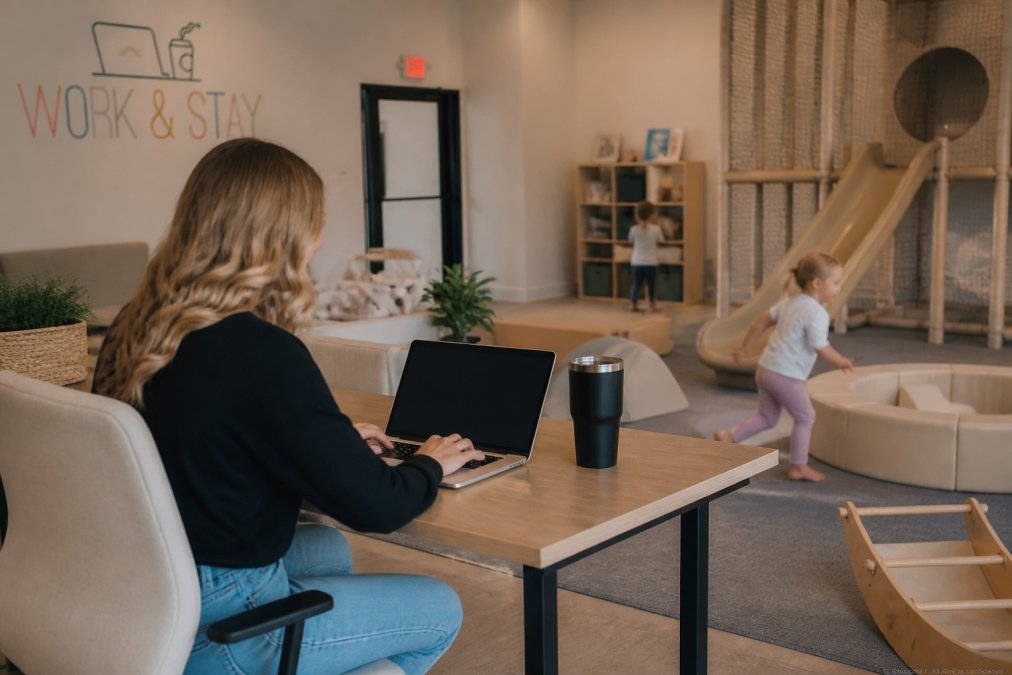
Play & Stay's indoor play space includes age-appropriate climbing structures and soft-play equipment designed specifically for toddlers, so younger children (ages 0-2) aren't intimidated or overwhelmed by equipment meant for older kids.
Social Growth and Peer Interaction
Toddlers aged 18 months and older begin noticing other children. They don't play with peers yet, but they watch, imitate, and start learning turn-taking and sharing.
An indoor playground puts toddlers in regular contact with peers, and over repeated visits familiar faces emerge. Some thrive on this exposure, others find it overwhelming, but either way toddlers learn that play can happen alongside others.
For only children or toddlers without regular peer contact, an indoor play space fills a real gap.
Cognitive Exploration and Confidence
Toddlers learn by exploring, and a well-designed indoor playground offers variety (textures, heights, equipment) that stimulates curiosity. A toddler who conquers a small climbing structure builds confidence, and one who tries a new activity learns that exploration is rewarding.
Play & Stay goes beyond open play with guided arts, music, and dance programming, where toddlers experience instruction, follow simple directions, and engage in creative expression alongside caregivers or teachers.
Confidence builds through small wins, and an indoor space designed for toddlers makes small wins frequent.
Indoor Playground Safety for Toddlers: What You Need to Know
Safety concerns often drive the "is indoor play worth it for toddlers" question: germs, equipment hazards, and supervision. Here is a checklist to use before you pay for a visit.
A Pre-Visit Safety Checklist for Parents
Walk in and look before you commit. A short observation pass tells you more than any marketing page.
Equipment condition
- Padding under climbers is intact, not compressed, torn, or taped over
- No exposed bolts, pinch points, or sharp edges at toddler height
- Slides and steps are scaled for ages 0-6, not adult-sized
- Netting and barriers are secure with no gaps a toddler could slip through
Age separation
- A distinct area for ages 0-2 or 0-3, physically separated from older kids
- Signage stating age limits and height limits, and staff who actually enforce them
- Toddler equipment that a 6-year-old cannot dominate during peak hours
Supervision
- Staff positioned so every zone is visible, not clustered at a front desk
- A stated caregiver-supervision policy (most spaces require a parent or guardian to stay within arm's reach of toddlers)
- A visible staff-to-child ratio during busy times
Emergency readiness
- First-aid kit on site and at least one staff member with current CPR/first-aid training
- A written incident procedure and a posted emergency contact method
- Clear exits and a check-in/check-out process so staff know which children are on site
Cleanliness and Illness Exposure: Practical Guidance
Indoor play spaces are communal environments, and germs spread in communal environments. What separates a responsible space from a careless one is what happens between visits.
Ask these questions directly:
- Cleaning cadence: Is equipment wiped down throughout the day, or only at close? Are high-touch surfaces (ball pits, play kitchen, mats) on a published schedule?
- Illness policy: Does the space turn away children with active fever, vomiting, or a persistent cough? Is the policy posted and enforced?
- Hand hygiene: Are hand-washing stations or sanitizer available at entry and exit, and is hand-washing encouraged before play?
- Ventilation: Does the space have open windows, fresh-air exchange, or air filtration? Good airflow matters more than a scent of cleaner.
When to skip a visit. Avoid shared indoor play during an active household illness, a local cold-and-flu surge, or when a child has a weakened immune system or a newborn sibling at home. If your toddler is recovering from a fever, wait until they have been symptom-free for a day.
Matching the Space to Your Toddler's Stage
Safety is also about fit: a space safe for a confident 3-year-old may overwhelm a new walker. Before you visit, ask whether the layout lets you keep your child in a zone matching their mobility, whether there is a quieter corner for a sensory-sensitive toddler, and whether staff redirect older children out of the toddler area.
Play & Stay's design includes separate areas specifically for the youngest guests (ages 0-6), so toddlers play on equipment scaled to their size and strength rather than on structures meant for older children. Learn more at playandstayaz.com.
How Long Should Toddlers Play at an Indoor Playground
The ideal duration depends on your toddler's age, temperament, and energy level. There's no universal "right" amount.
Toddlers aged 12-18 months often do better with 30-45 minutes of active play before they're overwhelmed. Toddlers aged 2-3 might sustain 45-60 minutes, especially with variety (open play plus structured activities).
Watch for tired signals: crankiness, clumsiness, loss of interest in new activities. Leaving while your child is still having fun means they'll want to come back.
One visit per week is plenty for most families.
SIGN UP FOR YOUR MEMBERSHIP TODAY →
Toddler Indoor Activities: Beyond Open Play
Open play, where toddlers roam freely on equipment, is the core offering at most indoor play spaces. But the best spaces add structure.
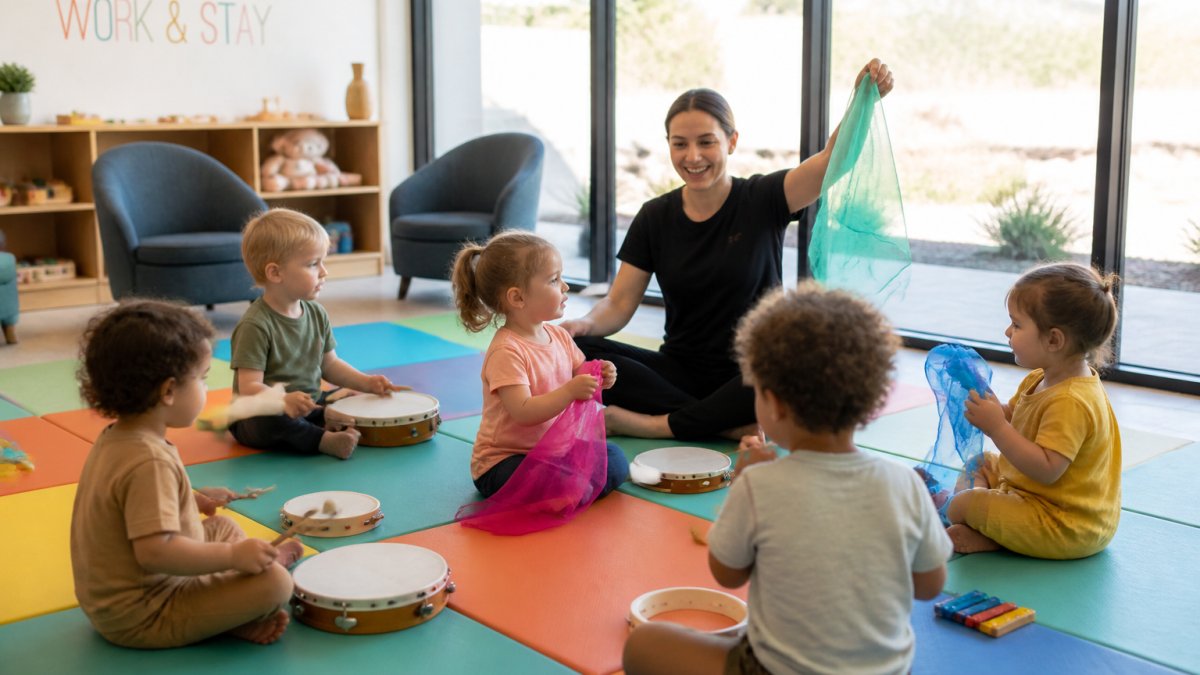
Guided activities like arts and crafts, music, or dance give toddlers a different play experience: they follow simple instructions, create something, and participate alongside peers in a low-pressure setting.
Play & Stay includes guided arts, music, and dance programming, so families get both options: structured time and free exploration.
The Trade-Offs: When Indoor Play May Not Be the Right Fit
Indoor play is not the answer for every family. The query asks whether it is worth it, a value question rather than a benefits question, so here is the honest ledger, including drawbacks most promotional pages leave out.
Cost Versus Value: Run the Math
Indoor play spaces typically sell day passes or memberships, and the right choice depends on how often you would actually go. Do this three-step calculation with the space's current posted rates:
- Estimate realistic visits per month. Be honest. Most families land at one to four visits a month, not weekly, once naps, work, and illness interrupt the schedule.
- Compare the day-pass total to the membership price. Multiply your realistic monthly visits by the day-pass rate. If that total exceeds the membership price, the membership wins. If it does not, buy day passes and keep your flexibility.
- Add the hidden costs. Parking, snacks, a sibling pass, and drive time all count. A space 30 minutes away costs an hour of round-trip time per visit.
Then compare against free and low-cost alternatives: public parks, library story times, community-center open gyms, and home play. Indoor play wins on weather-proof consistency and age-scaled equipment but loses on price per hour if free options are easy to reach. The value case is strongest for families without a yard, in extreme-heat or cold months, or with a toddler who needs peer exposure.
Toddler-Specific Drawbacks Competitors Skip
Most descriptions sell the benefits. Here are the trade-offs that matter for ages 1-3.
Age mixing. Even in a space for ages 0-6, a 5- or 6-year-old moves faster and heavier than a 2-year-old.
Waiting and turn-taking. Popular structures create lines.
Limited toddler access. Some equipment is simply too tall or too complex for a 1-year-old.
Nap and schedule mismatch. A visit that overlaps a nap window produces a tired toddler and a stressful outing.
Temperament mismatch. Some toddlers thrive in social, stimulating environments. Others find them stressful.
Developmental stage. Toddlers under 12 months get limited benefit from open play.
A Balanced Verdict
Indoor play earns its place when it solves a real problem: no yard, extreme weather, a toddler who needs peers, or a parent who needs a contained space where a child can burn energy safely. It loses value when cost outruns realistic use, crowds and age mixing undercut the experience, or free alternatives already meet your needs.
If you are local and want to test the fit before committing, Play & Stay offers day passes so families can try a visit without a membership. Visit playandstayaz.com to see current options and programming.
Is It Worth It? Making the Decision for Your Family
Is indoor play worth it for toddlers? Yes, if it aligns with your family's needs, budget, and values. No, if it doesn't.
The honest assessment:
Indoor play spaces offer real developmental benefits: safe, controlled environments for physical activity, social exposure, and exploration, plus a break for parents. For toddlers who thrive in these settings, the value is clear.
But they're not necessary for healthy development. Toddlers grow through outdoor play, home exploration, library programs, and unstructured time with caregivers.
The right decision depends on:
- Your toddler's personality and needs
- Your budget and schedule
- Your access to other play environments
- Whether you value the parent break as much as the child benefit
If you're local and curious whether an indoor play space fits your situation, Play & Stay offers day passes so families can try it without committing to a membership. Visit playandstayaz.com to explore options and see whether the space and programming match your toddler's needs.
The best choice isn't the most popular one, it's the one that works for your child, your schedule, and your family's values.
Indoor play spaces can support toddler development in meaningful ways, especially when they combine safe equipment with guided activities and supervision, but the real value depends on your family's situation.
Frequently Asked Questions
Is indoor play good for toddler development?
Yes, structured indoor play supports gross motor skills, balance, and coordination through climbing and active play. Social interaction with other children builds sharing and turn-taking skills. Guided activities like music and arts foster cognitive development and independence. However, indoor play works best as one part of your child's routine, not a replacement for outdoor time or home-based play.
How long should a toddler spend at an indoor playground?
Most toddlers benefit from 45 minutes to 90 minutes of active indoor play before energy and attention fade. Younger toddlers (12-18 months) may do well with shorter 30-45 minute sessions. Watch your child's cues: if they're overwhelmed, overstimulated, or losing interest, it's time to leave. Quality matters more than duration.
What should parents look for in an indoor play space for toddlers?
Prioritize age-appropriate equipment designed for toddlers, separate areas for different age groups, and clear supervision practices. Check that staff respond quickly to safety concerns and that the space is clean and well-maintained. Ask about their cleaning protocols, staff-to-child ratios, and how they handle sick children. Visit during busy hours to observe how the space actually operates.
Is indoor play worth it on a rainy or very hot day?
Yes, indoor play spaces provide a safe, climate-controlled alternative when outdoor play isn't practical. On extreme-weather days, they offer physical activity, social engagement, and a change of environment that benefits both children and parents. However, they're best used occasionally rather than as a daily substitute for outdoor play, which offers unique developmental benefits.