 listicle
Indoor Family Entertainment Centers: 2026 Parent Guide
Table of Contents
- What Counts as an Indoor Family Entertainment Center
- Attraction Types: From Indoor Playgrounds to Trampoline Parks
- Coworking With Childcare: A New Kind of Family Entertainment Center
- Drop-In Childcare Options Inside Entertainment Venues
- How to Compare Admission Fees and Membership Value
- Safety Protocols, Hygiene Standards, and Parental Amenities
- Frequently Asked Questions
Last Updated: September 19, 2026
What Counts as an Indoor Family Entertainment Center
Indoor family entertainment centers are climate-controlled venues that combine multiple attractions, such as play structures, arcade games, and party rooms, under one roof for children and caregivers. These facilities exist because families need somewhere to go when it is too hot, too cold, or too rainy to play outside.
The category has widened in recent years. A venue no longer needs a Ferris wheel to qualify. Many centers now stack a toddler zone, an arcade, a party room, and a snack counter into a single building, and some add something newer: a workspace where parents can answer email while their kids play nearby. That last piece matters more than most guides admit, and this Play & Stay guide treats it as a real category rather than a footnote.
Four features separate a true indoor family entertainment center from a simple play space:
- Multiple attractions rather than one slide or one ball pit
- Supervised or staffed areas so caregivers can step back
- Party and group hosting for birthdays and school events
- Amenities for adults such as seating, food, and restrooms
Attraction Types: From Indoor Playgrounds to Trampoline Parks
Attraction mix is the single biggest factor in whether a venue suits a family. A center built around high-energy physical play looks nothing like one built around quiet, supervised play, and choosing the wrong type wastes both money and a toddler's patience.
Most venues fall into a handful of recognizable formats. Larger entertainment centers bundle several of these together, which is why the same building can serve a four-year-old and a ten-year-old on the same afternoon. The practical move is to sort attractions by the age band they actually serve, then confirm the venue's minimums before you drive over.
Toddler Zones, Soft Play, and Sensory-Friendly Spaces
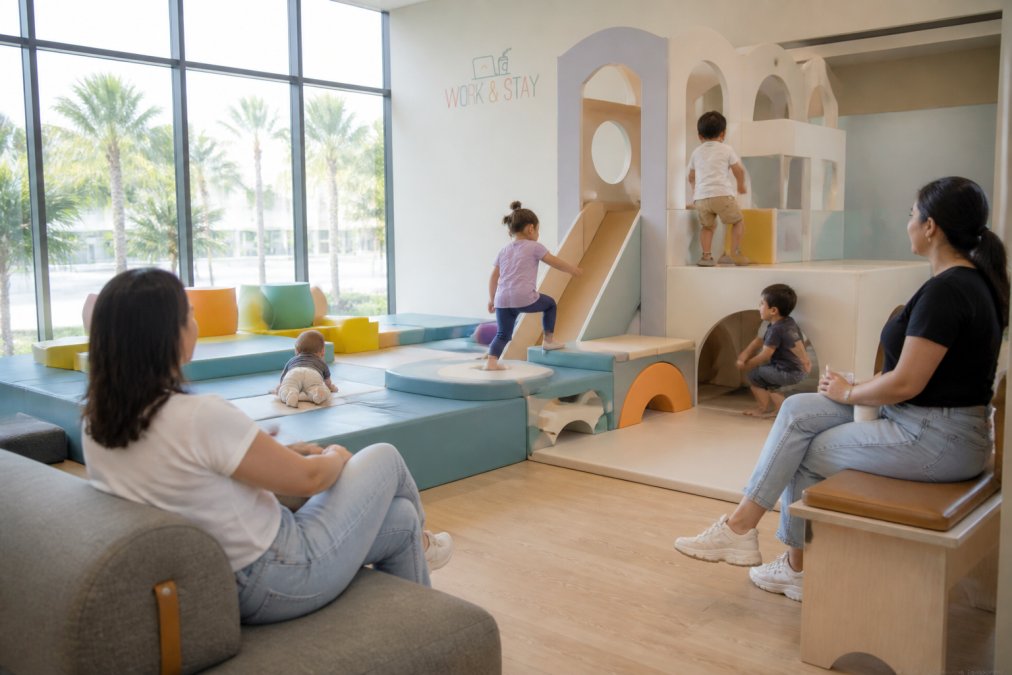
Toddler zones are padded, enclosed areas designed for children roughly 0 to 5, with soft blocks, small slides, and low climbing structures. They exist because open play floors overwhelm younger children, and because a designated zone lets staff keep the smallest guests away from bigger kids. Look for a defined boundary, a posted age or height limit, and a sightline from adult seating into the zone.
Sensory-friendly features have become a genuine differentiator rather than a marketing line. Quieter rooms, reduced lighting, lowered music volume, and posted low-traffic hours help children who find crowds and noise difficult. A growing number of venues publish these details on their websites, which makes planning far easier for caregivers. When you call ahead, ask three specific questions: Is there a designated quiet space? Are there hours with reduced sound and lighting? Is there a visual schedule or a calm-down corner a child can use mid-visit? A venue that can answer all three is built with neurodivergent kids in mind, not just marketed to them.
Arcades, Laser Tag, Go-Karts, and Mini Golf
Active-attraction formats skew older and tend to run on a pay-per-play model:
- Arcade games with card or token systems
- Laser tag arenas built for group play
- Indoor go-kart tracks on electric karts
- Mini golf and putting courses for mixed ages
- Trampoline parks, foam pits, and warrior courses for high-energy visitors
Age fit is where families get tripped up.
Coworking With Childcare: A New Kind of Family Entertainment Center
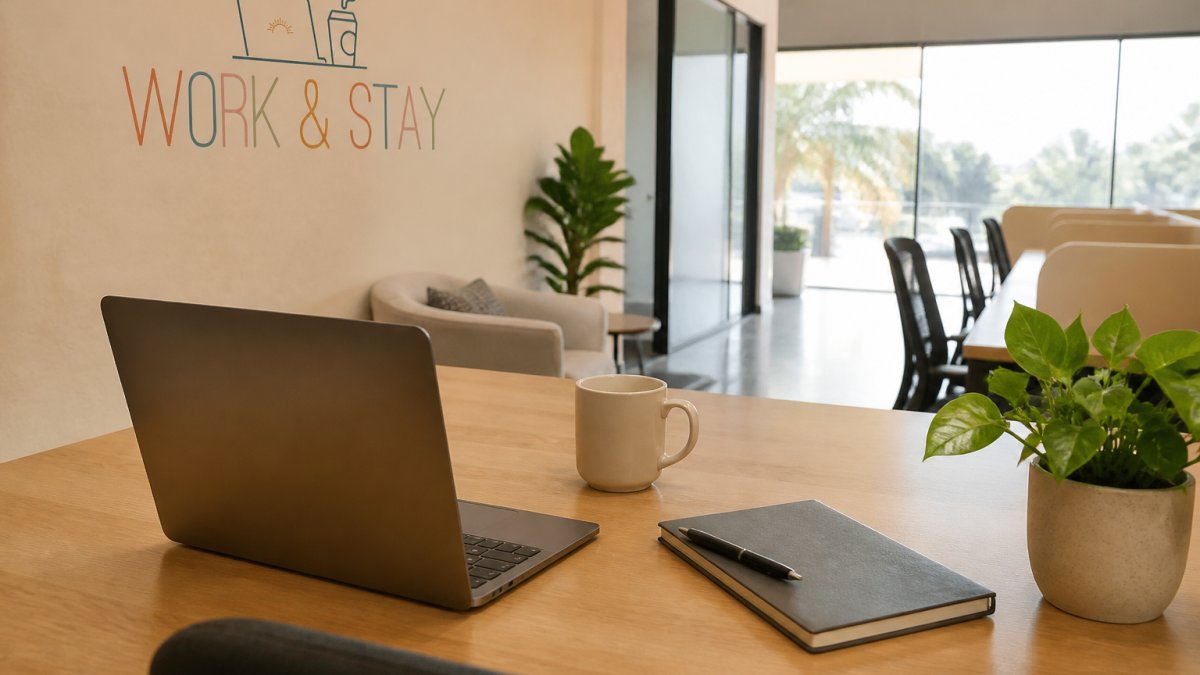
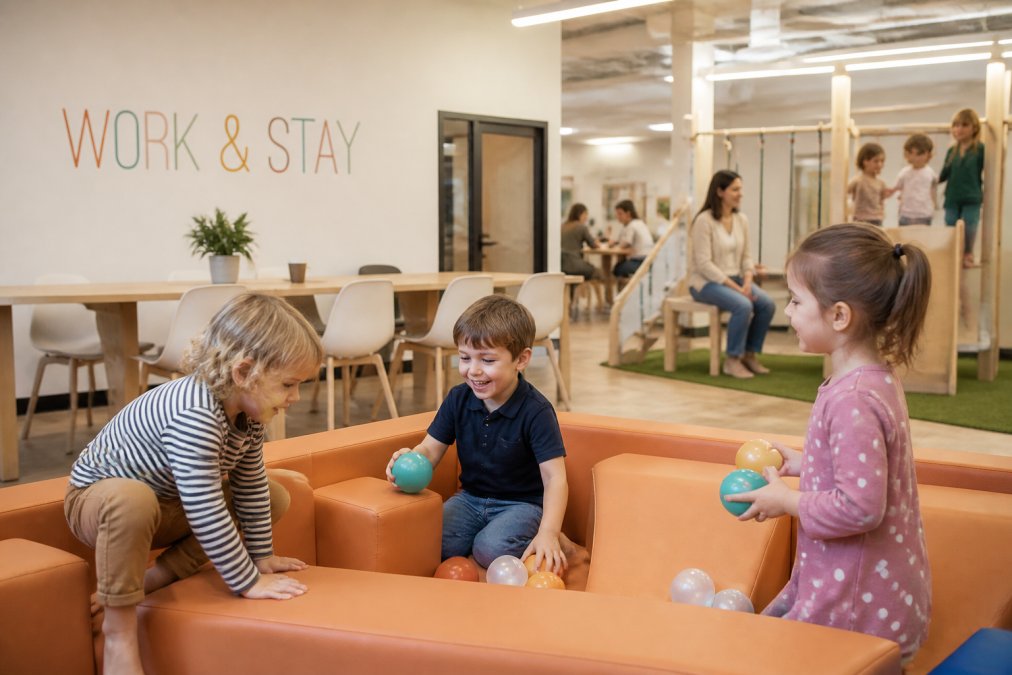
Coworking with childcare is a venue model that pairs a parent workspace with supervised, staffed childcare in a separate room, so a caregiver can work on site while their child plays nearby. It borrows the attractions and supervision of a family entertainment center and adds the one thing most centers lack: a quiet place for the adult.
Drop-In Childcare Options Inside Entertainment Venues
Drop-in childcare options let a family use a venue without committing to a membership or a fixed schedule. At an entertainment venue, that usually means buying a day pass, an hourly block, or a single-session ticket at the door rather than signing a contract.
SIGN UP FOR YOUR MEMBERSHIP TODAY →
- Whether the venue requires advance booking or accepts walk-ins
- The age range accepted, and whether diapered children are welcome
- Whether changing stations and staff help are available for younger guests
- Whether the parent must stay on site during the session
- What the check-in and pickup process looks like
How to Compare Admission Fees and Membership Value
Comparing family entertainment centers on price alone leads to bad decisions. The useful comparison is cost per hour of usable time, and that number depends on what the venue includes.
| Pricing Model | How It Works | Best For | Watch Out For |
|---|---|---|---|
| Pay-per-attraction | Buy credits for each ride or game | Occasional visits, older kids | Costs add up fast |
| All-day pass | One fee, unlimited access | Full-day family outings | Wasted if you stay an hour |
| Hourly or day pass | Pay for time on site | Drop-in childcare needs | Higher rate per hour |
| Monthly membership | Recurring fee, unlimited visits | Frequent local families | Break-even needs regular use |
| Party package | Flat rate for a group event | Birthdays, group events | Add-ons raise the total |
Safety Protocols, Hygiene Standards, and Parental Amenities
Safety and hygiene are the questions parents ask first and venues answer last. A center worth visiting will make both visible, from posted staff-to-child ratios to a cleaning schedule you can actually see happening. This is also where most directories stop short, so treat the details below as the questions that separate a well-run venue from a crowded room.
Ask about these before booking:
- Staff screening and training for anyone supervising children
- Check-in and checkout procedures that match a child to an authorized adult
- Cleaning routines for high-touch surfaces, play equipment, and restrooms
- Incident protocol, including how injuries are handled and who is notified
- Liability coverage and any required waivers
Hygiene Standards Worth Confirming
Cleaning claims are easy to make and hard to verify, so ask for specifics rather than a general assurance. A common pattern at well-run centers is a posted schedule for high-touch surfaces, a defined routine for ball pits and soft-play equipment, and hand-sanitizing stations at each zone entrance. For air quality, ask whether the space uses enhanced filtration or increased outside-air ventilation, since indoor play areas concentrate a lot of people in a small footprint.
Parental Amenities That Change How Long You Stay
Parental amenities matter just as much for a long visit. Seating with clear sight lines to the play area, restrooms with changing stations, snack options, and a quiet corner for a phone call all change how long a family can comfortably stay. A few specifics are worth checking on the website or by phone: Is there Wi-Fi, and is it reliable enough for a video call?
Frequently Asked Questions
What is considered a family entertainment center?
A family entertainment center is an indoor venue that combines multiple attractions under one roof, such as indoor playgrounds, arcade games, trampoline parks, laser tag, mini golf, and party rooms. Many also offer dining and group event packages. Unlike a single-purpose play space, these centers are built to serve a range of ages and interests, making them a practical choice for families with kids at different stages.
Are there indoor play spaces that offer coworking with childcare for parents?
Yes. Work & Stay in Scottsdale combines a coworking lounge and private workspaces with supervised, curriculum-based childcare for ages 0-6 in a separate classroom environment. Parents can take calls or focus on projects while their children are nearby in a structured setting. Memberships and day passes are available with no long-term contract. It is not a traditional daycare or unrestricted drop-off service; it is a workspace designed around parents who need both focus time and proximity to their kids.
What amenities should you look for in an indoor play facility?
Look for age-separated play zones, visible safety monitoring, clean restrooms with changing stations, and staff trained in incident response. Parent-friendly amenities matter too: seating with clear sightlines, Wi-Fi, and snack options. If you need to get work done, check whether the venue offers drop-in childcare options or a dedicated workspace. Also confirm hours, capacity limits, and whether reservations are required on weekends.
What are the benefits of supervised indoor play for toddlers?
Supervised indoor play helps toddlers build coordination, social skills, and confidence in a controlled environment. Structured sessions with teacher-led activities add routine and early learning to free play. For parents, the benefit is knowing their child is safe and engaged while they handle errands, take a break, or finish work. Venues designed for ages 0-6 typically separate the youngest guests from older, more physical play areas.
How can parents balance remote work with childcare?
The most workable setup is a space where your child is supervised in a separate room while you work nearby. Coworking with childcare solves the logistics: you get a quiet desk, your child gets structured play and classroom time, and you stay on-site for drop-offs, diaper changes, or separation anxiety moments. Flexible day passes help on weeks when school is closed or a sitter cancels. Check whether the venue offers hourly or drop-in childcare options before committing to a membership.