 how-to
How Much Does It Cost to Open a Daycare in 2026?
Table of Contents
- Startup Cost Breakdown: What You'll Actually Pay
- Childcare Business Startup Costs: Where the Money Goes
- Daycare Licensing Requirements by State: Fees and Compliance
- Facility Renovation, Insurance, and Safety Compliance
- The Hybrid Coworking and Childcare Business Model
- How Regional Cost Variance Changes Your Numbers
- Break-Even Point, Tuition Revenue, and Net Profit Margin
- Conclusion
- Frequently Asked Questions
Last Updated: September 13, 2026
Startup Cost Breakdown: What You'll Actually Pay
To open a daycare costs money in two distinct waves: a large one-time outlay to get licensed and operational, and a smaller recurring burn that decides whether you survive year one. Most guides lump them together and hand you a single scary number. That's useless for planning. This guide from Play & Stay, which is licensing its own childcare and coworking concept to Founding Partners nationwide, breaks the two apart so you can see where the money goes.
Here's the part most people get wrong: the startup number gets all the attention, but the monthly overhead is what kills new centers. A provider who raises enough to open but not enough to cover three slow months is in worse shape than one who opens smaller and stays liquid.
One-Time Costs vs. Monthly Overhead
One-time costs are the expenses you pay before the doors open: licensing and permit fees, facility renovation, initial equipment, deposits, and registration. They don't repeat. Monthly overhead is everything that recurs whether or not a single child walks in: rent, payroll, utilities, insurance premiums, software subscriptions, and supplies.
The practical rule is simple. Total one-time costs tell you how much capital to raise. Monthly overhead tells you how much cash reserve to hold. Budget at least three to six months of overhead on top of your startup figure, because enrollment builds gradually during the ramp-up period rather than filling on day one.
The Hidden 'Soft' Costs Nobody Budgets For
Hard costs show up on every checklist. Soft costs don't, and they're the ones that blow up budgets.
- Pre-opening payroll. You pay staff to train, set up classrooms, and complete background checks before any tuition revenue arrives.
- Deposits you don't get back. Commercial lease security deposits, utility deposits, and sometimes a deposit on a food service account.
- Marketing before you have a waitlist. Signs, a website, local ads, and printed materials all get paid for before the first enrollment.
- Consultant and application help. Licensing paperwork and business registration often require an accountant or attorney, and those hours add up.
- The re-inspection loop. Fail an inspection and you pay again, in fees and in lost weeks of operation.
Childcare Business Startup Costs: Where the Money Goes
Childcare business startup costs split into three big buckets: people, facility, and compliance. People costs are the largest recurring expense at any center. Facility costs are the largest one-time expense. Compliance costs are the smallest line item but the one that can stop you from opening at all.
Understanding that ranking matters because it tells you where to negotiate hardest. Lease terms and staffing models offer the most room to move. Licensing fees are fixed.
Staffing, Payroll, and Background Check Fees
Staffing is the single biggest ongoing cost, and it's driven by one regulation: the staff-to-child ratio. Ratios tighten as children get younger, so infant and toddler rooms require more adults per child than preschool rooms. That means your payroll scales with your age mix, not just your total enrollment.
Beyond base wages, budget for payroll taxes, workers' compensation, and background check fees for every hire. Background checks are typically required for all staff and often for volunteers, and they recur as you hire. Expect turnover to add to the total: every replacement means another check, another onboarding, and another training period.
Equipment, Curriculum, and Educational Supplies
Equipment and supplies are where new operators overspend and underspend at the same time. Overspend on furniture and toys. Underspend on the educational curriculum that justifies higher tuition.
A curriculum-based program needs age-appropriate learning materials, books, art supplies, and guided activity plans, not just play equipment. Cribs, changing stations, and safe sleep setups are non-negotiable for the youngest rooms. Cots, tables, and storage fill the older ones. Daycare management software for billing, attendance, and parent communication is a recurring subscription rather than a one-time purchase, so it belongs in your monthly overhead.
Daycare Licensing Requirements by State: Fees and Compliance
Daycare licensing requirements by state vary widely, and the variation is the point. Every state sets its own fee schedule, ratio rules, group sizes, staff training hours, and inspection cadence. There is no national license. A provider licensed in one state cannot simply open in another.
The core requirements are consistent in shape even where the numbers differ:
- A state-issued license or registration before caring for any child
- Criminal background checks and fingerprinting for all staff
- Pediatric CPR and first aid certification
- Minimum training hours in early childhood education, renewed on a schedule
- Documented health and safety standards, including immunization records
- Unannounced inspections at intervals set by the state
Home-based daycare and center-based childcare are licensed under different rules, and home-based operations usually face lower fees but tighter capacity caps. Because fees and thresholds change, verify current figures directly with your state's licensing agency before you build a budget around them. The Child Care Licensing and Regulation overview is a reasonable starting point for finding the right state office.
Zoning Permits, Fire Safety, and Health Inspections
Zoning permits come first, because a lease on a space that isn't zoned for childcare is a very expensive mistake. Confirm the zoning classification allows your use before signing anything.
After zoning, three inspections typically gate your opening. A fire safety inspection covers exits, extinguishers, alarm systems, and evacuation plans. A health inspection covers sanitation, food handling if you serve meals, and diaper-changing procedures. A licensing inspection ties it together and confirms ratios, records, and physical safety. Each can require fixes and a re-inspection, which means both extra fees and extra weeks.
Facility Renovation, Insurance, and Safety Compliance
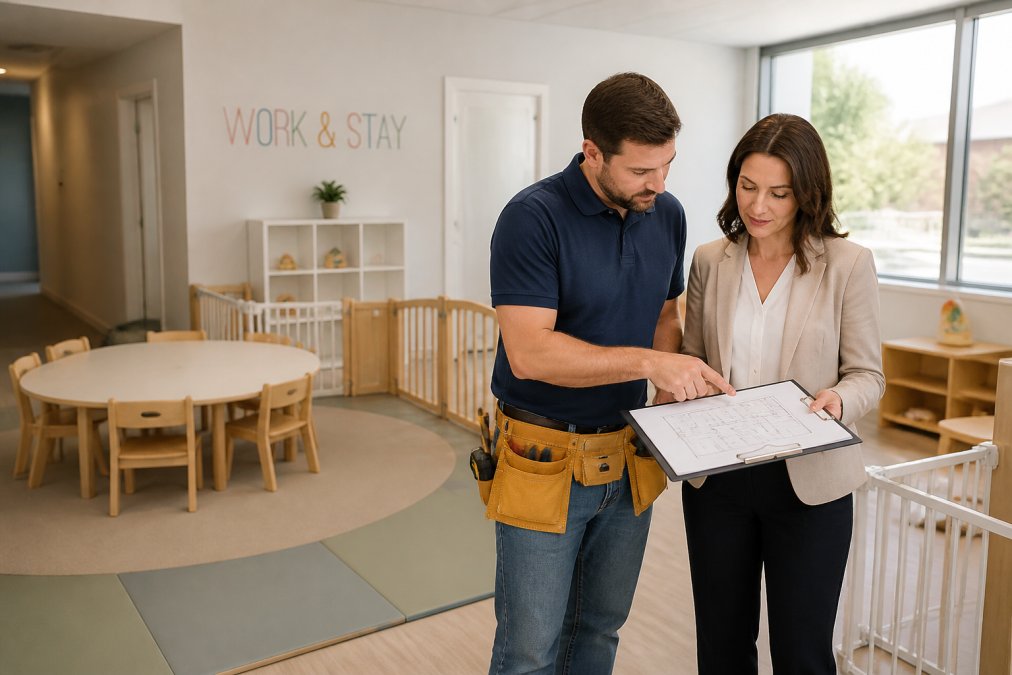
Facility renovation is usually the largest single startup expense, and the gap between a space that "looks fine" and one that passes inspection is wider than most first-time operators expect. Childcare-specific buildout includes child-height sinks and toilets, safety gates, outlet covers, soft flooring in play areas, secure entry, and separate space for the youngest children.
Insurance is the other cost that surprises people. Liability insurance for a childcare business is not optional in practice, and most landlords and licensing bodies require proof of coverage. General liability covers injuries on the premises. Professional liability covers claims about care and supervision. If you transport children, you need commercial auto coverage. Workers' compensation is required in most states once you have employees.
SIGN UP FOR YOUR MEMBERSHIP TODAY →
Safety compliance isn't a one-time box to check. Fire extinguishers get inspected annually. Background checks get renewed. Training hours get logged. Build a compliance calendar from day one, because lapsed documentation is one of the most common reasons a license gets flagged.
The Hybrid Coworking and Childcare Business Model
The hybrid coworking and childcare business model combines a flexible workspace for parents with supervised, curriculum-based childcare in a separate, licensed environment on the same premises. Parents work on site while their children are cared for steps away, and the business earns revenue from both the workspace side and the childcare side.
That dual revenue stream is a key advantage. A traditional center depends entirely on tuition. A hybrid operation adds workspace memberships and day passes, which can help smooth out enrollment dips that hit many childcare businesses during holidays and school breaks.
It can also change the cost structure in useful ways. One lease can cover both sides. One front desk and one management layer can serve both. Shared utilities and shared marketing can spread across two revenue sources instead of one. The tradeoff is complexity: you're running a licensed childcare operation and a workspace business at the same time, and both need their own systems, staffing, and compliance.
That's exactly the structure Play & Stay and Work & Stay operate under, and it's the concept now being offered to a limited number of Founding Partner locations in new markets. Operators who want the full model rather than a standalone center can review the Founding Partner opportunity.
How Regional Cost Variance Changes Your Numbers
Regional cost variance is the reason a single national average for daycare startup costs is close to meaningless. The same 2,000-square-foot buildout can carry wildly different rent, labor, and contractor costs depending on the market.
Four variables drive most of the difference:
| Cost Driver | What Changes by Region | Effect on Your Budget |
|---|---|---|
| Commercial lease | Urban vs. suburban rates, local demand | Largest one-time and monthly swing |
| Labor market | Local wage pressure, competition for staff | Directly scales payroll and turnover cost |
| Construction labor | Contractor availability and rates | Moves renovation cost up or down sharply |
| Licensing fees | State and county schedules | Smaller, but fixed and non-negotiable |
A practical way to localize your numbers: build your budget at a national baseline, then adjust each line by what local quotes actually say. Get three contractor bids, one real lease quote, and current wage data for early childhood staff in your metro. The adjusted total is your working number. Anything else is a guess.
Break-Even Point, Tuition Revenue, and Net Profit Margin
Break-even point is the enrollment level at which monthly tuition revenue covers monthly overhead. Below it, you lose money every month. Above it, every additional child improves your net profit margin, because most of your costs are already paid.
Calculating it takes three inputs: total monthly overhead, average tuition per child, and your realistic occupancy capacity. Divide monthly overhead by average tuition to get the number of children you need enrolled to break even. Then compare that number to your licensed capacity.
Here's the uncomfortable math. If your break-even requires 80% of licensed capacity and most new centers run well below that during the ramp-up period, you will operate at a loss for months. That's normal. What matters is having the cash reserve to reach the other side.
Two levers can move break-even faster than anything else. Raising tuition works only if your curriculum and ratios justify it. Adding a second revenue stream, like workspace memberships, can lower the enrollment you need on the childcare side alone. Food program subsidies can offset meal costs if you qualify, and checking eligibility is worth the paperwork.
Conclusion
The honest answer to how much it costs to open a daycare is that the total depends almost entirely on your market, your facility, and your model, and no national average will tell you what your specific buildout will run. What you can control is the structure: separate one-time costs from monthly overhead, reserve three to six months of operating cash, and pressure-test your break-even before you sign a lease.
For operators who want a proven structure rather than building one from scratch, the Play & Stay hybrid model pairs a licensed, curriculum-based childcare program with a parent workspace under a single roof and a single management layer. The Founding Partner program is opening a limited number of locations in new markets, with support across facility planning, licensing, staffing, and launch. Learn more and apply at the Work & Play & Stay Founding Partner page.
Frequently Asked Questions
How much money do I need to open a daycare?
The amount depends on whether you run a home-based or center-based program, your state's licensing fees, and local commercial lease rates. Center-based programs carry higher costs for facility renovation, staff-to-child ratio compliance, and liability insurance. Home-based daycares cost less but still need safety compliance, background check fees, and equipment. Build a business plan that separates startup capital from operating expenses so you know your true break-even point before signing a lease.
What are the primary startup costs for a childcare facility?
The main categories are facility renovation and safety compliance, licensing and zoning permits, fire safety inspection fees, childcare equipment and educational curriculum, staffing and payroll taxes, liability insurance, and marketing. Utility costs and commercial lease deposits add up fast. Many operators underestimate the ramp-up period, when tuition revenue is low but monthly overhead is already running at full strength.
How does a hybrid coworking and childcare business model differ from a traditional daycare?
A hybrid model combines a coworking workspace for parents with supervised, curriculum-based childcare in a separate environment. Instead of competing only on full-day enrollment, it generates revenue from workspace memberships alongside childcare. That can improve occupancy capacity during off-peak hours and reduce reliance on a single tuition stream. Play & Stay's Founding Partner program licenses this concept to operators in new markets.
Is a hybrid work-and-play model a more sustainable business investment?
It can be, because revenue comes from two sources: workspace access and childcare. That dual stream helps smooth the seasonal dips and ramp-up period that pressure traditional daycares. It also serves remote-working parents who need flexible, drop-in childcare rather than full-time enrollment. As with any business, results depend on your market, location, and execution. Explore the Founding Partner opportunity to see whether it fits your goals.