 how-to
Emergency Childcare Near Me: Find Safe Care Fast
Table of Contents
- What Is Emergency Childcare and When Do You Need It?
- Types of Emergency Childcare Services Available
- How to Find Immediate Childcare Near You
- Vetting Checklist: What to Look for in a Last-Minute Provider
- Coworking Space With Onsite Childcare: A Flexible Alternative
- Flexible Childcare Memberships and Payment Options
- Financial Assistance and Subsidies for Emergency Care
- Preparing a Go-Bag: What to Send With Your Child
Last Updated: August 17, 2026
What Is Emergency Childcare and When Do You Need It?
Emergency childcare is supervised care for your child on short notice when your regular arrangement falls through. Unlike scheduled childcare you book weeks in advance, emergency childcare services exist for moments when life throws you a curveball: a sick babysitter cancels two hours before your shift, a family emergency pulls you away from home, or you need a few hours to handle an unexpected crisis.
Most parents face this situation at least once a year. Your backup plan fails, you're stuck, and you need someone qualified and vetted to watch your child today, not next month.
The difference between true emergency childcare and convenience childcare matters. Crisis nurseries and non-profit services often operate on a sliding scale or free model because they're designed for genuine hardship. Paid emergency childcare services fill the gap when you need flexibility without crisis-level pricing. Work & Stay bridges both worlds, offering flexible drop-in childcare for working parents who need reliable backup without long-term contracts.
Types of Emergency Childcare Services Available
Emergency childcare comes in three main types, each with different speed, cost, and commitment levels.
Crisis Nurseries and Non-Profit Services
Crisis nurseries are community-funded programs designed for families in genuine hardship, job loss, illness, or parental burnout. They typically operate on a sliding-scale or free model and often accept children with minimal notice.
These services are valuable when you're in crisis, but they're not designed for convenience. Many operate limited hours, have capacity limits, and require you to demonstrate financial need or a specific hardship.
How to find them: Search "[your state] crisis nursery" or contact your local 211 service (dial 2-1-1 from any phone). The Childcare Aware of America database also lists emergency resources by state. Ask about eligibility, hours, age groups served, and whether they accept same-day placements.
In-Home Nanny and Babysitting Services
In-home care means someone comes to your house or watches your child in their home. This includes traditional babysitters, nanny placement agencies, and care-sharing networks.
The advantage is flexibility and one-on-one attention. The disadvantage is that vetting takes time, and availability varies wildly. A good babysitter books up weeks ahead. Finding one on an emergency basis is possible but unreliable.
Drop-In Childcare for Working Parents
Drop-in childcare centers accept children without advance booking, often on an hourly or daily basis. These range from dedicated play spaces to coworking facilities with onsite childcare.
This is the sweet spot for working parents who need flexibility without crisis-level pricing. You can book a few hours while you handle work, attend an appointment, or manage an unexpected situation. Many operate extended hours to accommodate work schedules.
Work & Stay offers this exact model: supervised, curriculum-based childcare for ages 0-6 available on day passes or memberships with no long-term contract. Parents can work on-site in a quiet coworking space while their child is steps away in a structured, teacher-led environment with guided activities designed for early development.
How to Find Immediate Childcare Near You
Speed matters when you need emergency childcare. Here's the fastest path to options.
Search Local Resources and Emergency Hotlines
Start with your local 211 service. Dial 2-1-1 from any phone and ask for emergency childcare resources. They'll give you names, numbers, and eligibility information for crisis nurseries and subsidized programs in your area.
Next, search your state's childcare licensing board. Most states maintain public databases of licensed providers filtered by age group, location, and services offered.
Contact your employer's HR or benefits team. Many companies partner with childcare providers or have backup childcare benefits you may not know about. Some offer emergency childcare vouchers or subsidized access to drop-in centers.
Check local coworking spaces and family-focused businesses. Many now offer childcare services or partner with providers.
Check Booking Availability and Service Area Coverage
Once you have a list, confirm:
- Same-day availability: Can they take your child today?
- Age group: Do they serve your child's age?
- Hours of operation: Do their hours match when you need care?
- Service area: Do they require you to be within a certain distance?
- Capacity: Do they have space?
Write down the answers. You're building your backup plan, so accuracy matters.

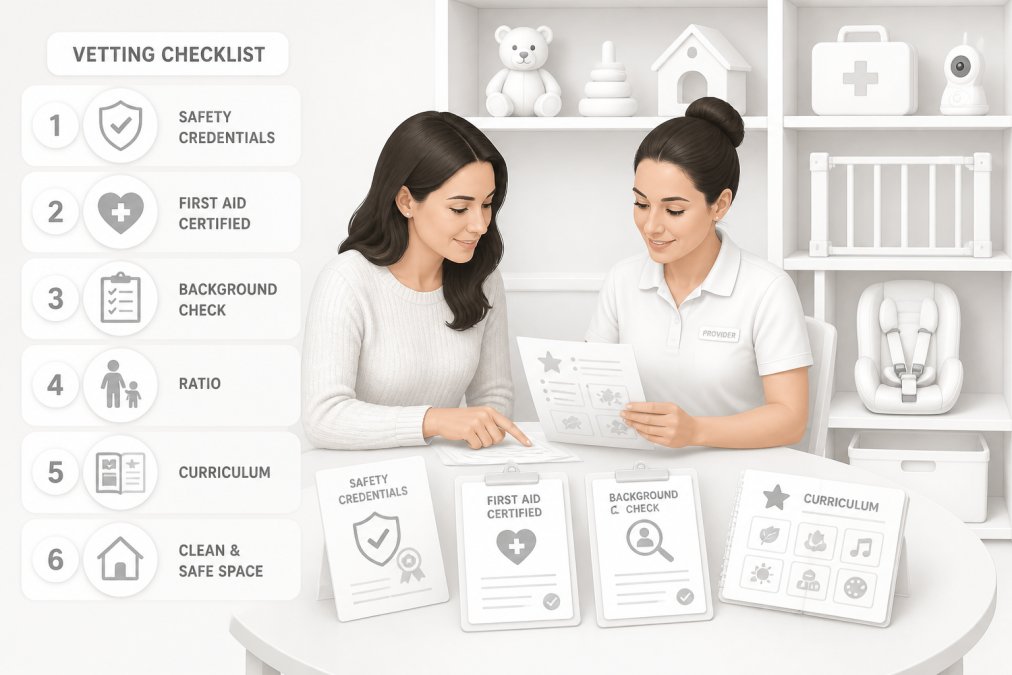
Vetting Checklist: What to Look for in a Last-Minute Provider
Finding someone fast doesn't mean skipping safety. Before you leave your child with anyone, confirm these non-negotiables.
Background Checks and Child Safety Standards
Licensed childcare providers are required to pass background checks, but standards vary by state. Ask directly: Has this provider been screened for criminal history, child abuse, and neglect?
Check their licensing status. Licensed providers are inspected regularly and must follow state safety standards. Ask about their child-to-staff ratio. State law sets minimums, but lower ratios are safer. A 1:4 infant ratio is safer than 1:6, even if both are legal.
Inquire about their illness policy. Will they accept your child if they have a cold? A fever? What's their protocol if your child gets sick while in their care?
Questions to Ask Before Leaving Your Child
Once you've confirmed the basics, ask the provider directly:
- What's your experience with my child's age group?
- How do you handle separation anxiety?
- What activities will my child do? Structured activities keep kids engaged.
- How will you communicate with me? Can they text updates or call if there's an issue?
- What's your emergency protocol? If your child gets hurt or sick, what do they do?
- Can I visit or stay nearby? Some parents want to be close by while they work.
Document their answers. You're being a responsible parent.
Coworking Space With Onsite Childcare: A Flexible Alternative
The best backup plan isn't a crisis service or a babysitter. It's a coworking space with onsite childcare.
Work & Stay combines both. You get a quiet workspace to focus on work or handle urgent tasks, and your child is steps away in supervised, curriculum-based childcare. No commute between two locations. No wondering if your child is safe, you can check in anytime. No guilt for working while your child is engaged in structured activities.
This model solves the core problem: you need to be productive, but your regular childcare fell through. A drop-in childcare setup lets you work and have reliable backup care in the same place.
Your child isn't shuttled to a stranger's home or an unfamiliar center. They're in a space designed for young children, with teachers trained in early development. For working parents, this is emergency childcare that doesn't feel like an emergency.
Flexible Childcare Memberships and Payment Options
Emergency childcare doesn't have to mean paying premium crisis rates. Many providers offer flexible memberships or pay-as-you-go options that can be more cost-effective than traditional full-time childcare depending on usage.
Memberships typically work like this: you pay a monthly fee and get a set number of hours or days per month. The advantage is predictable monthly cost and priority booking.
Day passes are simpler: you pay per day, no commitment. This works best if you only need backup care sporadically.
Some providers offer hybrid models: a small monthly membership fee that gives you access to discounted day rates.
Work & Stay offers both memberships and day passes with no long-term contract. You can try a single day pass to see if the setup works for your family, then decide if a membership makes sense based on your actual usage.
Compare what you actually need. If you use backup childcare two days a month, a day-pass model may be more cost-effective. If you use it eight days a month, a membership usually saves money.
Financial Assistance and Subsidies for Emergency Care
Many families assume emergency childcare is unaffordable. It doesn't have to be.
Subsidies exist. Your state may offer childcare subsidies based on income. These typically cover licensed providers, which includes most crisis nurseries and professional childcare centers. Contact your state's childcare licensing board or department of human services to ask about eligibility.
Some employers offer childcare benefits or backup care programs. Ask your HR department. Benefits might include subsidized access to drop-in centers or emergency childcare vouchers.
Non-profit crisis nurseries often operate on a sliding scale or free model specifically because they serve families who can't afford market rates.
Tax benefits also apply. The Dependent Care Account (FSA) lets you set aside pre-tax money for childcare. The Child and Dependent Care Tax Credit provides a credit on your federal taxes. Ask about these options, many families leave money on the table because they don't know these programs exist.
Preparing a Go-Bag: What to Send With Your Child
When you need emergency childcare on short notice, you'll likely grab essentials in a rush. A pre-packed go-bag saves time and ensures you don't forget critical items.
Pack these items in a small backpack you keep ready:
- Diapers and wipes (if your child is in diapers). Send enough for a full day.
- Change of clothes (at least two complete outfits). Include socks and shoes.
- Snacks (non-perishable). Include any allergy-safe options.
- Water bottle or juice box.
- Comfort item (blanket, stuffed animal, pacifier). Familiar objects help with separation anxiety.
- Medications (if needed). Clearly labeled with your child's name, dosage, and instructions.
- Sunscreen and hat (if outdoors play is likely).
- Special instructions. Allergies, behavioral triggers, favorite activities. Write them down.
Keep this bag in your car or near your door. When you need care fast, grab it and go.
Update the bag every few months. Swap out clothes as your child grows, refresh snacks, and check expiration dates on medications. A well-maintained go-bag is your safety net.
Frequently Asked Questions
What is the difference between emergency childcare and drop-in care?
Emergency childcare serves parents in urgent, unplanned situations, sudden illness, family crisis, or essential work demands, and is often available immediately with minimal notice. Drop-in childcare is flexible, scheduled care for working parents who need reliable, recurring access to safe supervision. Drop-in childcare for working parents typically offers better continuity, curriculum-based activities, and predictable availability, making it ideal for regular work schedules. Emergency care prioritizes speed and accessibility over structured programming.
How do I find emergency childcare on short notice?
Start by calling your local emergency hotline or crisis nursery (search '[your state] crisis nursery' online). Contact established childcare providers in your service area, many reserve spots for emergency situations. Ask friends, family, and neighbors for trusted referrals. Online platforms and nanny placement services can connect you with background-checked providers within hours. If you work from home or need flexible arrangements regularly, explore drop-in childcare for working parents at nearby coworking spaces, which often have immediate or same-day availability.
What should I look for in a last-minute childcare provider?
Verify background checks and child safety standards immediately, ask for proof of clearance and liability insurance. Confirm they have experience with your child's age group and any special needs. Ask about their incident protocol, first aid certification, and emergency contact procedures. Tour the facility if possible to assess cleanliness and safety. Request references from other parents. Ensure they understand your child's routines, allergies, and comfort needs. Trust your instincts, a trustworthy provider will welcome your questions and transparency.
Are there financial assistance programs for emergency childcare?
Yes. Many states offer child care subsidies through the Child Care and Development Fund (CCDF) for eligible families, and some provide emergency assistance grants. Non-profit crisis nurseries often provide free or sliding-scale services. Contact your state's child care licensing agency or local family support organizations to learn about programs in your area. Some employers offer emergency childcare benefits or dependent care flexible spending accounts (FSAs) that can help offset costs. Ask potential providers about sliding-scale fees or emergency assistance programs they partner with.
Finding emergency childcare near me fast is stressful, but it doesn't have to be chaotic. The key is preparation: know your options before you need them, vet providers while you're calm, and keep essentials ready to go. For working parents, a flexible childcare option like Work & Stay removes much of that stress, you have backup care available whenever you need it, without the commitment of full-time childcare. Start building your backup plan today so you're ready when life gets unpredictable.
This article was written using GrandRanker