 listicle
Indoor Parks for Kids: What Parents Should Know
Table of Contents
- What Counts as an Indoor Park?
- Indoor Parks vs Traditional Play Spaces: Key Differences
- Supervised Open Play: What It Means and Why It Matters
- Coworking Spaces With Childcare: A New Option for Working Parents
- Flexible Childcare Options That Fit Real Family Schedules
- What to Look for in a High-Quality Indoor Park
- Conclusion
- Frequently Asked Questions
Last Updated: September 20, 2026
What Counts as an Indoor Park?
An indoor park is a climate-controlled play facility built for children, usually combining soft play structures, open floor space, and age-specific zones under one roof. This guide from Play & Stay breaks down what parents should know before choosing one.
The category covers a lot of ground. Some indoor parks are simple: a padded climbing frame, a ball pit, a few ride-on toys. Others function as full family entertainment centers with arcade games, laser tag, trampoline parks, and party rooms. For parents of children ages 0-6, the smaller end of that spectrum usually works better.
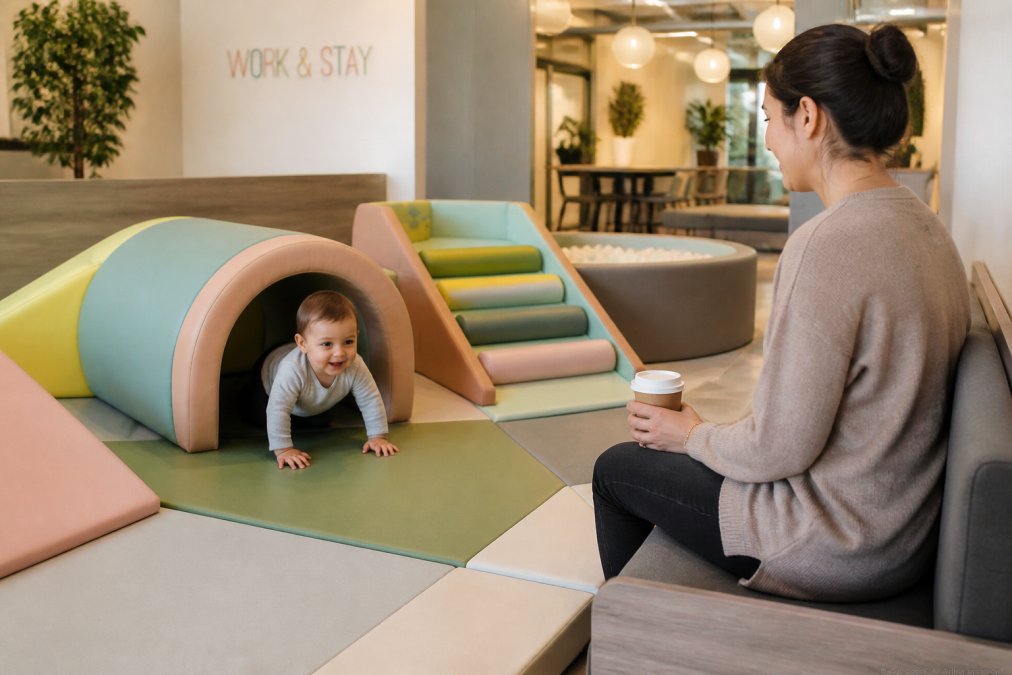
Supervised open play is the model most parents actually want. That means staff are present, watching the floor, and guiding activities rather than leaving children to roam unattended. It is different from a drop-off daycare and different from a free-for-all play area.
Most indoor parks charge through admission fees, day passes, or membership options. Hours vary, and many venues run shorter weekend hours than weekday ones. The details matter more than the label on the sign.
Indoor Parks vs Traditional Play Spaces: Key Differences
Traditional play spaces tend to be smaller and simpler: a play corner inside a cafe, a church basement with toys, a library nook. Indoor parks are purpose-built recreational facilities with dedicated equipment, staff, and safety protocols.
The practical differences show up fast:
- Capacity and layout. Indoor parks are designed for groups, with zones for toddlers and older children separated.
- Staffing. Supervised play means someone is watching the floor. Traditional play spaces often leave supervision entirely to parents.
- Programming. Many indoor parks run guided arts, music, and movement sessions alongside free play.
- Amenities. Family entertainment centers typically add party rooms, snack areas, and seating for adults.
That last point matters more than most guides admit. A play space with nowhere comfortable for a parent to sit is a play space parents avoid.
Supervised Open Play: What It Means and Why It Matters
Supervised open play is structured freedom: children choose what to do, but trained staff keep an eye on safety, encourage sharing, and step in when a toddler needs help. It sits between free play and a formal class.
Why does it matter? Because physical development and social skills both depend on repetition and gentle guidance. Children learn coordination by climbing, balance by wobbling, and self-esteem by trying something hard and getting it right. A staff member who notices a hesitant child and offers a hand changes the whole experience.
A common mistake is assuming supervision means children are entertained while parents disappear. Good supervised play keeps parents nearby and informed. Many facilities design the space so adults can see the floor from a seating area, which helps children with separation anxiety settle in without a meltdown.
Coworking Spaces With Childcare: A New Option for Working Parents
Coworking spaces with childcare combine a professional workspace with supervised care for young children in the same building. For remote-working parents, that combination solves a problem neither a traditional office nor a daycare handles well.
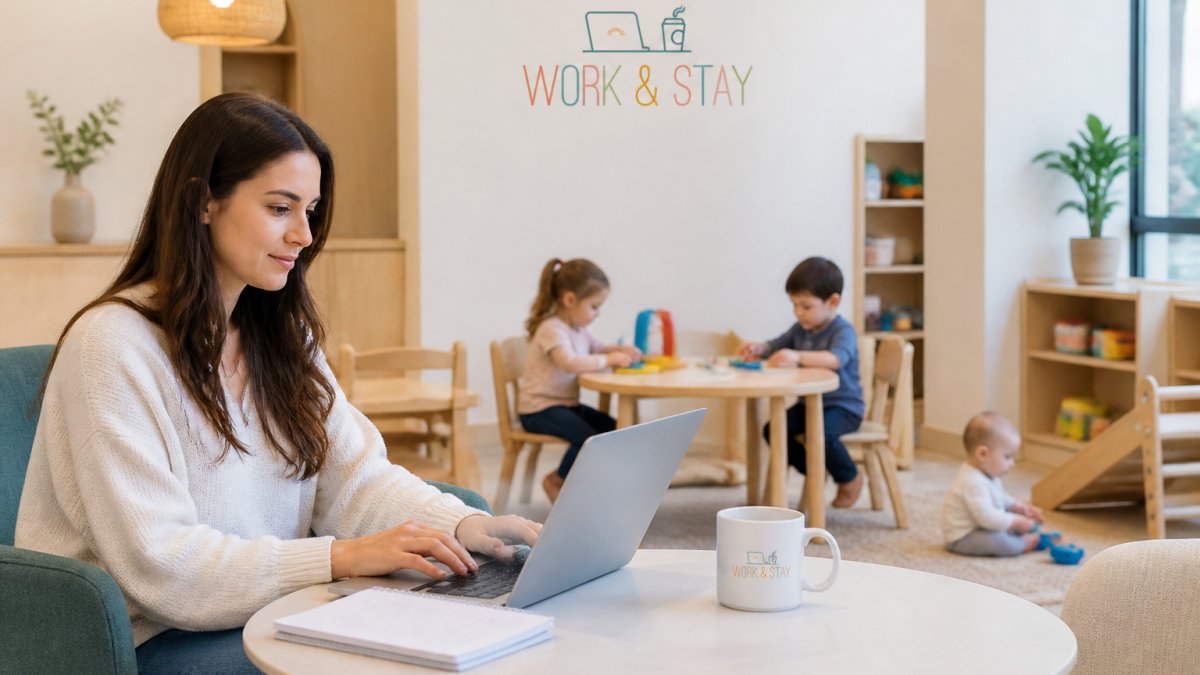
The setup usually looks like this: a coworking lounge and private workspaces on one side, a curriculum-based classroom for children ages 0-6 on the other, with staff supervising both. Parents can take a call without a toddler on their lap, then walk over at break time.
Work & Stay in Scottsdale runs on this model. The childcare is teacher-led and curriculum-based rather than simple babysitting, and access comes through memberships or day passes with no long-term contract. That flexibility matters for parents who work part-time or travel.
A frequent worry: will you hear screaming kids through the walls during a client call? In a well-designed space, no. The childcare area sits in a separate environment, so the noise stays on the play side.
SIGN UP FOR YOUR MEMBERSHIP TODAY →
Flexible Childcare Options That Fit Real Family Schedules
Flexible childcare options are the difference between a service parents use and one they abandon. Rigid schedules and long contracts are the two biggest reasons families walk away from traditional care arrangements. But "flexible" means different things depending on how you work, so it helps to match the format to the week you actually have.
If you work remotely a few days a week. You need a block of focused hours, not a full-time slot. A day pass paired with a workspace is usually the right fit: you drop in, your child joins supervised play or a guided session, and you take calls from a desk instead of a kitchen counter. The key feature to look for is that the childcare sits in a separate environment from the workspace, so a client call does not compete with a room full of toddlers.
If your schedule changes week to week. Drop-in and hourly care exist for exactly this. You pay for the hours you use, when you use them, with no long-term contract. This is the format that survives a canceled sitter, a half-day of school, or a deadline that lands on a Tuesday.
If you need backup care on short notice. Backup childcare is the safety net for the days when school closes unexpectedly or a caregiver calls out. The value here is speed and no commitment, you should be able to book the same day without re-enrolling.
If you want a steady routine. A month-to-month membership gives you a predictable rhythm without locking you into an annual agreement. This is the middle ground between occasional drop-in and full-time daycare, and it is the format most part-time and hybrid-working parents land on.
| Option | Best For | Commitment | Typical Use |
|---|---|---|---|
| Drop-in / hourly care | Occasional errands or appointments | None | A few hours at a time |
| Day pass | Remote work days, backup care | None | Full or half day |
| Monthly membership | Regular weekly routine | Month-to-month | Several visits per week |
| Traditional daycare | Full-time working parents | Annual contract | Five days per week |
This is the model Work & Stay was built around: a coworking space for parents with supervised, onsite childcare in a separate childcare environment, available through memberships or day passes with no long-term contract.
What to Look for in a High-Quality Indoor Park
Safety protocols and hygiene standards separate a well-run facility from a room full of toys. The problem is that most listings never publish them, so you have to ask. Here is what to ask, why it matters, and what a good answer sounds like.
- Are play zones separated by age, with a dedicated toddler zone?
- Is equipment inspected and cleaned on a posted schedule?
- Are staff trained in incident response, and is there a written protocol?
- Are changing stations available for children still in diapers?
- Can parents see the play floor from the seating area?
- Are sensory-friendly features available for children who need calmer spaces?
- Is there somewhere comfortable for a parent to sit, work, or relax?
Skip any facility that cannot answer basic safety questions on the spot. If staff cannot explain their incident protocol, cleaning schedule, or staff-to-child ratios, that silence tells you what the operation values.
The single most useful question you can ask is not about equipment, it is about what happens when something goes wrong. A facility with a clear, rehearsed answer is almost always the one that also cleans on schedule and trains its staff.
Conclusion
Finding an indoor park that fits your family comes down to three things: safety you can verify, supervision you can trust, and flexibility that matches your actual week. Most venues get one or two right. Fewer get all three.
Frequently Asked Questions
What should parents look for in a high-quality indoor park?
Check age separation first. A good indoor park has distinct zones for toddlers and older kids, soft-play materials, and clear sightlines so you can see your child from anywhere. Ask about cleaning schedules, staff-to-child ratios, and whether staff are trained in basic first aid. Also look at amenities: changing stations, a quiet corner, and seating for adults. If you plan to work, ask whether the venue offers a workspace and supervised childcare, like Work & Stay does for children ages 0-6.
What are the benefits of indoor play spaces for toddlers?
Indoor play spaces give toddlers a safe, climate-controlled place to climb, crawl, and explore, which supports coordination, balance, and social skills. Unlike a home living room, these spaces are designed with soft surfaces and age-appropriate equipment, so falls are less risky. Many facilities also offer guided activities like music, art, and movement classes that build early literacy and motor development. For parents, the benefit is a contained environment where kids burn energy without wrecking the house.
Are there indoor spaces that offer both play and coworking for parents?
Yes. A growing number of facilities combine a coworking lounge with supervised childcare on site. Work & Stay in Scottsdale is one example: parents get a quiet workspace with private rooms for calls, while children ages 0-6 stay in a separate, teacher-led classroom just steps away. Access works through memberships or day passes with no long-term contract, which suits remote workers, freelancers, and parents who only need a few focused hours a week.
What age ranges are typically served by indoor play centers?
Most indoor play centers focus on either ages 0-6 or ages 5-12, and some serve both with separate zones. Toddler-focused venues usually cap at age 5 or 6 because equipment is sized for smaller bodies. Adventure parks with trampolines and climbing walls tend to serve ages 5 and up. If you have children in different age brackets, look for a facility with clearly divided areas so a preschooler isn't sharing space with bigger kids.